Anti-PAX1 antibody [5A2] - BSA and Azide free
- BOND RX™ Validated
- Recombinant
- What is this?
Be the first to review this product! Submit a review
|
(2 Publications )
- IHC-Fr
Unknown
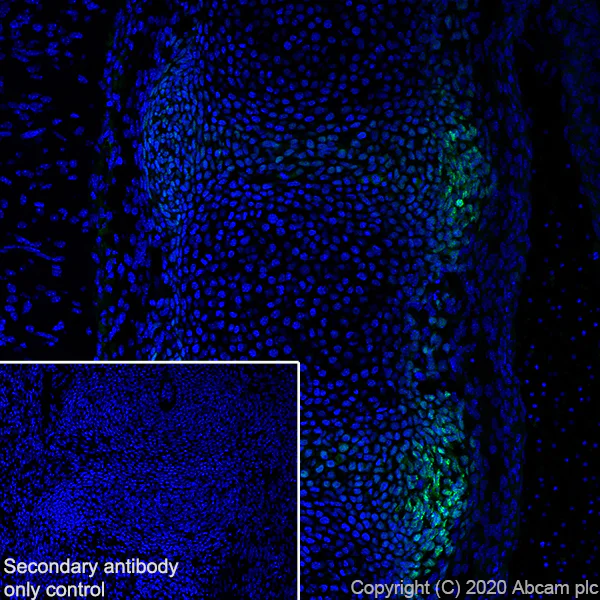
Immunohistochemistry (Frozen sections) - Anti-PAX1 antibody [5A2] - BSA and Azide free (AB255841)
Immunohistochemical analysis of 4% PFA-fixed, 0.2% Triton X-100 permeabilized frozen mouse E14.5 embryo tissue labeling PAX1 with ab252847 at 28.76 μg/mL followed by ab150157 Goat Anti-Rat IgG H&L (Alexa Fluor® 488) at dilution (Green). Positive staining on mouse embryo is observed. The nuclear counterstain was DAPI (Blue).
Secondary antibody control : Secondary antibody is ab150157 Goat Anti-Rat IgG H&L (Alexa Fluor® 488)at dilution.
Heat mediated antigen retrieval using sodium citrate buffer (10mM citrate pH 6.0 + 0.05% Tween-20).
This data was developed using the same antibody clone in a different buffer formulation containing PBS, BSA, glycerol, and sodium azide (ab252847).
- IHC-P
Unknown
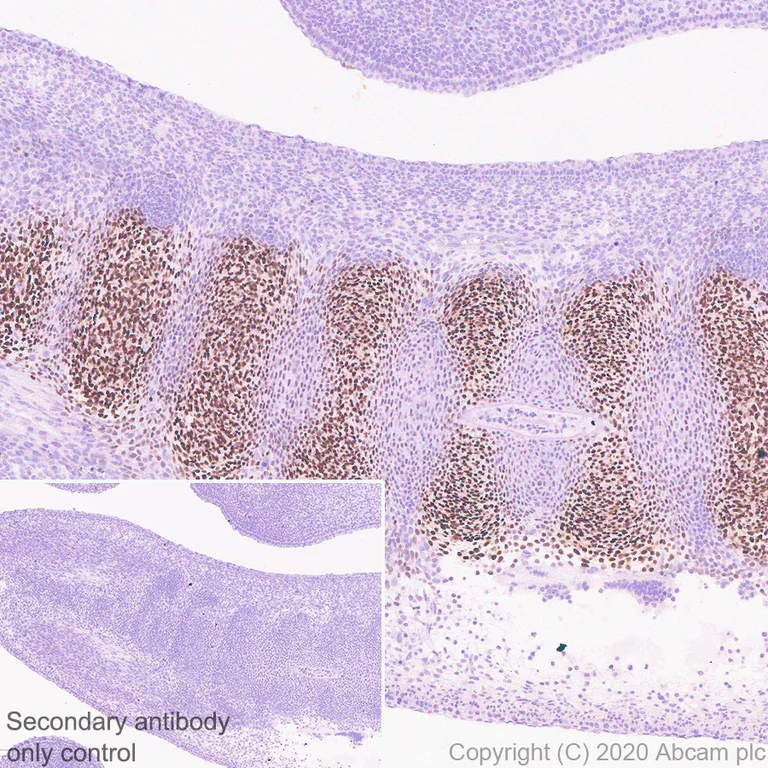
Immunohistochemistry (Formalin/PFA-fixed paraffin-embedded sections) - Anti-PAX1 antibody [5A2] - BSA and Azide free (AB255841)
Immunohistochemical analysis of paraffin-embedded mouse embroy day 14.5 tissue labeling PAX1 with ab252847 at 1.438 μg/mL followed by a ready to use Goat Anti-Rat IgG H&L (HRP polymer) (ab214882). Nuclear staining on the intervertebral disk in mouse embroy day 14.5. The section was incubated with ab252847 for 30 mins at room temperature. The immunostaining was performed on a Leica Biosystems BOND® RX instrument. Counterstained with Hematoxylin.
Secondary antibody only control : Secondary antibody is a ready to use Goat Anti-Rat IgG H&L (HRP polymer) (ab214882).
Heat mediated antigen retrieval with Tris-EDTA buffer (pH 9.0, epitope retrieval solution2) for 20 mins.
This data was developed using the same antibody clone in a different buffer formulation containing PBS, BSA, glycerol, and sodium azide (ab252847).
Related conjugates and formulations (1)
-
Anti-PAX1 antibody [5A2]
Complementary Products


Primary Antibodies
AB183734
RabMAb|Recombinant|Lab Essentials|20ul selling size

- 5
- 24


Primary Antibodies
AB221660
Anti-Nestin antibody [EPR22023] - Neural Stem Cell Marker
20ul selling size|RabMAb|Recombinant

- 1
- 1
Reactivity data
Product details
ab255841 is the carrier-free version of ab252847.
What are the advantages of a recombinant monoclonal antibody?
This product is a recombinant monoclonal antibody, which offers several advantages including:
- - High batch-to-batch consistency and reproducibility
- - Improved sensitivity and specificity
- - Long-term security of supply
- - Animal-free batch production
For more information, read more on recombinant antibodies.
Want a custom formulation?
This antibody clone is manufactured by Abcam. If you require a custom buffer formulation or conjugation for your experiments, please contact orders@abcam.com
Conjugation ready
Our carrier-free antibodies are typically supplied in a PBS-only formulation, purified and free of BSA, sodium azide and glycerol. This conjugation-ready format is designed for use with fluorochromes, metal isotopes, oligonucleotides, and enzymes, which makes them ideal for antibody labelling, functional and cell-based assays, flow-based assays (e.g. mass cytometry) and Multiplex Imaging applications.
Use our conjugation kits for antibody conjugates that are ready-to-use in as little as 20 minutes with 1 minute hands-on-time and 100% antibody recovery: available for fluorescent dyes, HRP, biotin and gold.
Compatibility
This product is compatible with the Maxpar® Antibody Labeling Kit from Fluidigm, without the need for antibody preparation. Maxpar® is a trademark of Fluidigm Canada Inc.
Properties and storage information
Form
Purification technique
Storage buffer
Shipped at conditions
Appropriate short-term storage conditions
Appropriate long-term storage conditions
Storage information
Supplementary information
This supplementary information is collated from multiple sources and compiled automatically.
Biological function summary
The paired box protein PAX1 functions as an important player in embryogenesis primarily influencing the formation and differentiation of tissues. It is not known to be part of any large protein complex. PAX1 regulates the expression of various genes involved in the development of the axial skeleton particularly in the vertebral column. The accurate expression of PAX1 ensures proper skeletal structure formation acting as a determinant in vertebrate development.
Pathways
PAX1 contributes significantly to the Hedgehog and Wnt signaling pathways both of which are indispensable in regulating cell growth differentiation and patterning during embryogenesis. PAX1 collaborates with other proteins like Gli3 an important transcription factor in Hedgehog signaling. Within these pathways PAX1 ensures proper signaling cascades that streamline developmental processes and morphology.
Product protocols
- Visit the General protocols
- Visit the Troubleshooting
Target data
Alternative Names
Publications (2)
Recent publications for all applications. Explore the full listand refine your search
Cartilage :19476035251323601 PubMed40119525
2025
Applications
Unspecified application
Species
Unspecified reactive species
Monoclonal antibodies in immunodiagnosis and immun 35:259-262 PubMed27705080
2016
Applications
Unspecified application
Species
Unspecified reactive species
Product promise
Please note: All products are 'FOR RESEARCH USE ONLY. NOT FOR USE IN DIAGNOSTIC OR THERAPEUTIC PROCEDURES'.
For licensing inquiries, please contact partnerships@abcam.com