PE Anti-ATP citrate lyase antibody [EP704Y]
- RabMAb
- Recombinant
- What is this?
5
(1 Review)
|
(1 Publication)
- Flow Cyt (Intra)
Lab
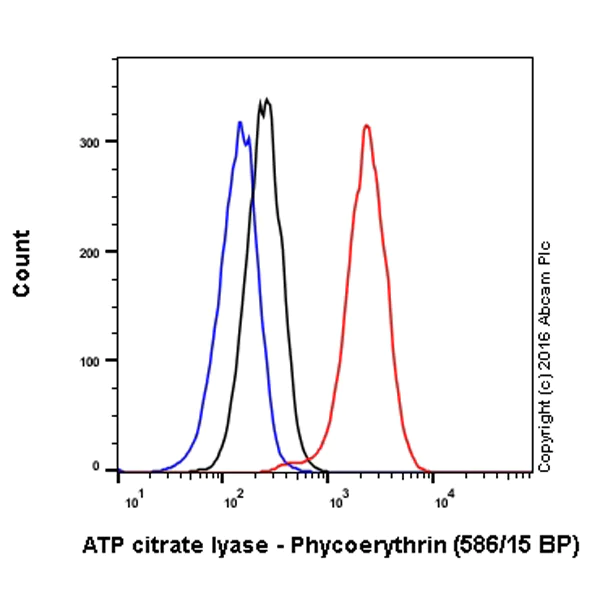
Flow Cytometry (Intracellular) - PE Anti-ATP citrate lyase antibody [EP704Y] (AB209750)
Overlay histogram showing HeLa cells stained with ab209750 (red line). The cells were fixed with 80% methanol (5 min) and then permeabilized with 0.1% PBS-Triton X-100 for 30 min at 22°C. The cells were then incubated in 1x PBS / 10% normal goat serum to block non-specific protein-protein interactions followed by the antibody (ab209750, 1/5000 dilution) for 30 min at 22°C.
Isotype control antibody (black line) was rabbit IgG (monoclonal) Phycoerythrin (ab209478) used at the same concentration and conditions as the primary antibody. Unlabelled sample (blue line) was also used as a control.
Acquisition of >5,000 events were collected using a 50mW Yellow-Green laser (561nm) and 586/15 bandpass filter.
Related conjugates and formulations (4)
-
Anti-ATP citrate lyase antibody [EP704Y]
-
Anti-ATP citrate lyase antibody [EP704Y] - BSA and Azide free
-
519 Alexa Fluor® 488
Alexa Fluor® 488 Anti-ATP citrate lyase antibody [EP704Y]
-
665 Alexa Fluor® 647
Alexa Fluor® 647 Anti-ATP citrate lyase antibody [EP704Y]
Alternative Products


Primary Antibodies
AB53007
Anti-ATP citrate lyase (phospho T447 + S451) antibody [EP737Y]
RabMAb|Recombinant

- 5
- 1
Complementary Products

Primary Antibodies
AB212122
PE Anti-IDH2 antibody [EPR7577]
RabMAb|Recombinant|KO Validated|Trial Size

- 5
- 1
Primary Antibodies
AB210451
PE Anti-ASS1 antibody [EPR12398]
RabMAb|Recombinant|KO Validated|Trial Size

- 4
- 1
Primary Antibodies
AB216385
Alexa Fluor® 594 Anti-ATP5A antibody [EPR13030(B)] - Mitochondrial Marker
RabMAb|Recombinant

- 4
- 1
Primary Antibodies
AB197536
Alexa Fluor® 488 Anti-Peroxiredoxin 2/PRP antibody [EPR5154]
RabMAb|Recombinant|Trial Size

- 0
- 0
Reactivity data
Product details
Patented technology
Our RabMAb® technology is a patented hybridoma-based technology for making rabbit monoclonal antibodies. For details on our patents, please refer to RabMAb® patents.
What are the advantages of a recombinant monoclonal antibody?
This product is a recombinant monoclonal antibody, which offers several advantages including:
- - High batch-to-batch consistency and reproducibility
- - Improved sensitivity and specificity
- - Long-term security of supply
- - Animal-free batch production
For more information, read more on recombinant antibodies.
Properties and storage information
Form
Purification technique
Storage buffer
Shipped at conditions
Appropriate short-term storage conditions
Appropriate long-term storage conditions
Aliquoting information
Storage information
Supplementary information
This supplementary information is collated from multiple sources and compiled automatically.
Biological function summary
ATP citrate lyase plays an important role in lipid metabolism and energy production. It drives the conversion of citrate-derived acetyl-CoA a central metabolite in lipogenesis providing substrates for fatty acid and cholesterol synthesis. ACLY functions as a homotetramer complex to facilitate its enzymatic activity. This mechanism supports energy homeostasis linking carbohydrate metabolism with lipid biosynthesis.
Pathways
The enzyme ATP citrate lyase is instrumental in the citric acid cycle and fatty acid synthesis pathways. It is a central player in the cholesterol biosynthesis pathway which tightly connects to acetyl-CoA and citrate shuttle processes. In these pathways it interacts functionally with other enzymes such as acetyl-CoA carboxylase which further processes acetyl-CoA into malonyl-CoA serving as a precursor for fatty acid elongation.
Product protocols
- Visit the General protocols
- Visit the Troubleshooting
Target data
Alternative Names
Publications (1)
Recent publications for all applications. Explore the full listand refine your search
Arthritis research & therapy 27:173 PubMed40890810
2025
Applications
Unspecified application
Species
Unspecified reactive species
Product promise
Please note: All products are 'FOR RESEARCH USE ONLY. NOT FOR USE IN DIAGNOSTIC OR THERAPEUTIC PROCEDURES'.
For licensing inquiries, please contact partnerships@abcam.com