JavaScript is disabled in your browser. Please enable JavaScript to view this website.
AB303604

PE Anti-C5a-R antibody [EPR23278-117]

Be the first to review this product! Submit a review

|

(0 Publication)
Rabbit Recombinant Monoclonal C5a-R antibody - conjugated to PE. Suitable for Flow Cyt, ICC/IF, IHC-P and reacts with Human samples.
1 Images
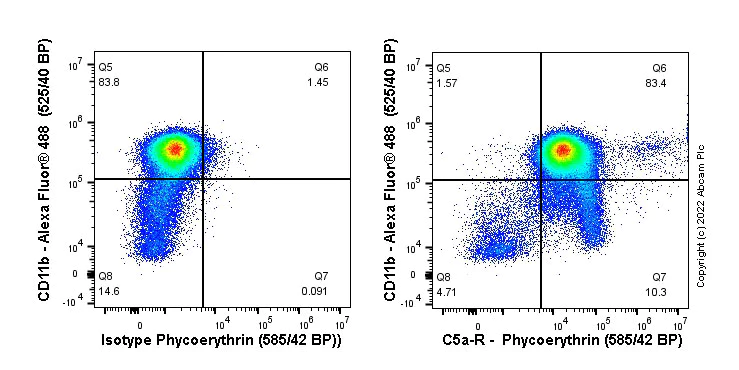
Flow Cytometry - PE Anti-C5a-R antibody [EPR23278-117] (AB303604)
  • Flow Cyt

Supplier Data

Flow Cytometry - PE Anti-C5a-R antibody [EPR23278-117] (AB303604)

Flow cytometry staining of human peripheral blood mononuclear cells (PBMCs) with ab303604 (right) or Rabbit IgG (monoclonal) Phycoerythrin (ab209478) isotype (left). PBMCs were incubated for 30 min on ice in 1x PBS containing 10μg/ml human IgG and 10% normal goat serum to block FC receptors and non-specific protein-protein interaction followed by the antibody (ab303604) or Rabbit IgG (monoclonal) Phycoerythrin (ab209478) isotype (100 μl at 1μg/ml (1/500)) for 30 min on ice. The cells were simultaneously stained with CD11b.

Acquisition of >30000 events were collected using a 50 mW Yellow/Green laser (561 nm) and 585/42 bandpass filter. Events were gated on live monocytes.

  • Unconjugated

    Anti-C5a-R antibody [EPR23278-117]

  • Carrier free

    Anti-C5a-R antibody [EPR23278-117] - BSA and Azide free

  • 660 APC

    APC Anti-C5a-R antibody [EPR23278-117]

  • 565 Alexa Fluor® 555

    Alexa Fluor® 555 Anti-C5a-R antibody [EPR23278-117]

  • 665 Alexa Fluor® 647

    Alexa Fluor® 647 Anti-C5a-R antibody [EPR23278-117]

Key facts

Host species

Rabbit

Clonality

Monoclonal

Clone number

EPR23278-117

Isotype

IgG

Conjugation

PE

Excitation/Emission

Ex: 480;565nm, Em: 578nm

Carrier free

No

Reacts with

Human

Applications

ICC/IF, IHC-P, Flow Cyt

applications

Immunogen

The exact immunogen used to generate this antibody is proprietary information.

Reactivity data

{ "title": "Reactivity Data", "filters": { "stats": ["", "Species", "Dilution Info", "Notes"], "tabs": { "all-applications": {"fullname" : "All Applications", "shortname": "All Applications"}, "FlowCyt" : {"fullname" : "Flow Cytometry", "shortname":"Flow Cyt"}, "ICCIF" : {"fullname" : "Immunocytochemistry/ Immunofluorescence", "shortname":"ICC/IF"}, "IHCP" : {"fullname" : "Immunohistochemistry (Formalin/PFA-fixed paraffin-embedded sections)", "shortname":"IHC-P"} }, "product-promise": { "all": "all", "testedAndGuaranteed": "tested", "guaranteed": "expected", "predicted": "predicted", "notRecommended": "not-recommended" } }, "values": { "Human": { "FlowCyt-species-checked": "testedAndGuaranteed", "FlowCyt-species-dilution-info": "1/500", "FlowCyt-species-notes": "<p></p>", "ICCIF-species-checked": "guaranteed", "ICCIF-species-dilution-info": "", "ICCIF-species-notes": "<p></p>", "IHCP-species-checked": "guaranteed", "IHCP-species-dilution-info": "", "IHCP-species-notes": "<p></p>" } } }

Product details

Patented technology
Our RabMAb® technology is a patented hybridoma-based technology for making rabbit monoclonal antibodies. For details on our patents, please refer to RabMAb® patents.

What are the advantages of a recombinant monoclonal antibody?
This product is a recombinant monoclonal antibody, which offers several advantages including:

  • - High batch-to-batch consistency and reproducibility
  • - Improved sensitivity and specificity
  • - Long-term security of supply
  • - Animal-free batch production

For more information, read more on recombinant antibodies.

Properties and storage information

Form
Liquid
Purification technique
Affinity purification Protein A
Storage buffer
pH: 7.4 Preservative: 0.02% Sodium azide Constituents: PBS, 1% BSA
Shipped at conditions
Blue Ice
Appropriate short-term storage duration
1-2 weeks
Appropriate short-term storage conditions
+4°C
Appropriate long-term storage conditions
+4°C
Aliquoting information
Upon delivery aliquot
Storage information
Avoid freeze / thaw cycle|Store in the dark

Supplementary information

This supplementary information is collated from multiple sources and compiled automatically.

C5a-R also known as CD88 or C5aR1 is a protein found primarily on the surface of immune cells like macrophages and neutrophils. Its mass is approximately 45 kDa. C5a-R functions as a G protein-coupled receptor (GPCR) and binds the complement component C5a a powerful inflammatory peptide. The receptor is expressed in various tissues but primarily in the immune system where it plays a significant role in immune responses and inflammatory processes.
Biological function summary

C5a-R functions as a mediator of inflammation and immune responses. It is a part of the complement system a complex of proteins involved in innate immunity. Upon binding to C5a this receptor initiates a signaling cascade that leads to the recruitment and activation of immune cells at sites of inflammation. It amplifies the inflammatory response leading to cell chemotaxis degranulation and the production of pro-inflammatory cytokines.

Pathways

C5a-R plays an important role in the complement and immune pathways. It interacts closely with the C5 protein which is a core component of the complement pathway. This receptor also connects to other immune system proteins such as the C3 and C4 proteins through the cascade. Together these interactions help defend against pathogenic infections and maintain immune homeostasis.

C5a-R is associated with conditions like rheumatoid arthritis and sepsis. In rheumatoid arthritis the receptor's activation by C5a contributes to chronic inflammation and joint damage. During sepsis overactivation of C5a-R can lead to excessive inflammation and tissue damage. The receptor's involvement in these diseases is often linked with other proteins in the complement system such as C3a and C4a which also play roles in modulating inflammation and immune responses.

Product protocols

For this product, it's our understanding that no specific protocols are required. You can visit:

Target data

Receptor for the chemotactic and inflammatory peptide anaphylatoxin C5a, stimulating chemotaxis, granule enzyme release, intracellular calcium release and superoxide anion production (PubMed : 10636859, PubMed : 15153520, PubMed : 1847994, PubMed : 29300009, PubMed : 36806352, PubMed : 7622471, PubMed : 8182049, PubMed : 9553099). Ligand binding causes a conformation change that triggers signaling via guanine nucleotide-binding proteins (G proteins) and modulates the activity of downstream effectors, such as adenylate cyclase (PubMed : 36806352, PubMed : 37852260). C5AR1 is coupled to G(i)/G(o) (GNAI1 or GNAO1) G alpha proteins and mediates inhibition of adenylate cyclase (PubMed : 36806352, PubMed : 37852260). The ligand interacts with at least two sites on the receptor : a high-affinity site on the extracellular N-terminus, and a second site in the transmembrane region which activates downstream signaling events (PubMed : 7622471, PubMed : 8182049, PubMed : 9553099).
See full target information C5AR1

Alternative Names

CD88, C5AR, C5R1, C5AR1, C5a anaphylatoxin chemotactic receptor 1, C5a anaphylatoxin chemotactic receptor, C5a-R, C5aR

Product promise

We are committed to supporting your work with high-quality reagents, and we're here for you every step of the way. In the unlikely event that one of our products does not perform as expected, you're protected by our Product Promise.
For full details, please see our Terms & Conditions

Please note: All products are 'FOR RESEARCH USE ONLY. NOT FOR USE IN DIAGNOSTIC OR THERAPEUTIC PROCEDURES'.

For licensing inquiries, please contact partnerships@abcam.com