JavaScript is disabled in your browser. Please enable JavaScript to view this website.
AB18236

PE Anti-CD63 antibody [MEM-259]

Be the first to review this product! Submit a review

|

(2 Publications )

Anti-CD63 antibody [MEM-259] conjugated to PE - suitable for flow cytometry, and reacts with human samples. Clone [MEM-259] is a mouse monoclonal antibody cited in 29 publications.

Design your panel with our interactive flow cytometry panel builder. Click here.
1 Images
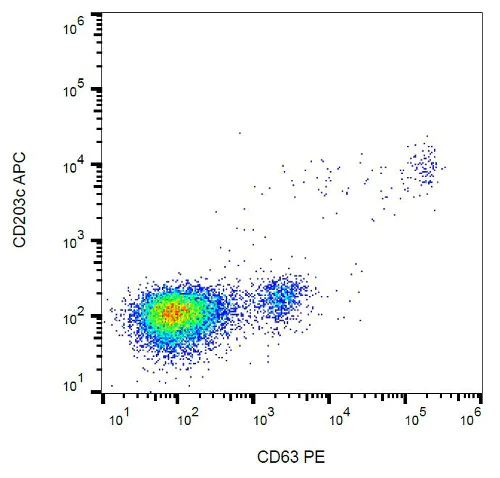
Flow Cytometry - PE Anti-CD63 antibody [MEM-259] (AB18236)
  • Flow Cyt

Supplier Data

Flow Cytometry - PE Anti-CD63 antibody [MEM-259] (AB18236)

Flow cytometry analysis of IgE-activated peripheral blood stained with anti-human CD63 (MEM-259) PE.

  • 519 FITC

    FITC Anti-CD63 antibody [MEM-259]

  • 667 PE/Cy5®

    PE/Cy5® Anti-CD63 antibody [MEM-259]

  • 675 PerCP

    PerCP Anti-CD63 antibody [MEM-259]

Key facts

Host species

Mouse

Clonality

Monoclonal

Clone number

MEM-259

Isotype

IgG1

Conjugation

PE

Excitation/Emission

Ex: 480;565nm, Em: 578nm

Carrier free

No

Reacts with

Human

Applications

Flow Cyt

applications

Immunogen

Cell preparation containing CD63 protein. The exact immunogen used to generate this antibody is proprietary information.

P08962

Reactivity data

{ "title": "Reactivity Data", "filters": { "stats": ["", "Species", "Dilution Info", "Notes"], "tabs": { "all-applications": {"fullname" : "All Applications", "shortname": "All Applications"}, "FlowCyt" : {"fullname" : "Flow Cytometry", "shortname":"Flow Cyt"} }, "product-promise": { "all": "all", "testedAndGuaranteed": "tested", "guaranteed": "expected", "predicted": "predicted", "notRecommended": "not-recommended" } }, "values": { "Human": { "FlowCyt-species-checked": "testedAndGuaranteed", "FlowCyt-species-dilution-info": "20 µL for 10^6 Cells", "FlowCyt-species-notes": "<p>20 μl for a 100 μl sample is recommended.</p><p><a href='/en-us/products/primary-antibodies/pe-mouse-igg1-b11-6-isotype-control-ab91357'>ab91357</a> - Mouse monoclonal IgG1, is suitable for use as an isotype control with this antibody.</p>" } } }

Properties and storage information

Form
Liquid
Purification notes
The conjugate is purified by size-exclusion chromatography.
Storage buffer
pH: 7.4 Preservative: 0.097% Sodium azide Constituents: BSA, PBS
Shipped at conditions
Blue Ice
Appropriate short-term storage conditions
+4°C
Appropriate long-term storage conditions
+4°C

Supplementary information

This supplementary information is collated from multiple sources and compiled automatically.

CD63 is a protein commonly known as LAMP-3 a member of the tetraspanin family with a molecular weight of approximately 25-65 kDa depending on post-translational modifications such as glycosylation. It resides mainly on the membrane of intracellular vesicles such as lysosomes and platelets. CD63 also appears on the surface of activated cells particularly in immune cells. Researchers often use CD63 as a marker in assays including CD63 western blot techniques due to its distinct expression patterns.
Biological function summary

CD63 participates in various cellular processes including membrane trafficking cell adhesion and signal transduction. It associates with integrins and other tetraspanins forming complexes that influence cellular adhesion and migration. Through its role in exosome formation CD63 contributes significantly to intercellular communication by facilitating the transfer of proteins lipids and RNA between cells.

Pathways

CD63 plays a role in pathways linked to cell proliferation and migration and immune response regulation. Within the integrin-mediated signaling pathway CD63 interacts with proteins such as integrins to promote cell adhesion and migration. CD63 also links to vesicle trafficking pathways collaborating with proteins involved in exocytosis and endocytosis which affect cell membrane restructuring and intracellular transport.

CD63 shows connections with cancer and immune system disorders. Its role in promoting cell adhesion and migration links it with cancer metastasis including melanoma and breast cancer where CD63 expression levels often rise. Additionally CD63 associates with allergic reactions due to its involvement in histamine release where it impacts immune proteins like FcεRI which participate in allergy pathogenesis.

Product protocols

For this product, it's our understanding that no specific protocols are required. You can visit:

Target data

Functions as a cell surface receptor for TIMP1 and plays a role in the activation of cellular signaling cascades. Plays a role in the activation of ITGB1 and integrin signaling, leading to the activation of AKT, FAK/PTK2 and MAP kinases. Promotes cell survival, reorganization of the actin cytoskeleton, cell adhesion, spreading and migration, via its role in the activation of AKT and FAK/PTK2. Plays a role in VEGFA signaling via its role in regulating the internalization of KDR/VEGFR2. Plays a role in intracellular vesicular transport processes, and is required for normal trafficking of the PMEL luminal domain that is essential for the development and maturation of melanocytes. Plays a role in the adhesion of leukocytes onto endothelial cells via its role in the regulation of SELP trafficking. May play a role in mast cell degranulation in response to Ms4a2/FceRI stimulation, but not in mast cell degranulation in response to other stimuli.
See full target information CD63

Alternative Names

CD63, MLA1, TSPAN30, CD63 antigen, Granulophysin, Lysosomal-associated membrane protein 3, Lysosome integral membrane protein 1, Melanoma-associated antigen ME491, OMA81H, Ocular melanoma-associated antigen, Tetraspanin-30, LAMP-3, Limp1, Tspan-30

Publications (2)

Recent publications for all applications. Explore the full listand refine your search

Small (Weinheim an der Bergstrasse, Germany) 19:e2301019 PubMed37209021

2023

Engineered Cytokine-Primed Extracellular Vesicles with High PD-L1 Expression Ameliorate Type 1 Diabetes.

Applications

Unspecified application

Species

Unspecified reactive species

Lanxing Wang,Chunxiao Qi,Hongmei Cao,Yanwen Zhang,Xing Liu,Lina Qiu,Hang Wang,Lijuan Xu,Zhenzhou Wu,Jianfeng Liu,Shusen Wang,Deling Kong,Yuebing Wang

International immunology 30:215-228 PubMed29373679

2018

Mechanistic peculiarities of activation-induced mobilization of cytotoxic effector proteins in human T cells.

Applications

Unspecified application

Species

Unspecified reactive species

Marcus Lettau,Fred Armbrust,Katharina Dohmen,Lisann Drews,Tobias Poch,Michelle Dietz,Dieter Kabelitz,Ottmar Janssen
View all publications

Product promise

We are committed to supporting your work with high-quality reagents, and we're here for you every step of the way. In the unlikely event that one of our products does not perform as expected, you're protected by our Product Promise.
For full details, please see our Terms & Conditions

Please note: All products are 'FOR RESEARCH USE ONLY. NOT FOR USE IN DIAGNOSTIC OR THERAPEUTIC PROCEDURES'.

For licensing inquiries, please contact partnerships@abcam.com