PE Anti-CRISPR-Cas9 antibody [EPR19799]
- RabMAb
- Recombinant
- What is this?
Be the first to review this product! Submit a review
|
(1 Publication)
- Flow Cyt (Intra)
Lab
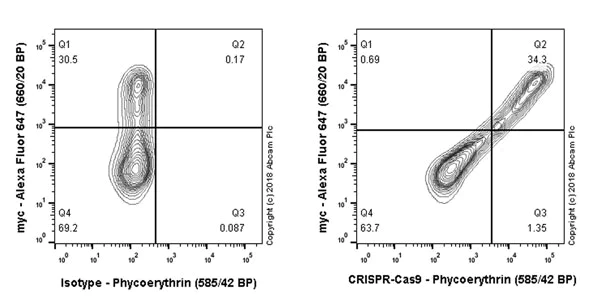
Flow Cytometry (Intracellular) - PE Anti-CRISPR-Cas9 antibody [EPR19799] (AB215701)
Flow cytometric analysis of 293T transfected with CRISPR-Cas9 with Myc tag stained with ab215701 (right panel). The cells were fixed with 4% formaldehyde (10 min) and then permeabilized with 90% methanol. The cells were then incubated in 1x PBS / 10% normal goat serum to block non-specific protein-protein interactions followed by the antibody (ab215701, 1/500 dilution) for 30 min at 22°C.
Isotype control antibody (left panel) was Rabbit IgG (monoclonal) Phycoerythrin (ab209478) used at the same concentration and conditions as the primary antibody. Co-staining with anti-myc (y-axis).
Acquisition of >5,000 events were collected using a 20 mW blue solid-state laser (488nm) and 585/42 bandpass filter.
Related conjugates and formulations (4)
-
Anti-CRISPR-Cas9 antibody [EPR19799]
-
Anti-CRISPR-Cas9 antibody [EPR19799] - BSA and Azide free
-
519 Alexa Fluor® 488
Alexa Fluor® 488 Anti-CRISPR-Cas9 antibody [EPR19799]
-
665 Alexa Fluor® 647
Alexa Fluor® 647 Anti-CRISPR-Cas9 antibody [EPR19799]
Alternative Products

Primary Antibodies
AB189380
Anti-CRISPR-Cas9 antibody [EPR18991]
20ul selling size|RabMAb|Recombinant

- 4
- 1
Primary Antibodies
AB202638
Anti-CRISPR-Cas9 antibody [EPR19620]
20ul selling size|RabMAb|Recombinant

- 0
- 0
Primary Antibodies
AB215240
Alexa Fluor® 647 Anti-CRISPR-Cas9 antibody [EPR18991]
RabMAb|Recombinant

- 0
- 0
Primary Antibodies
AB210752
Anti-CRISPR-Cas9 antibody [EPR19619-92]
20ul selling size|RabMAb|Recombinant

- 0
- 0
Primary Antibodies
AB203943
Anti-CRISPR-Cas9 antibody [EPR19795]
20ul selling size|RabMAb|Recombinant

- 0
- 0
Complementary Products

Primary Antibodies
AB288325
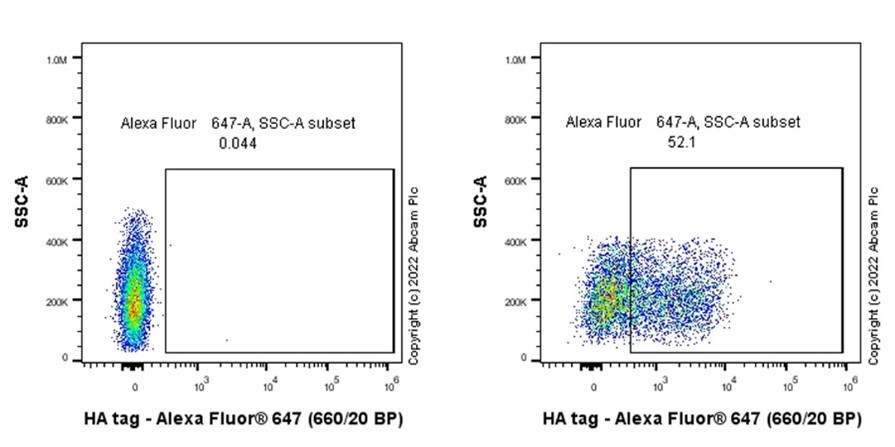
Alexa Fluor® 647 Anti-HA tag antibody [EPR22819-101]
RabMAb|Recombinant
- 3
- 1

Reactivity data
Product details
Patented technology
Our RabMAb® technology is a patented hybridoma-based technology for making rabbit monoclonal antibodies. For details on our patents, please refer to RabMAb® patents.
What are the advantages of a recombinant monoclonal antibody?
This product is a recombinant monoclonal antibody, which offers several advantages including:
- - High batch-to-batch consistency and reproducibility
- - Improved sensitivity and specificity
- - Long-term security of supply
- - Animal-free batch production
For more information, read more on recombinant antibodies.
Properties and storage information
Form
Purification technique
Storage buffer
Shipped at conditions
Appropriate short-term storage duration
Appropriate short-term storage conditions
Appropriate long-term storage conditions
Aliquoting information
Storage information
Supplementary information
This supplementary information is collated from multiple sources and compiled automatically.
Biological function summary
The Cas9 protein functions as an integral part of the CRISPR-Cas9 complex which includes a guide RNA to direct the protein to specific DNA sequences. This complex enables precise cuts at targeted locations within the genome. The Cas9 protein size allows it to fit effectively within cells facilitating genome editing in areas such as research agriculture and therapeutics. The complexity of CRISPR-Cas9 also includes the interaction with other cellular components that assist in DNA repair post-cleavage.
Pathways
CRISPR-Cas9 plays a role in DNA repair pathways particularly non-homologous end joining and homologous recombination. After Cas9-induced DNA breaks these pathways become active to repair the cleaved DNA. The gene editing process facilitated by CRISPR-Cas9 often involves interaction with DNA repair proteins like ku70/80 and Rad51 in response to induced breaks. This allows for either the incorporation of new genetic material or the modification of existing genes.
Product protocols
- Visit the General protocols
- Visit the Troubleshooting
Target data
Additional targets
Alternative Names
Publications (1)
Recent publications for all applications. Explore the full listand refine your search
BMC veterinary research 21:11 PubMed39789573
2025
Applications
Unspecified application
Species
Unspecified reactive species
Product promise
Please note: All products are 'FOR RESEARCH USE ONLY. NOT FOR USE IN DIAGNOSTIC OR THERAPEUTIC PROCEDURES'.
For licensing inquiries, please contact partnerships@abcam.com