JavaScript is disabled in your browser. Please enable JavaScript to view this website.
AB228780

Anti-Peroxiredoxin 1/PAG antibody

Be the first to review this product! Submit a review

|

(2 Publications )
Rabbit Polyclonal Peroxiredoxin 1/PAG antibody. Suitable for WB, IHC-P and reacts with Mouse, Human samples. Cited in 2 publications. Immunogen corresponding to Recombinant Fragment Protein within Human PRDX1.
3 Images
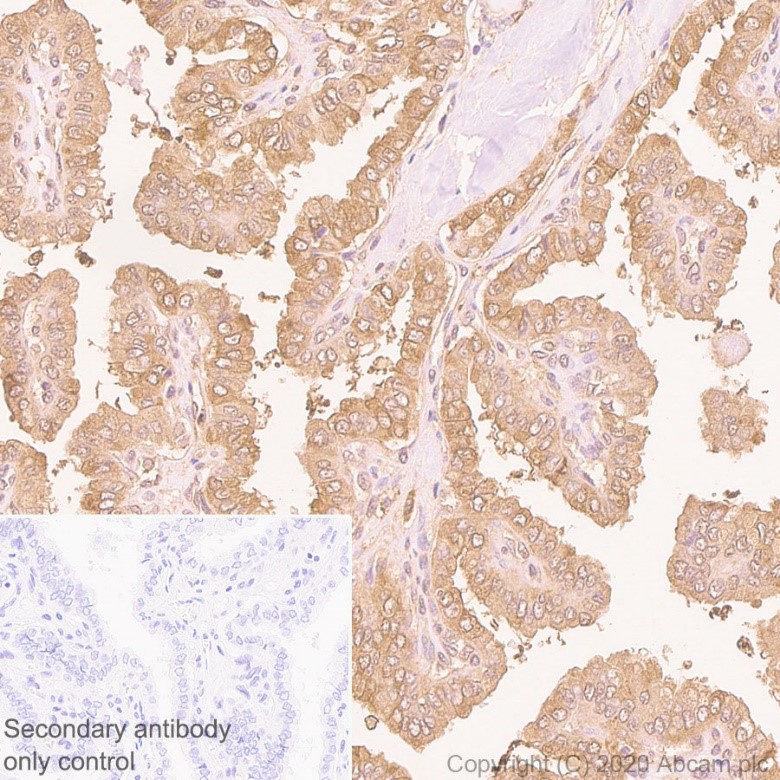
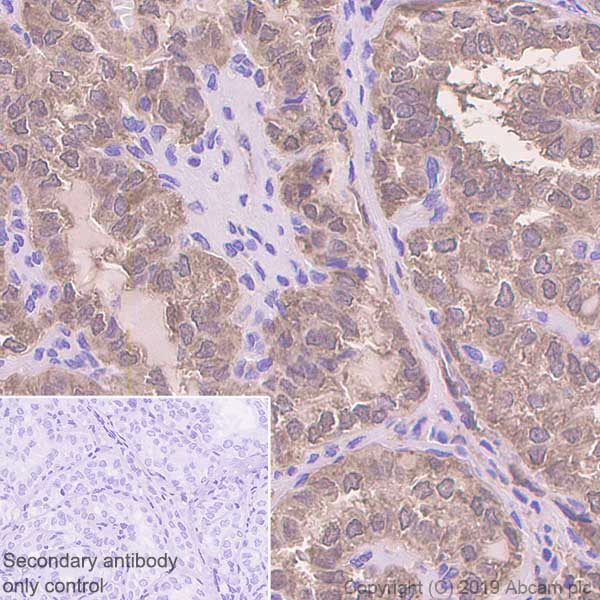
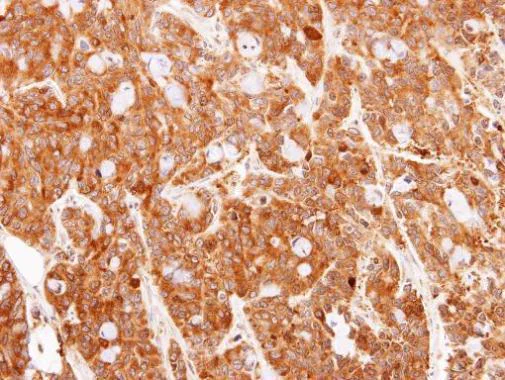
Immunohistochemistry (Formalin/PFA-fixed paraffin-embedded sections) - Anti-Peroxiredoxin 1/PAG antibody (AB228780)
  • IHC-P

Supplier Data

Immunohistochemistry (Formalin/PFA-fixed paraffin-embedded sections) - Anti-Peroxiredoxin 1/PAG antibody (AB228780)

Paraffin-embedded HT-29 (human colorectal adenocarcinoma cell line) xenograft tissue stained for Peroxiredoxin 1/PAG using ab228780 at 1/100 dilution in immunohistochemical analysis.
Western blot - Anti-Peroxiredoxin 1/PAG antibody (AB228780)
  • WB

Supplier Data

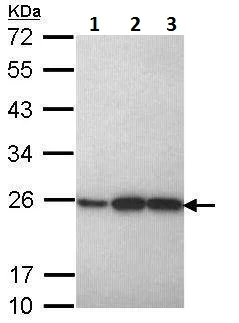
Western blot - Anti-Peroxiredoxin 1/PAG antibody (AB228780)

12 % SDS-PAGE gel.

All lanes:

Western blot - Anti-Peroxiredoxin 1/PAG antibody (ab228780) at 1/1000 dilution

Lane 1:

NCI-H1299 (human lung carcinoma cell line) whole cell lysate at 30 µg

Lane 2:

HeLa (human epithelial cell line from cervix adenocarcinoma) whole cell lysate at 30 µg

Lane 3:

HepG2 (human liver hepatocellular carcinoma cell line) whole cell lysate at 30 µg

Predicted band size: 22 kDa

false
Western blot - Anti-Peroxiredoxin 1/PAG antibody (AB228780)
  • WB

Supplier Data

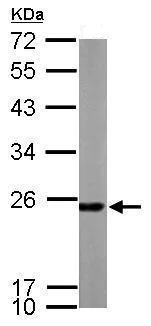
Western blot - Anti-Peroxiredoxin 1/PAG antibody (AB228780)

12% SDS-PAGE gel.

All lanes:

Western blot - Anti-Peroxiredoxin 1/PAG antibody (ab228780) at 1/1000 dilution

All lanes:

Mouse brain lysate at 50 µg

Predicted band size: 22 kDa

false

Key facts

Host species

Rabbit

Clonality

Polyclonal

Isotype

IgG

Carrier free

No

Reacts with

Mouse, Human

Applications

WB, IHC-P

applications

Immunogen

Recombinant Fragment Protein within Human PRDX1. The exact immunogen used to generate this antibody is proprietary information.

Q06830

Reactivity data

{ "title": "Reactivity Data", "filters": { "stats": ["", "Species", "Dilution Info", "Notes"], "tabs": { "all-applications": {"fullname" : "All Applications", "shortname": "All Applications"}, "WB" : {"fullname" : "Western blot", "shortname":"WB"}, "IHCP" : {"fullname" : "Immunohistochemistry (Formalin/PFA-fixed paraffin-embedded sections)", "shortname":"IHC-P"} }, "product-promise": { "all": "all", "testedAndGuaranteed": "tested", "guaranteed": "expected", "predicted": "predicted", "notRecommended": "not-recommended" } }, "values": { "Human": { "WB-species-checked": "testedAndGuaranteed", "WB-species-dilution-info": "1/500 - 1/3000", "WB-species-notes": "<p></p>", "IHCP-species-checked": "testedAndGuaranteed", "IHCP-species-dilution-info": "1/100 - 1/1000", "IHCP-species-notes": "<p></p>" }, "Mouse": { "WB-species-checked": "testedAndGuaranteed", "WB-species-dilution-info": "1/500 - 1/3000", "WB-species-notes": "<p></p>", "IHCP-species-checked": "guaranteed", "IHCP-species-dilution-info": "", "IHCP-species-notes": "" }, "Rat": { "WB-species-checked": "predicted", "WB-species-dilution-info": "", "WB-species-notes": "", "IHCP-species-checked": "predicted", "IHCP-species-dilution-info": "", "IHCP-species-notes": "" }, "Cow": { "WB-species-checked": "predicted", "WB-species-dilution-info": "", "WB-species-notes": "", "IHCP-species-checked": "predicted", "IHCP-species-dilution-info": "", "IHCP-species-notes": "" }, "Dog": { "WB-species-checked": "predicted", "WB-species-dilution-info": "", "WB-species-notes": "", "IHCP-species-checked": "predicted", "IHCP-species-dilution-info": "", "IHCP-species-notes": "" }, "Rhesus monkey": { "WB-species-checked": "predicted", "WB-species-dilution-info": "", "WB-species-notes": "", "IHCP-species-checked": "predicted", "IHCP-species-dilution-info": "", "IHCP-species-notes": "" } } }

Properties and storage information

Form
Liquid
Purification technique
Affinity purification Immunogen
Storage buffer
pH: 7 Preservative: 0.01% Thimerosal (merthiolate) Constituents: 10% Glycerol (glycerin, glycerine), 1.21% Tris, 0.75% Glycine
Shipped at conditions
Blue Ice
Appropriate short-term storage duration
1-2 weeks
Appropriate short-term storage conditions
+4°C
Appropriate long-term storage conditions
-20°C
Aliquoting information
Upon delivery aliquot
Storage information
Avoid freeze / thaw cycle

Supplementary information

This supplementary information is collated from multiple sources and compiled automatically.

Peroxiredoxin 1 also known as PAG plays an important role as an antioxidant enzyme. It is part of the peroxiredoxin family with a molecular mass of around 22 kDa. This protein helps reduce hydrogen peroxide and organic hydroperoxides to water and corresponding alcohols using reducing equivalents provided by thiol-containing donor molecules. Peroxiredoxin 1/PAG expresses widely in human tissues and cells including liver and erythrocytes reflecting its involvement in cellular redox regulation.
Biological function summary

Peroxiredoxin 1 helps maintain cellular homeostasis by protecting cells from oxidative stress. It forms homodimers or interacts with other proteins to propagate cellular responses to changes in redox state. As an important member of the antioxidant defense mechanism it contributes to cellular signaling through modulation of hydrogen peroxide signaling pathways. The protein also plays a role in cell proliferation and apoptosis making it significant for cellular health and disease prevention.

Pathways

Peroxiredoxin 1 participates in critical processes such as the MAPK signaling and TGF-beta pathways. It interacts with MAPK-related proteins influencing cell survival and growth. Peroxiredoxin 1 indirectly modulates downstream signaling molecules that contribute to cellular responses. In these pathways the protein's antioxidant properties allow regulation of reactive oxygen species levels which directly affect cellular signaling cascades.

Peroxiredoxin 1 is relevant to cancer and neurodegenerative disorders. Overexpression or misregulation of this protein has been linked to various cancers where it potentially interacts with oncogenic proteins like c-Myc to promote tumor progression. Additionally abnormal levels of Peroxiredoxin 1 associate with neurodegenerative diseases as oxidative stress is a common factor in their pathology. These connections suggest the protein as a promising target in therapeutic interventions for these diseases.

Product protocols

For this product, it's our understanding that no specific protocols are required. You can visit:

Target data

Thiol-specific peroxidase that catalyzes the reduction of hydrogen peroxide and organic hydroperoxides to water and alcohols, respectively. Plays a role in cell protection against oxidative stress by detoxifying peroxides and as sensor of hydrogen peroxide-mediated signaling events. Might participate in the signaling cascades of growth factors and tumor necrosis factor-alpha by regulating the intracellular concentrations of H(2)O(2) (PubMed : 9497357). Reduces an intramolecular disulfide bond in GDPD5 that gates the ability to GDPD5 to drive postmitotic motor neuron differentiation (By similarity).
See full target information PRDX1

Alternative Names

PAGA, PAGB, TDPX2, PRDX1, Peroxiredoxin-1, Natural killer cell-enhancing factor A, Proliferation-associated gene protein, Thioredoxin peroxidase 2, Thioredoxin-dependent peroxide reductase 2, Thioredoxin-dependent peroxiredoxin 1, NKEF-A, PAG

Publications (2)

Recent publications for all applications. Explore the full listand refine your search

Journal of cell communication and signaling 17:993-1008 PubMed37191839

2023

MiR-218-5p promotes trophoblast infiltration and inhibits endoplasmic reticulum/oxidative stress by reducing UBE3A-mediated degradation of SATB1.

Applications

Unspecified application

Species

Unspecified reactive species

Xiao Gu,Xiaomei Sun,Yanling Yu,Lei Li

The Journal of veterinary medical science 84:914-923 PubMed35584951

2022

The immunohistochemical detection of peroxiredoxin 1 and 2 in canine spontaneous vascular endothelial tumors.

Applications

Unspecified application

Species

Unspecified reactive species

Narumi Otsuka,Kairi Ishimaru,Mami Murakami,Minami Goto,Akihiro Hirata,Hiroki Sakai
View all publications

Product promise

We are committed to supporting your work with high-quality reagents, and we're here for you every step of the way. In the unlikely event that one of our products does not perform as expected, you're protected by our Product Promise.
For full details, please see our Terms & Conditions

Please note: All products are 'FOR RESEARCH USE ONLY. NOT FOR USE IN DIAGNOSTIC OR THERAPEUTIC PROCEDURES'.

For licensing inquiries, please contact partnerships@abcam.com