JavaScript is disabled in your browser. Please enable JavaScript to view this website.
AB103432

Anti-PHD2 / prolyl hydroxylase antibody [366G/76/3]

Be the first to review this product! Submit a review

|

(5 Publications )
Mouse Monoclonal PHD2 / prolyl hydroxylase antibody. Suitable for Flow Cyt and reacts with Human samples. Cited in 5 publications.
1 Images
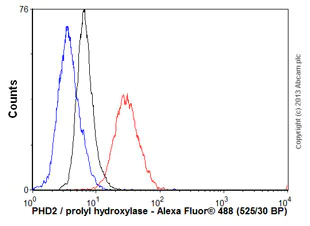
Flow Cytometry - Anti-PHD2 / prolyl hydroxylase antibody [366G/76/3] (AB103432)
  • Flow Cyt

Unknown

Flow Cytometry - Anti-PHD2 / prolyl hydroxylase antibody [366G/76/3] (AB103432)

Overlay histogram showing SHSY-5Y cells stained with ab103432 (red line). The cells were fixed with 4% paraformaldehyde (10 min) and then permeabilized with 0.1% PBS-Tween for 20 min. The cells were then incubated in 1x PBS / 10% normal goat serum / 0.3M glycine to block non-specific protein-protein interactions followed by the antibody (ab103432, 0.1μg/1x106 cells) for 30 min at 22°C. The secondary antibody used was Alexa Fluor® 488 goat anti-mouse IgG (H&L) (ab150113) at 1/2000 dilution for 30 min at 22°C. Isotype control antibody (black line) was mouse IgG1 [ICIGG1] (ab91353, 1μg/1x106 cells) used under the same conditions. Unlabelled sample (blue line) was also used as a control. Acquisition of >5,000 events were collected using a 20mW Argon ion laser (488nm) and 525/30 bandpass filter. This antibody gave a positive signal in SHSY-5Y cells fixed with 80% methanol (5 min)/permeabilized with 0.1% PBS-Tween for 20 min used under the same conditions.

Key facts

Host species

Mouse

Clonality

Monoclonal

Clone number

366G/76/3

Isotype

IgG1

Carrier free

No

Reacts with

Human

Applications

Flow Cyt

applications

Immunogen

The exact immunogen used to generate this antibody is proprietary information.

Reactivity data

{ "title": "Reactivity Data", "filters": { "stats": ["", "Species", "Dilution Info", "Notes"], "tabs": { "all-applications": {"fullname" : "All Applications", "shortname": "All Applications"}, "FlowCyt" : {"fullname" : "Flow Cytometry", "shortname":"Flow Cyt"} }, "product-promise": { "all": "all", "testedAndGuaranteed": "tested", "guaranteed": "expected", "predicted": "predicted", "notRecommended": "not-recommended" } }, "values": { "Human": { "FlowCyt-species-checked": "testedAndGuaranteed", "FlowCyt-species-dilution-info": "0.1 µg for 10^6 Cells", "FlowCyt-species-notes": "<p><a href='/en-us/products/primary-antibodies/mouse-igg1-kappa-monoclonal-15-6e10a7-isotype-control-ab170190'>ab170190</a> - Mouse monoclonal IgG1, is suitable for use as an isotype control with this antibody.</p>" } } }

Properties and storage information

Form
Liquid
Purification technique
Affinity purification Protein A/G
Storage buffer
Preservative: 0.02% Sodium azide Constituents: PBS
Shipped at conditions
Blue Ice
Appropriate short-term storage conditions
+4°C
Appropriate long-term storage conditions
-20°C
Aliquoting information
Upon delivery aliquot
Storage information
Avoid freeze / thaw cycle

Supplementary information

This supplementary information is collated from multiple sources and compiled automatically.

The protein PHD2 also known as prolyl hydroxylase 3 EGLN1 or 366G is a member of the prolyl hydroxylase family with a molecular mass of approximately 46 kDa. PHD2 is expressed in a variety of tissues particularly those in the human body's oxygen-sensing cellular machinery. This protein functions mechanically by adding hydroxyl groups to proline residues on its target proteins an enzymatic activity essential for its role in cellular oxygen sensing.
Biological function summary

This hydroxylation process influences the stability of hypoxia-inducible factor (HIF) by marking it for degradation under normal oxygen levels. PHD2 is a monomeric enzyme but its hydroxylase activity does not require association with other proteins to function. By regulating HIF PHD2 plays a critical role in cellular responses to oxygen availability controlling genes involved in processes such as angiogenesis metabolism and cell survival.

Pathways

PHD2 participates in the HIF signaling pathway and oxygen homeostasis pathways. The regulation of HIF by PHD2 occurs alongside PHD1 and PHD3 which have similar hydroxylase activities. Importantly PHD2 protects cells from hypoxia-related stress by ensuring the degradation of HIF-α subunits under normoxic conditions thereby maintaining cellular homeostasis and proper metabolic function.

PHD2 has connections with conditions such as cancer and chronic kidney disease. Its role in cancer is linked to its regulation of HIF where dysregulation can lead to abnormal cell growth and angiogenesis. In chronic kidney disease the insights into PHD2's function offer potential therapeutic targets particularly since HIF stabilization can ameliorate anemia frequently associated with this condition. Interactions between PHD2 and other proteins in these disease pathways make it a significant focal point for research aimed at developing new treatments.

Product protocols

For this product, it's our understanding that no specific protocols are required. You can visit:

Target data

Cellular oxygen sensor that catalyzes, under normoxic conditions, the post-translational formation of 4-hydroxyproline in hypoxia-inducible factor (HIF) alpha proteins. Hydroxylates a specific proline found in each of the oxygen-dependent degradation (ODD) domains (N-terminal, NODD, and C-terminal, CODD) of HIF1A. Also hydroxylates HIF2A. Has a preference for the CODD site for both HIF1A and HIF1B. Hydroxylated HIFs are then targeted for proteasomal degradation via the von Hippel-Lindau ubiquitination complex. Under hypoxic conditions, the hydroxylation reaction is attenuated allowing HIFs to escape degradation resulting in their translocation to the nucleus, heterodimerization with HIF1B, and increased expression of hypoxy-inducible genes. EGLN1 is the most important isozyme under normoxia and, through regulating the stability of HIF1, involved in various hypoxia-influenced processes such as angiogenesis in retinal and cardiac functionality. Target proteins are preferentially recognized via a LXXLAP motif.
See full target information EGLN1

Alternative Names

C1orf12, PNAS-118, PNAS-137, EGLN1, Egl nine homolog 1, Hypoxia-inducible factor prolyl hydroxylase 2, Prolyl hydroxylase domain-containing protein 2, SM-20, HIF-PH2, HIF-prolyl hydroxylase 2, HPH-2, PHD2

Publications (5)

Recent publications for all applications. Explore the full listand refine your search

Medicina (Kaunas, Lithuania) 58: PubMed36013579

2022

Novel Germline Variant in a Metastatic Pheochromocytoma and Chronic Myeloid Leukemia, but in the Absence of Polycythemia.

Applications

Unspecified application

Species

Unspecified reactive species

Aldesia Provenzano,Massimiliano Chetta,Giuseppina De Filpo,Giulia Cantini,Andrea La Barbera,Gabriella Nesi,Raffaella Santi,Serena Martinelli,Elena Rapizzi,Michaela Luconi,Mario Maggi,Massimo Mannelli,Tonino Ercolino,Letizia Canu

Cancer discovery 10:460-475 PubMed31810986

2019

TBK1 Is a Synthetic Lethal Target in Cancer with Loss.

Applications

Unspecified application

Species

Unspecified reactive species

Lianxin Hu,Haibiao Xie,Xijuan Liu,Frances Potjewyd,Lindsey I James,Emily M Wilkerson,Laura E Herring,Ling Xie,Xian Chen,Johnny Castillo Cabrera,Kai Hong,Chengheng Liao,Xianming Tan,Albert S Baldwin,Kan Gong,Qing Zhang

Histopathology 47:602-10 PubMed16324198

2005

Use of novel monoclonal antibodies to determine the expression and distribution of the hypoxia regulatory factors PHD-1, PHD-2, PHD-3 and FIH in normal and neoplastic human tissues.

Applications

Unspecified application

Species

Unspecified reactive species

E J Soilleux,H Turley,Y M Tian,C W Pugh,K C Gatter,A L Harris

The Journal of biological chemistry 279:42719-25 PubMed15302861

2004

Genetic analysis of the role of the asparaginyl hydroxylase factor inhibiting hypoxia-inducible factor (FIH) in regulating hypoxia-inducible factor (HIF) transcriptional target genes [corrected].

Applications

Unspecified application

Species

Unspecified reactive species

Ineke P Stolze,Ya-Min Tian,Rebecca J Appelhoff,Helen Turley,Charles C Wykoff,Jonathan M Gleadle,Peter J Ratcliffe

The Journal of biological chemistry 279:38458-65 PubMed15247232

2004

Differential function of the prolyl hydroxylases PHD1, PHD2, and PHD3 in the regulation of hypoxia-inducible factor.

Applications

Unspecified application

Species

Unspecified reactive species

Rebecca J Appelhoff,Ya-Min Tian,Raju R Raval,Helen Turley,Adrian L Harris,Christopher W Pugh,Peter J Ratcliffe,Jonathan M Gleadle
View all publications

Product promise

We are committed to supporting your work with high-quality reagents, and we're here for you every step of the way. In the unlikely event that one of our products does not perform as expected, you're protected by our Product Promise.
For full details, please see our Terms & Conditions

Please note: All products are 'FOR RESEARCH USE ONLY. NOT FOR USE IN DIAGNOSTIC OR THERAPEUTIC PROCEDURES'.

For licensing inquiries, please contact partnerships@abcam.com