JavaScript is disabled in your browser. Please enable JavaScript to view this website.
AB227673

Anti-PHLPP2 antibody [SP220]

Be the first to review this product! Submit a review

|

(5 Publications )
Rabbit Recombinant Monoclonal PHLPP2 antibody. Suitable for WB, IHC-P and reacts with Human samples. Cited in 5 publications.
4 Images
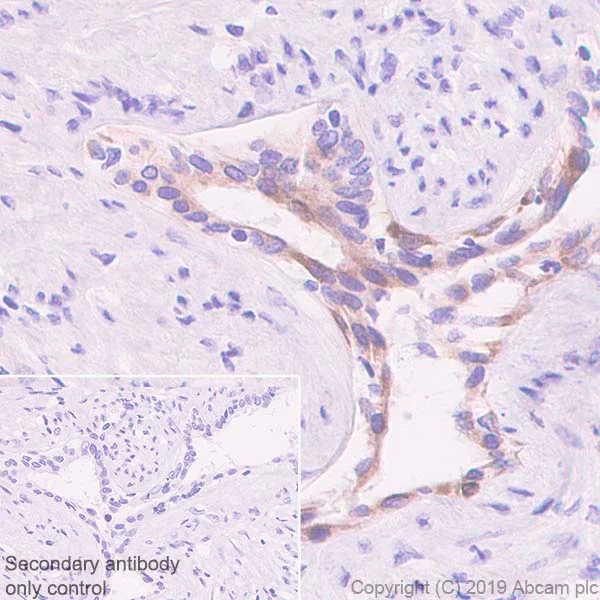
Immunohistochemistry (Formalin/PFA-fixed paraffin-embedded sections) - Anti-PHLPP2 antibody [SP220] (AB227673)
  • IHC-P

Unknown

Immunohistochemistry (Formalin/PFA-fixed paraffin-embedded sections) - Anti-PHLPP2 antibody [SP220] (AB227673)

Immunohistochemistry (Formalin/PFA-fixed paraffin-embedded sections) analysis of Human prostate carcinoma tissue sections labeling PHLPP2 with ab227673 at 1/100 dilution (1.65 µg/ml). Heat mediated antigen retrieval was performed Heat mediated antigen retrieval with Tris-EDTA buffer (pH 9.0, epitope retrieval solution 2) for 20 mins. Rabbit specific IHC polymer detection kit HRP/DAB (ab209101) was used as the secondary antibody. Negative control : PBS instead of the primary antibody. Hematoxylin was used as a counterstain.
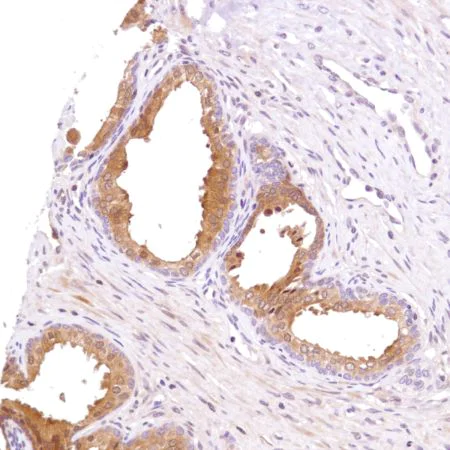
Immunohistochemistry (Formalin/PFA-fixed paraffin-embedded sections) - Anti-PHLPP2 antibody [SP220] (AB227673)
  • IHC-P

Supplier Data

Immunohistochemistry (Formalin/PFA-fixed paraffin-embedded sections) - Anti-PHLPP2 antibody [SP220] (AB227673)

Formalin-fixed paraffin-embedded human prostate tissue stained for PHLPP2 using ab227673 at 1/100 dilution in immunohistochemical analysis.
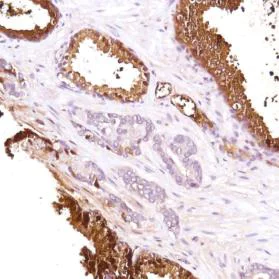
Immunohistochemistry (Formalin/PFA-fixed paraffin-embedded sections) - Anti-PHLPP2 antibody [SP220] (AB227673)
  • IHC-P

Supplier Data

Immunohistochemistry (Formalin/PFA-fixed paraffin-embedded sections) - Anti-PHLPP2 antibody [SP220] (AB227673)

Formalin-fixed paraffin-embedded human prostate adenocarcinoma tissue stained for PHLPP2 using ab227673 at 1/100 dilution in immunohistochemical analysis.
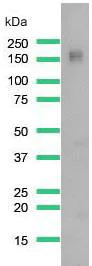
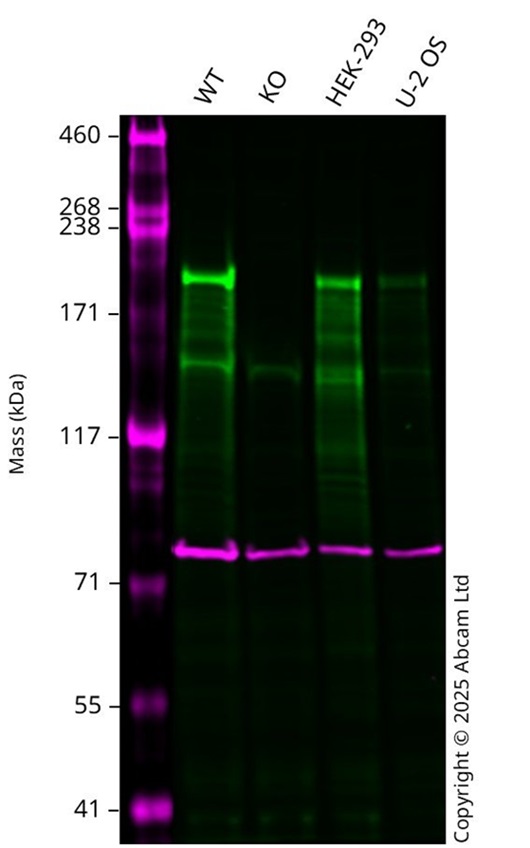
Western blot - Anti-PHLPP2 antibody [SP220] (AB227673)
  • WB

Supplier Data

Western blot - Anti-PHLPP2 antibody [SP220] (AB227673)

All lanes:

Western blot - Anti-PHLPP2 antibody [SP220] (ab227673) at 1/400 dilution

All lanes:

HEK-293T (human epithelial cell line from embryonic kidney transformed with large T antigen) cell lysate.

Predicted band size: 147 kDa

false

  • Carrier free

    Anti-PHLPP2 antibody [SP220] - BSA and Azide free

Key facts

Host species

Rabbit

Clonality

Monoclonal

Clone number

SP220

Isotype

IgG

Carrier free

No

Reacts with

Human

Applications

IHC-P, WB

applications

Immunogen

The exact immunogen used to generate this antibody is proprietary information.

Reactivity data

{ "title": "Reactivity Data", "filters": { "stats": ["", "Species", "Dilution Info", "Notes"], "tabs": { "all-applications": {"fullname" : "All Applications", "shortname": "All Applications"}, "WB" : {"fullname" : "Western blot", "shortname":"WB"}, "IHCP" : {"fullname" : "Immunohistochemistry (Formalin/PFA-fixed paraffin-embedded sections)", "shortname":"IHC-P"} }, "product-promise": { "all": "all", "testedAndGuaranteed": "tested", "guaranteed": "expected", "predicted": "predicted", "notRecommended": "not-recommended" } }, "values": { "Human": { "WB-species-checked": "testedAndGuaranteed", "WB-species-dilution-info": "1/400", "WB-species-notes": "<p>Primary antibody incubation for 1 hour at room temperature.</p>", "IHCP-species-checked": "testedAndGuaranteed", "IHCP-species-dilution-info": "1/100", "IHCP-species-notes": "<p>Perform heat mediated antigen retrieval by boiling tissue section in citrate buffer, pH 6.0 for 10 minutes followed by cooling at room temperature for 20 minutes.</p><p>Primary antibody incubation for 10 minutes at room temperature.</p>" }, "Mouse": { "WB-species-checked": "predicted", "WB-species-dilution-info": "", "WB-species-notes": "", "IHCP-species-checked": "predicted", "IHCP-species-dilution-info": "", "IHCP-species-notes": "" } } }

Properties and storage information

Form
Liquid
Purification technique
Affinity purification Protein A/G
Purification notes
Purified from TCS by protein A/G.
Storage buffer
pH: 7.6 Preservative: 0.1% Sodium azide Constituents: PBS, 1% BSA
Shipped at conditions
Conditional Ambient
Appropriate short-term storage duration
1-2 weeks
Appropriate short-term storage conditions
+4°C
Appropriate long-term storage conditions
-20°C
Aliquoting information
Upon delivery aliquot
Storage information
Avoid freeze / thaw cycle

Supplementary information

This supplementary information is collated from multiple sources and compiled automatically.

PHLPP2 also known as PH domain leucine-rich repeat protein phosphatase 2 functions as a serine/threonine phosphatase that specifically dephosphorylates Akt at the Ser473 site. This regulatory action on Akt influences many cellular processes including cell growth survival and metabolism. PHLPP2 has a molecular mass of approximately 140 kDa and is expressed in various tissues including liver and lung. Alternative names such as SCOP2 may sometimes reference this protein in specific research contexts.
Biological function summary

PHLPP2 modulates key signaling pathways by acting as a significant negative regulator of the Akt signaling pathway. It does not work alone; PHLPP2 can interact with functional complexes to exert its phosphatase activity more effectively. By dephosphorylating Akt PHLPP2 reduces the signaling output that leads to cell proliferation and survival responses leading to normal cellular homeostasis. This regulatory function positions PHLPP2 as a balancing component ensuring that Akt activity remains tightly controlled.

Pathways

PHLPP2 plays a role in the PI3K/Akt signaling pathway which is critical for cellular growth and metabolic functions. It also indirectly impacts the mTOR pathway through its regulation of Akt as Akt is an upstream activator of mTOR. By keeping Akt activity in check via dephosphorylation PHLPP2 keeps the downstream effects of the PI3K/Akt/mTOR axis in balance. It relates closely to proteins like PTEN which also acts as a negative regulator of the PI3K/Akt pathway ensuring that excessive Akt activity does not drive uncontrolled cellular events.

Mutations or altered expression of PHLPP2 have connections to cancer and diabetes. In cancer decreased levels of PHLPP2 can lead to an increase in Akt activity promoting uncontrolled cell division and survival therefore contributing to tumorigenesis. PHLPP2's influence on diabetes involves its regulation of insulin signaling where dysregulation can affect glucose homeostasis. The relationship between PHLPP2 Akt and insulin signaling highlights its important role in maintaining normal metabolic control and preventing disease progression in these contexts.

Product protocols

For this product, it's our understanding that no specific protocols are required. You can visit:

Target data

Protein phosphatase involved in regulation of Akt and PKC signaling. Mediates dephosphorylation in the C-terminal domain hydrophobic motif of members of the AGC Ser/Thr protein kinase family; specifically acts on 'Ser-473' of AKT1, 'Ser-660' of PRKCB isoform beta-II and 'Ser-657' of PRKCA. Akt regulates the balance between cell survival and apoptosis through a cascade that primarily alters the function of transcription factors that regulate pro- and antiapoptotic genes. Dephosphorylation of 'Ser-473' of Akt triggers apoptosis and decreases cell proliferation. Also controls the phosphorylation of AKT3. Dephosphorylates STK4 on 'Thr-387' leading to STK4 activation and apoptosis (PubMed : 20513427). Dephosphorylates RPS6KB1 and is involved in regulation of cap-dependent translation (PubMed : 21986499). Inhibits cancer cell proliferation and may act as a tumor suppressor. Dephosphorylation of PRKCA and PRKCB leads to their destabilization and degradation. Dephosphorylates RAF1 inhibiting its kinase activity (PubMed : 24530606).
See full target information PHLPP2

Alternative Names

KIAA0931, PHLPPL, PHLPP2, PH domain leucine-rich repeat-containing protein phosphatase 2, PH domain leucine-rich repeat-containing protein phosphatase-like, PHLPP-like

Publications (5)

Recent publications for all applications. Explore the full listand refine your search

Nature medicine 31:1949-1957 PubMed40082695

2025

A B7H3-targeting antibody-drug conjugate in advanced solid tumors: a phase 1/1b trial.

Applications

Unspecified application

Species

Unspecified reactive species

Yuxiang Ma,Yunpeng Yang,Yan Huang,Wenfeng Fang,Jinhui Xue,Xiangjiao Meng,Yun Fan,Siqing Fu,Lin Wu,Yulong Zheng,Jian Liu,Zhihua Liu,Wu Zhuang,Seth Rosen,Song Qu,Bihui Li,Mingjun Li,Yanqiu Zhao,Shujun Yang,Yinghua Ji,David Sommerhalder,Suxia Luo,Kunyu Yang,Jingao Li,Dongqing Lv,Peng Zhang,Yuanyuan Zhao,Shaodong Hong,Yang Zhang,Shen Zhao,Steve Chin,Xian Zhang,Wei Lian,Jiaqiang Cai,Tongtong Xue,Li Zhang,Hongyun Zhao

BMC women's health 24:25 PubMed38184561

2024

PHLPP1 inhibits the growth and aerobic glycolysis activity of human ovarian granular cells through inactivating AKT pathway.

Applications

Unspecified application

Species

Unspecified reactive species

Xiaoyan Yang,Min A,Tana Gegen,Badema Daoerji,Yue Zheng,Aiming Wang

Medical oncology (Northwood, London, England) 40:290 PubMed37658961

2023

RNF149 confers cisplatin resistance in esophageal squamous cell carcinoma via destabilization of PHLPP2 and activating PI3K/AKT signalling.

Applications

Unspecified application

Species

Unspecified reactive species

Jinrong Zhu,Jiuren Tang,Yongqi Wu,Xiangyu Qiu,Xin Jin,Rongxin Zhang

Cell death & disease 13:285 PubMed35354796

2022

TRIM46 activates AKT/HK2 signaling by modifying PHLPP2 ubiquitylation to promote glycolysis and chemoresistance of lung cancer cells.

Applications

Unspecified application

Species

Unspecified reactive species

Jicheng Tantai,Xufeng Pan,Yong Chen,Yuzhou Shen,Chunyu Ji

Journal of molecular histology 52:437-447 PubMed33847879

2021

LncRNA LOC729178 acts as a sponge of miR-144-3p to mitigate cigarette smoke extract-induced inflammatory injury via regulating PHLPP2 in 16HBE cells.

Applications

Unspecified application

Species

Unspecified reactive species

Meihong Wang,Yufang Liu,Yufen Zhang,Luchang Zhang
View all publications

Product promise

We are committed to supporting your work with high-quality reagents, and we're here for you every step of the way. In the unlikely event that one of our products does not perform as expected, you're protected by our Product Promise.
For full details, please see our Terms & Conditions

Please note: All products are 'FOR RESEARCH USE ONLY. NOT FOR USE IN DIAGNOSTIC OR THERAPEUTIC PROCEDURES'.

For licensing inquiries, please contact partnerships@abcam.com