Anti-Phosphomevalonate kinase antibody [EPR15029]
- RabMAb
- Recombinant
- What is this?
Be the first to review this product! Submit a review
|
(1 Publication)
- WB
Supplier Data
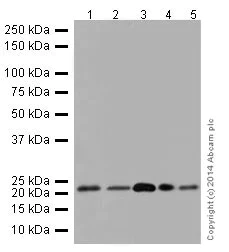
Western blot - Anti-Phosphomevalonate kinase antibody [EPR15029] (AB199725)
Blocking/Dilution buffer : 5% NFDM/TBST.
All lanes:
Western blot - Anti-Phosphomevalonate kinase antibody [EPR15029] (ab199725) at 1/1000 dilution
Lane 1:
HEK293 (Human embryonic kidney) whole cell lysate at 10 µg
Lane 2:
Human fetal liver tissue lysate at 10 µg
Lane 3:
Human fetal brain tissue lysate at 10 µg
Lane 4:
Human fetal heart tissue lysate at 10 µg
Lane 5:
Human fetal kidney tissue lysate at 10 µg
Secondary
All lanes:
Anti-Rabbit IgG (HRP), specific to the non-reduced form of IgG at 1/1000 dilution
Predicted band size: 21 kDa
Observed band size: 22 kDa
false
Exposure time: 3min
- WB
Unknown
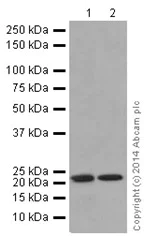
Western blot - Anti-Phosphomevalonate kinase antibody [EPR15029] (AB199725)
Blocking/Dilution buffer : 5% NFDM/TBST.
All lanes:
Western blot - Anti-Phosphomevalonate kinase antibody [EPR15029] (ab199725) at 1/1000 dilution
Lane 1:
Human fetal kidney lysate at 10 µg
Lane 2:
HeLa (Human epithelial cells from cervix adenocarcinoma) whole cell lysate at 10 µg
Secondary
All lanes:
Anti-Rabbit IgG (HRP), specific to the non-reduced form of IgG at 1/1000 dilution
Predicted band size: 21 kDa
Observed band size: 22 kDa
false
Exposure time: 1min
Related conjugates and formulations (1)
-
Anti-Phosphomevalonate kinase antibody [EPR15029] - BSA and Azide free
Alternative Products
Complementary Products
Primary Antibodies
AB285111
Anti-Glutathione Peroxidase 3/GPx-3 antibody [EPR23605-272] - BSA and Azide free (Detector)
RabMAb|Recombinant
- 0
- 0
Primary Antibodies
AB166904
Anti-beta glucuronidase (GUSB) antibody [EPR10616]
RabMAb|Recombinant

- 0
- 0

Reactivity data
Product details
Patented technology
Our RabMAb® technology is a patented hybridoma-based technology for making rabbit monoclonal antibodies. For details on our patents, please refer to RabMAb® patents.
What are the advantages of a recombinant monoclonal antibody?
This product is a recombinant monoclonal antibody, which offers several advantages including:
- - High batch-to-batch consistency and reproducibility
- - Improved sensitivity and specificity
- - Long-term security of supply
- - Animal-free batch production
For more information, read more on recombinant antibodies.
Properties and storage information
Form
Purification technique
Storage buffer
Shipped at conditions
Appropriate short-term storage duration
Appropriate short-term storage conditions
Appropriate long-term storage conditions
Aliquoting information
Storage information
Supplementary information
This supplementary information is collated from multiple sources and compiled automatically.
Biological function summary
Phosphomevalonate kinase functions as an important regulatory enzyme in the synthesis of cholesterol and non-sterol isoprenoids. It does not operate as part of a larger protein complex but through its sole catalytic activity it impacts the production of downstream molecules essential for cell membrane integrity and steroid hormone production. The enzyme's activity can affect the availability of isoprenoid precursors linking metabolic flux through the mevalonate pathway to cellular growth and differentiation processes.
Pathways
Phosphomevalonate kinase plays a central role in the mevalonate pathway a vital metabolic pathway for cholesterol biosynthesis. It is responsible for converting mevalonate-5-phosphate to mevalonate-5-diphosphate a necessary step towards producing farnesyl pyrophosphate. This pathway is closely related to the biosynthesis of cholesterol and other essential isoprenoids. PMVK activity is associated with other enzymes in the pathway like HMG-CoA reductase a major control point in cholesterol biosynthesis.
Product protocols
- Visit the General protocols
- Visit the Troubleshooting
Target data
Alternative Names
Publications (1)
Recent publications for all applications. Explore the full listand refine your search
Oncology letters 18:6459-6468 PubMed31819776
2019
Applications
Unspecified application
Species
Unspecified reactive species
Product promise
Please note: All products are 'FOR RESEARCH USE ONLY. NOT FOR USE IN DIAGNOSTIC OR THERAPEUTIC PROCEDURES'.
For licensing inquiries, please contact partnerships@abcam.com