Anti-PIGK antibody [EPR17843]
- 20ul selling size
- RabMAb
- Recombinant
- What is this?
Be the first to review this product! Submit a review
|
(9 Publications )
- ICC/IF
Lab
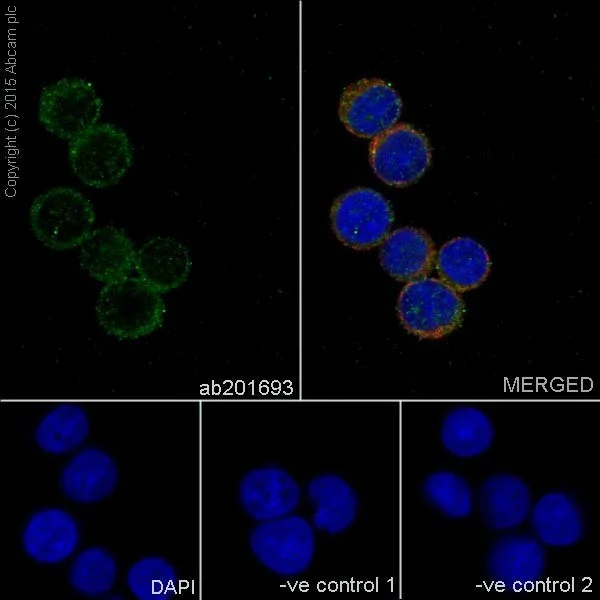
Immunocytochemistry/ Immunofluorescence - Anti-PIGK antibody [EPR17843] (AB201693)
Immunofluorescent analysis of 4% paraformaldehyde-fixed 0.1% Triton X-100 permeabilized Jurkat (Human T cell leukemia cells from peripheral blood) cells labeling PIGK with ab201693 at 1/500 dilution followed by Goat anti-rabbit IgG (Alexa Fluor® 488) (ab150077) secondary antibody at 1/500 dilution (green).
Confocal image showing cytoplasmic staining on Jurkat cell line.
The nuclear counter stain is DAPI (blue).
Tubulin is detected with ab7291 (anti-Tubulin mouse mAb) at 1/1000 dilution and ab150120 (AlexaFluor®594 Goat anti-Mouse secondary) at 1/500 dilution (red).
The negative controls are as follows :
-ve control 1 : ab201693 at 1/1000 dilution followed by ab150120 (AlexaFluor®594 Goat anti-Mouse secondary) at 1/500 dilution.
-ve control 2 : ab7291 (anti-Tubulin mouse mAb) at 1/1000 dilution followed by ab150077 (Alexa Fluor®488 Goat Anti-Rabbit IgG H&L) at 1/500 dilution.
- Flow Cyt (Intra)
Supplier Data
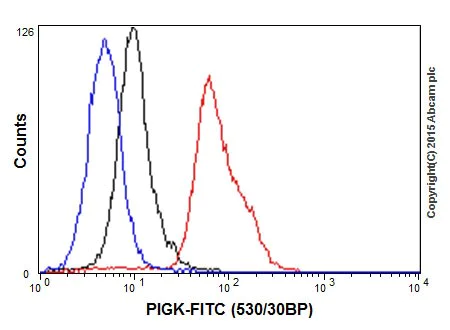
Flow Cytometry (Intracellular) - Anti-PIGK antibody [EPR17843] (AB201693)
Intracellular flow cytometric analysis of 2% paraformaldehyde-fixed HEK-293 (Human epithelial cells from embryonic kidney) cells labeling PIGK with ab201693 at 1/100 dilution (red) compared with a rabbit monoclonal IgG isotype control (ab172730;black) and an unlabelled control (cells without incubation with primary antibody and secondary antibody; blue). Goat anti rabbit IgG (FITC) at 1/150 dilution was used as the secondary antibody.
- ICC/IF
Lab
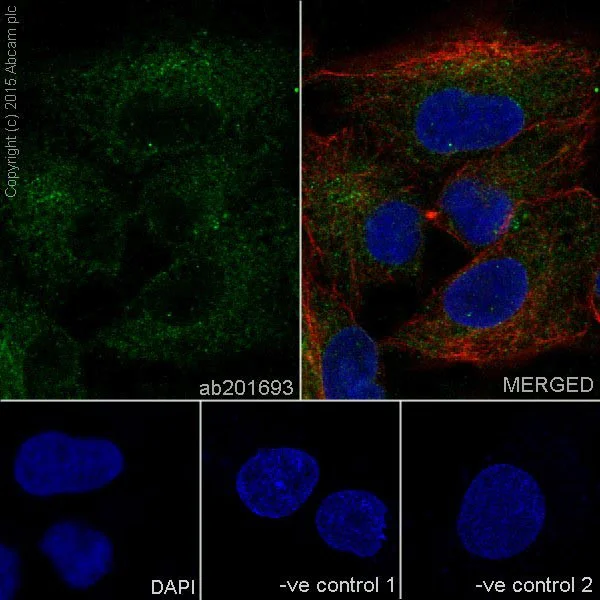
Immunocytochemistry/ Immunofluorescence - Anti-PIGK antibody [EPR17843] (AB201693)
Immunofluorescent analysis of 100% methanol-fixed 0.1% Triton X-100 permeabilized A549 (Human lung carcinoma) cells labeling PIGK with ab201693 at 1/500 dilution followed by Goat anti-rabbit IgG (Alexa Fluor® 488) (ab150077) secondary antibody at 1/500 dilution (green).
Confocal image showing cytoplasmic staining on A549 cell line.
The nuclear counter stain is DAPI (blue).
Tubulin is detected with ab7291 (anti-Tubulin mouse mAb) at 1/1000 dilution and ab150120 (AlexaFluor®594 Goat anti-Mouse secondary) at 1/500 dilution (red).
The negative controls are as follows :
-ve control 1 : ab201693 at 1/1000 dilution followed by ab150120 (AlexaFluor®594 Goat anti-Mouse secondary) at 1/500 dilution.
-ve control 2 : ab7291 (anti-Tubulin mouse mAb) at 1/1000 dilution followed by ab150077 (Alexa Fluor®488 Goat Anti-Rabbit IgG H&L) at 1/500 dilution.
- IP
Supplier Data
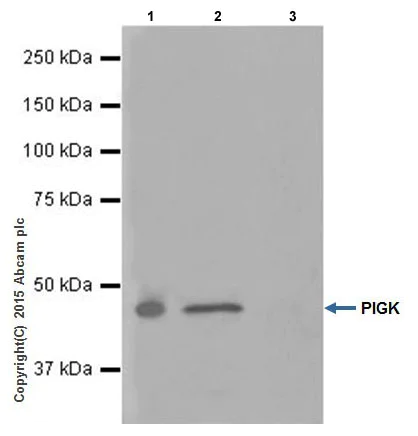
Immunoprecipitation - Anti-PIGK antibody [EPR17843] (AB201693)
PIGK was immunoprecipitated from 1mg of HEK293 (Human epithelial cells from embryonic kidney) whole cell lysate with ab201693 at 1/30 dilution.
Western blot was performed from the immunoprecipitate using ab201693 at 1/2000 dilution.
VeriBlot for IP Detection Reagent (HRP) (ab131366) was used for detection at 1/1500 dilution.
Lane 1 : HEK293 whole cell lysate10 μg (Input).
Lane 2 : ab201693 IP in HEK293 whole cell lysate.
Lane 3 : Rabbit monoclonal IgG (ab172730) instead of ab201693 in HEK293 whole cell lysate.
Blocking and dilution buffer and concentration : 5% NFDM/TBST.
Exposure time : 5 seconds.
All lanes:
Immunoprecipitation - Anti-PIGK antibody [EPR17843] (ab201693)
Predicted band size: 45 kDa
false
- WB
Supplier Data
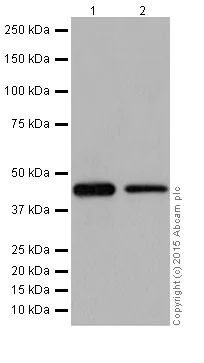
Western blot - Anti-PIGK antibody [EPR17843] (AB201693)
Blocking/Dilution buffer : 5% NFDM/TBST.
All lanes:
Western blot - Anti-PIGK antibody [EPR17843] (ab201693) at 1/2000 dilution
Lane 1:
HT1080 (Human fibrosarcoma cells) cell lysate at 20 µg
Lane 2:
HEK-293 (Human epithelial cells from embryonic kidney) cell lysate at 20 µg
Secondary
All lanes:
Goat Anti-Rabbit IgG, (H+L), Peroxidase conjugated at 1/1000 dilution
Predicted band size: 45 kDa
Observed band size: 45 kDa
false
Exposure time: 1min
- WB
Supplier Data
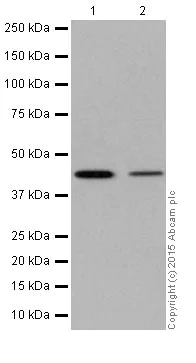
Western blot - Anti-PIGK antibody [EPR17843] (AB201693)
Blocking/Dilution buffer : 5% NFDM/TBST.
All lanes:
Western blot - Anti-PIGK antibody [EPR17843] (ab201693) at 1/2000 dilution
Lane 1:
Human pancreas lysate at 10 µg
Lane 2:
Human fetal liver lysate at 10 µg
Secondary
All lanes:
Anti-Rabbit IgG (HRP), specific to the non-reduced form of IgG at 1/1000 dilution
Predicted band size: 45 kDa
Observed band size: 45 kDa
false
Exposure time: 3min
- WB
Supplier Data
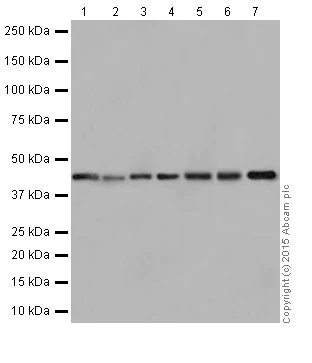
Western blot - Anti-PIGK antibody [EPR17843] (AB201693)
Blocking/Dilution buffer : 5% NFDM/TBST.
All lanes:
Western blot - Anti-PIGK antibody [EPR17843] (ab201693) at 1/2000 dilution
Lane 1:
Mouse brain lysate at 10 µg
Lane 2:
Mouse heart lysate at 10 µg
Lane 3:
Mouse kidney lysate at 10 µg
Lane 4:
Mouse spleen lysate at 10 µg
Lane 5:
Rat brain lysate at 10 µg
Lane 6:
Rat kidney lysate at 10 µg
Lane 7:
C6 (Rat glial tumor cells) cell lysate at 10 µg
Secondary
All lanes:
Goat Anti-Rabbit IgG, (H+L), Peroxidase conjugated at 1/1000 dilution
Predicted band size: 45 kDa
Observed band size: 45 kDa
false
Exposure time: 1min
Related conjugates and formulations (1)
-
Anti-PIGK antibody [EPR17843] - BSA and Azide free
Complementary Products
Primary Antibodies
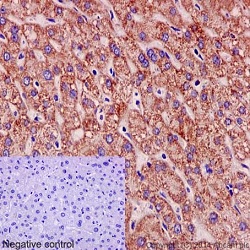
AB125011
Anti-TSG101 antibody [EPR7130(B)]
20ul selling size|BOND RX™ Validated|RabMAb|Recombinant

- 4
- 10

Reactivity data
Product details
Patented technology
Our RabMAb® technology is a patented hybridoma-based technology for making rabbit monoclonal antibodies. For details on our patents, please refer to RabMAb® patents.
What are the advantages of a recombinant monoclonal antibody?
This product is a recombinant monoclonal antibody, which offers several advantages including:
- - High batch-to-batch consistency and reproducibility
- - Improved sensitivity and specificity
- - Long-term security of supply
- - Animal-free batch production
For more information, read more on recombinant antibodies.
Properties and storage information
Form
Purification technique
Storage buffer
Shipped at conditions
Appropriate short-term storage duration
Appropriate short-term storage conditions
Appropriate long-term storage conditions
Aliquoting information
Storage information
Supplementary information
This supplementary information is collated from multiple sources and compiled automatically.
Biological function summary
The GPI transamidase complex which includes PIGK facilitates the attachment of proteins to the cell membrane via GPI anchors. This activity is a critical post-translational modification essential for the functionality and localization of these proteins. Within this complex PIGK operates alongside other components such as PIGT and GPAA1 to ensure correct positioning and attachment of GPI-anchored proteins.
Pathways
PIGK contributes to the biosynthesis and remodeling of GPI-anchored proteins impacting the GPI-anchor biosynthesis pathway itself. This pathway plays an integral role in cellular processes that involve anchoring proteins like CD55 and CD59 which are important for membrane dynamics and cell surface interactions. As part of these pathways PIGK's function links closely with other proteins in the remodeling process ensuring proper protein placement and functionality.
Product protocols
- Visit the General protocols
- Visit the Troubleshooting
Target data
Alternative Names
Publications (9)
Recent publications for all applications. Explore the full listand refine your search
Advanced science (Weinheim, Baden-Wurttemberg, Germany) 12:e02838 PubMed40548932
2025
Applications
Unspecified application
Species
Unspecified reactive species
Cancer biology & medicine 22: PubMed40488414
2025
Applications
Unspecified application
Species
Unspecified reactive species
Journal of extracellular vesicles 13:e12460 PubMed38853287
2024
Applications
Unspecified application
Species
Unspecified reactive species
Journal of experimental & clinical cancer research : CR 43:160 PubMed38840183
2024
Applications
Unspecified application
Species
Unspecified reactive species
Current protocols 3:e856 PubMed37540780
2023
Applications
Unspecified application
Species
Unspecified reactive species
The Journal of cell biology 222: PubMed37389656
2023
Applications
Unspecified application
Species
Unspecified reactive species
The FEBS journal 290:3359-3368 PubMed36808246
2023
Applications
Unspecified application
Species
Unspecified reactive species
Cell structure and function 46:65-71 PubMed34193731
2021
Applications
Unspecified application
Species
Unspecified reactive species
Kidney diseases (Basel, Switzerland) 6:422-433 PubMed33313063
2020
Applications
Unspecified application
Species
Unspecified reactive species
Product promise
Please note: All products are 'FOR RESEARCH USE ONLY. NOT FOR USE IN DIAGNOSTIC OR THERAPEUTIC PROCEDURES'.
For licensing inquiries, please contact partnerships@abcam.com