Anti-PKN2 antibody [EPR5490] - BSA and Azide free
- RabMAb
- Recombinant
- KO Validated
- What is this?
Be the first to review this product! Submit a review
|
(0 Publication)
- WB
Lab
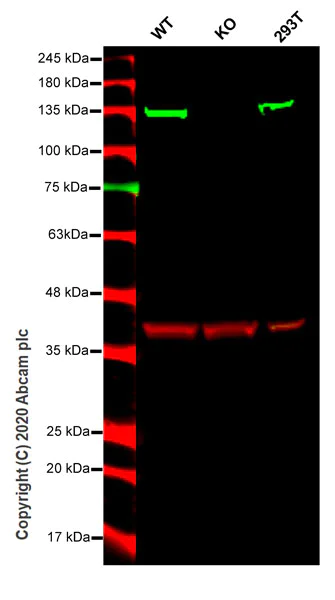
Western blot - Anti-PKN2 antibody [EPR5490] - BSA and Azide free (AB248857)
This data was developed using the same antibody clone in a different buffer formulation (ab138514).
Lanes 1-3 : Merged signal (red and green). Green - ab138514 observed at 112 kDa. Red - loading control, ab8245 observed at 37 kDa.
ab138514 Anti-PKN2 antibody [EPR5490] was shown to specifically react with PKN2 in wild-type HeLa cells. Loss of signal was observed when knockout cell line ab264691 (knockout cell lysate ab258587) was used. Wild-type and PKN2 knockout samples were subjected to SDS-PAGE. ab138514 and Anti-GAPDH antibody [6C5] - Loading Control (ab8245) were incubated overnight at 4°C at 1 in 1000 dilution and 1 in 20000 dilution respectively. Blots were developed with Goat anti-Rabbit IgG H&L (IRDye® 800CW) preadsorbed (ab216773) and Goat anti-Mouse IgG H&L (IRDye® 680RD) preadsorbed (ab216776) secondary antibodies at 1 in 10000 dilution for 1 hour at room temperature before imaging.
All lanes:
Western blot - Anti-PKN2 antibody [EPR5490] (<a href='/en-us/products/primary-antibodies/pkn2-antibody-epr5490-ab138514'>ab138514</a>) at 1/1000 dilution
Lane 1:
Wild-type HeLa cell lysate at 20 µg
Lane 2:
PKN2 knockout HeLa cell lysate at 20 µg
Lane 3:
HEK-293T cell lysate at 20 µg
Predicted band size: 112 kDa
Observed band size: 112 kDa
false
- WB
Lab
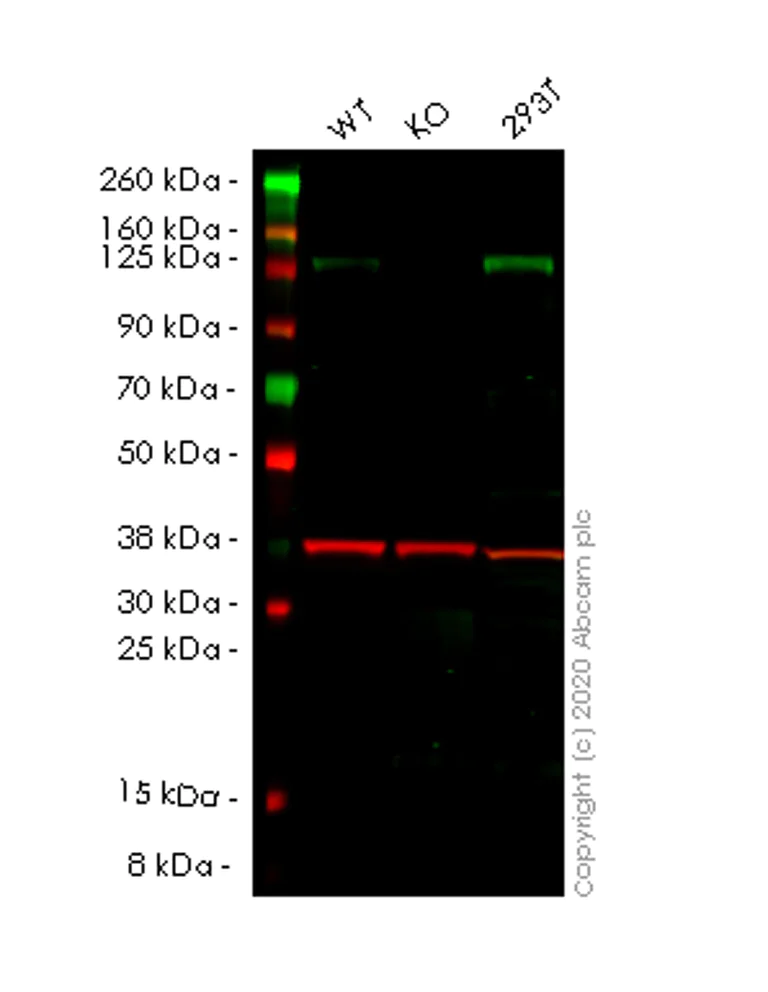
Western blot - Anti-PKN2 antibody [EPR5490] - BSA and Azide free (AB248857)
This data was developed using ab138514, the same antibody clone in a different buffer formulation.
Lanes 1-3 : Merged signal (red and green). Green - ab138514 observed at 125 kDa. Red - loading control ab8245 observed at 36 kDa.
ab138514 Anti-PKN2 antibody [EPR5490] (ab138514) was shown to specifically react with PKN2 in wild-type HCT cells. Loss of signal was observed when knockout cell line ab266894 (knockout cell lysate ab258588) was used. Wild-type and PKN2 knockout samples were subjected to SDS-PAGE. ab138514 and Anti-GAPDH antibody [6C5] - Loading Control (ab8245) were incubated overnight at 4°C at 1 in 1000 dilution and 1 in 20000 dilution respectively. Blots were developed with Goat anti-Rabbit IgG H&L (IRDye® 800CW) preadsorbed (ab216773) and Goat anti-Mouse IgG H&L (IRDye® 680RD) preadsorbed (ab216776) secondary antibodies at 1 in 20000 dilution for 1 hour at room temperature before imaging.
All lanes:
Western blot - Anti-PKN2 antibody [EPR5490] (<a href='/en-us/products/primary-antibodies/pkn2-antibody-epr5490-ab138514'>ab138514</a>) at 1/1000 dilution
Lane 1:
Wild-type HCT 116 (Human colorectal carcinoma cell line) whole cell lysate at 20 µg
Lane 2:
PKN2 knockout HCT 116 (Human colorectal carcinoma cell line) whole cell lysate at 20 µg
Lane 2:
Western blot - Human PKN2 knockout HCT116 cell line (<a href='/en-us/products/cell-lines/human-pkn2-knockout-hct116-cell-line-ab266894'>ab266894</a>)
Lane 3:
HEK-293T (Human epithelial cell line from embryonic kidney transformed with large T antigen) whole cell lysate at 20 µg
Secondary
All lanes:
Western blot - Goat anti-Rabbit IgG H&L (IRDye® 800CW) preadsorbed (<a href='/en-us/products/secondary-antibodies/goat-rabbit-igg-h-l-irdye-800cw-preadsorbed-ab216773'>ab216773</a>) at 1/10000 dilution
Predicted band size: 112 kDa
Observed band size: 125 kDa
false
Related conjugates and formulations (1)
-
Anti-PKN2 antibody [EPR5490]
Complementary Products

Sample Prep & Detection Kits
AB270709
5’ Feature Barcode Antibody Conjugation Kit - Lightning-Link® - Oligos 21-30
- 0
- 0
Primary Antibodies
AB187660
Anti-PRK3+PRK2+PRK1 (phospho T718 + T774 + T816) antibody [EPR1044(2)]
RabMAb|Recombinant|Trial Size
- 0
- 0
Primary Antibodies
AB16667
BOND RX™ Validated|KO Validated|RabMAb|Advanced Validation|Recombinant|20ul selling size

- 5
- 133
Primary Antibodies
AB181602
Anti-GAPDH antibody [EPR16891] - Loading Control
KD Validated|RabMAb|Recombinant|Lab Essentials|20ul selling size

- 5
- 23
Primary Antibodies
AB133267
Anti-Syntenin antibody [EPR8102]
20ul selling size|RabMAb|Recombinant|KO Validated
- 3
- 1
Reactivity data
Product details
ab248857 is the carrier-free version of ab138514.
Patented technology
Our RabMAb® technology is a patented hybridoma-based technology for making rabbit monoclonal antibodies. For details on our patents, please refer to RabMAb® patents.
What are the advantages of a recombinant monoclonal antibody?
This product is a recombinant monoclonal antibody, which offers several advantages including:
- - High batch-to-batch consistency and reproducibility
- - Improved sensitivity and specificity
- - Long-term security of supply
- - Animal-free batch production
For more information, read more on recombinant antibodies.
Conjugation ready
Our carrier-free antibodies are typically supplied in a PBS-only formulation, purified and free of BSA, sodium azide and glycerol. This conjugation-ready format is designed for use with fluorochromes, metal isotopes, oligonucleotides, and enzymes, which makes them ideal for antibody labelling, functional and cell-based assays, flow-based assays (e.g. mass cytometry) and Multiplex Imaging applications.
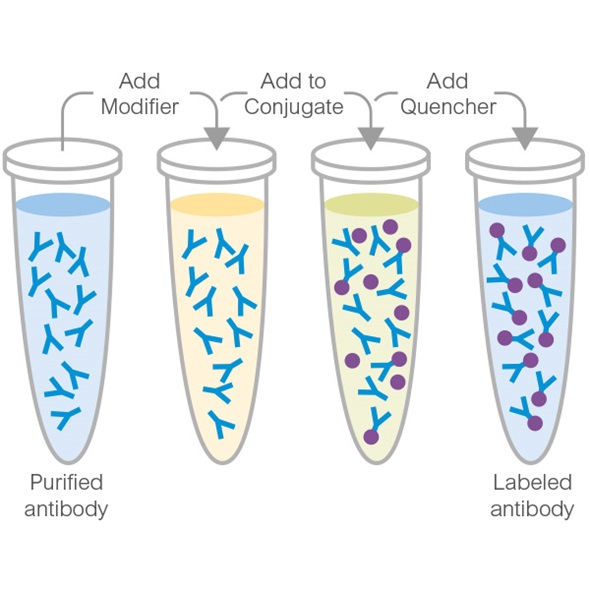
Use our conjugation kits for antibody conjugates that are ready-to-use in as little as 20 minutes with 1 minute hands-on-time and 100% antibody recovery: available for fluorescent dyes, HRP, biotin and gold.
Compatibility
This product is compatible with the Maxpar® Antibody Labeling Kit from Fluidigm, without the need for antibody preparation. Maxpar® is a trademark of Fluidigm Canada Inc.
Properties and storage information
Form
Purification technique
Storage buffer
Shipped at conditions
Appropriate short-term storage conditions
Appropriate long-term storage conditions
Storage information
Product protocols
- Visit the General protocols
- Visit the Troubleshooting
Target data
Alternative Names
Product promise
Please note: All products are 'FOR RESEARCH USE ONLY. NOT FOR USE IN DIAGNOSTIC OR THERAPEUTIC PROCEDURES'.
For licensing inquiries, please contact partnerships@abcam.com