JavaScript is disabled in your browser. Please enable JavaScript to view this website.
AB182564

Anti-POLD3 antibody [EP9480]

Be the first to review this product! Submit a review

|

(8 Publications )

Rabbit Recombinant Monoclonal POLD3 antibody. Suitable for WB, ICC/IF and reacts with Human samples. Cited in 8 publications.

View Alternative Names

KIAA0039, POLD3, DNA polymerase delta subunit 3, DNA polymerase delta subunit C, DNA polymerase delta subunit p66, DNA polymerase delta subunit p68

3 Images
Immunocytochemistry/ Immunofluorescence - Anti-POLD3 antibody [EP9480] (AB182564)
  • ICC/IF

Supplier Data

Immunocytochemistry/ Immunofluorescence - Anti-POLD3 antibody [EP9480] (AB182564)

Immunofluorescent analysis of 4% paraformaldehyde-fixed 293T cells labeling POLD3 with ab182564 at 1/100 dilution, followed by Goat anti rabbit IgG (Alexa Fluor®555) secondary antibody at 1/200 dilution (left panel). Right panel counter stained with Dapi (blue).
Western blot - Anti-POLD3 antibody [EP9480] (AB182564)
  • WB

Supplier Data

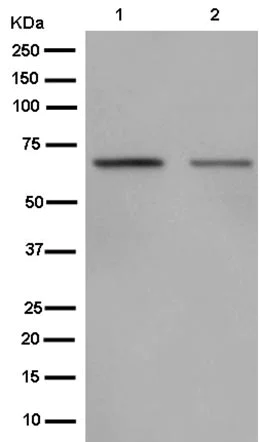
Western blot - Anti-POLD3 antibody [EP9480] (AB182564)

All lanes:

Western blot - Anti-POLD3 antibody [EP9480] (ab182564) at 1/5000 dilution

Lane 1:

Hela lysate at 20 µg

Lane 2:

293T lysate at 20 µg

Secondary

All lanes:

Goat Anti-Rabbit IgG, (H+L), Peroxidase conjugate at 1/1000 dilution

Predicted band size: 51 kDa

Observed band size: 63 kDa

false
Western blot - Anti-POLD3 antibody [EP9480] (AB182564)
  • WB

Supplier Data

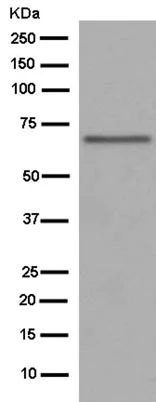
Western blot - Anti-POLD3 antibody [EP9480] (AB182564)

All lanes:

Western blot - Anti-POLD3 antibody [EP9480] (ab182564) at 1/5000 dilution

All lanes:

Jurkat lysate at 10 µg

Secondary

All lanes:

Goat Anti-Rabbit IgG, (H+L), Peroxidase conjugate at 1/1000 dilution

Predicted band size: 51 kDa

Observed band size: 63 kDa

false

  • Carrier free

    Anti-POLD3 antibody [EP9480] - BSA and Azide free

Key facts

Host species

Rabbit

Clonality

Monoclonal

Clone number

EP9480

Isotype

IgG

Carrier free

No

Reacts with

Human

Applications

WB, ICC/IF

applications

Immunogen

The exact immunogen used to generate this antibody is proprietary information.

Reactivity data

{ "title": "Reactivity Data", "filters": { "stats": ["", "Species", "Dilution Info", "Notes"], "tabs": { "all-applications": {"fullname" : "All Applications", "shortname": "All Applications"}, "WB" : {"fullname" : "Western blot", "shortname":"WB"}, "ICCIF" : {"fullname" : "Immunocytochemistry/ Immunofluorescence", "shortname":"ICC/IF"} }, "product-promise": { "all": "all", "testedAndGuaranteed": "tested", "guaranteed": "expected", "predicted": "predicted", "notRecommended": "not-recommended" } }, "values": { "Human": { "WB-species-checked": "testedAndGuaranteed", "WB-species-dilution-info": "1/1000 - 1/10000", "WB-species-notes": "<p></p>", "ICCIF-species-checked": "testedAndGuaranteed", "ICCIF-species-dilution-info": "1/100", "ICCIF-species-notes": "<p></p>" } } }

Product details

Patented technology
Our RabMAb® technology is a patented hybridoma-based technology for making rabbit monoclonal antibodies. For details on our patents, please refer to RabMAb® patents.

Properties and storage information

Form
Liquid
Purification technique
Affinity purification Protein A
Storage buffer
pH: 7.2 Preservative: 0.01% Sodium azide Constituents: PBS, 40% Glycerol (glycerin, glycerine), 0.05% BSA
Shipped at conditions
Conditional Ambient
Appropriate short-term storage duration
1-2 weeks
Appropriate short-term storage conditions
+4°C
Appropriate long-term storage conditions
-20°C
Aliquoting information
Upon delivery aliquot
Storage information
Avoid freeze / thaw cycle

Supplementary information

This supplementary information is collated from multiple sources and compiled automatically.

POLD3 also known as DNA polymerase delta subunit 3 has an important role in DNA replication and repair. It acts as a regulatory subunit of the DNA polymerase delta complex which is responsible for high-fidelity DNA synthesis. The protein weighs approximately 57 kDa and shows expression in various tissues indicating its widespread role in the body.
Biological function summary

The DNA polymerase delta complex includes POLD3 which helps in DNA replication and repair processes. POLD3 supports the polymerase activity improving the fidelity and stability of the DNA polymerase delta holoenzyme during DNA synthesis. POLD3’s presence in the polymerase delta complex allows it to be integral in ensuring accurate DNA duplication making it an important participant in genomic maintenance.

Pathways

The DNA replication pathway prominently involves the action of POLD3. The protein participates in the DNA damage response pathway too contributing to the repair process. POLD3 interacts with other associated proteins in these pathways like the PCNA (proliferating cell nuclear antigen) enhancing the performance of DNA polymerase delta to achieve precise DNA synthesis and repair.

Abnormal POLD3 function links to malignancies such as colorectal cancer. The mutations or changes in expression levels can affect the DNA replication fidelity promoting genomic instability. Additionally POLD3 connects with RAD9 another protein involved in the DNA damage checkpoint with alterations in these proteins being significant in the progression of specific cancers.

Product protocols

For this product, it's our understanding that no specific protocols are required. You can visit:

Target data

Accessory component of both the DNA polymerase delta complex and the DNA polymerase zeta complex (PubMed : 17317665, PubMed : 22801543, PubMed : 24449906). As a component of the trimeric and tetrameric DNA polymerase delta complexes (Pol-delta3 and Pol-delta4, respectively), plays a role in high fidelity genome replication, including in lagging strand synthesis, and repair. Required for optimal Pol-delta activity. Stabilizes the Pol-delta complex and plays a major role in Pol-delta stimulation by PCNA (PubMed : 10219083, PubMed : 10852724, PubMed : 11595739, PubMed : 16510448, PubMed : 24035200). Pol-delta3 and Pol-delta4 are characterized by the absence or the presence of POLD4. They exhibit differences in catalytic activity. Most notably, Pol-delta3 shows higher proofreading activity than Pol-delta4 (PubMed : 19074196, PubMed : 20334433). Although both Pol-delta3 and Pol-delta4 process Okazaki fragments in vitro, Pol-delta3 may also be better suited to fulfill this task, exhibiting near-absence of strand displacement activity compared to Pol-delta4 and stalling on encounter with the 5'-blocking oligonucleotides. Pol-delta3 idling process may avoid the formation of a gap, while maintaining a nick that can be readily ligated (PubMed : 24035200). Along with DNA polymerase kappa, DNA polymerase delta carries out approximately half of nucleotide excision repair (NER) synthesis following UV irradiation. In this context, POLD3, along with PCNA and RFC1-replication factor C complex, is required to recruit POLD1, the catalytic subunit of the polymerase delta complex, to DNA damage sites (PubMed : 20227374). Under conditions of DNA replication stress, required for the repair of broken replication forks through break-induced replication (BIR) (PubMed : 24310611). Involved in the translesion synthesis (TLS) of templates carrying O6-methylguanine or abasic sites performed by Pol-delta4, independently of DNA polymerase zeta (REV3L) or eta (POLH). Facilitates abasic site bypass by DNA polymerase delta by promoting extension from the nucleotide inserted opposite the lesion (PubMed : 19074196, PubMed : 25628356, PubMed : 27185888). Also involved in TLS, as a component of the tetrameric DNA polymerase zeta complex. Along with POLD2, dramatically increases the efficiency and processivity of DNA synthesis of the DNA polymerase zeta complex compared to the minimal zeta complex, consisting of only REV3L and REV7 (PubMed : 24449906).
See full target information POLD3

Publications (8)

Recent publications for all applications. Explore the full list and refine your search

Nature communications 14:1353 PubMed36906648

2023

Short-term molecular consequences of chromosome mis-segregation for genome stability.

Applications

Unspecified application

Species

Unspecified reactive species

Lorenza Garribba,Giuseppina De Feudis,Valentino Martis,Martina Galli,Marie Dumont,Yonatan Eliezer,René Wardenaar,Marica Rosaria Ippolito,Divya Ramalingam Iyer,Andréa E Tijhuis,Diana C J Spierings,Michael Schubert,Silvia Taglietti,Chiara Soriani,Simon Gemble,Renata Basto,Nick Rhind,Floris Foijer,Uri Ben-David,Daniele Fachinetti,Ylli Doksani,Stefano Santaguida

Cell reports 42:112062 PubMed36729836

2023

GEN1 promotes common fragile site expression.

Applications

Unspecified application

Species

Unspecified reactive species

Anaid Benitez,Marie Sebald,Radhakrishnan Kanagaraj,Monica C Rodrigo-Brenni,Ying Wai Chan,Chih-Chao Liang,Stephen C West

Nature communications 12:512 PubMed33479235

2021

Oncogenic herpesvirus KSHV triggers hallmarks of alternative lengthening of telomeres.

Applications

Unspecified application

Species

Unspecified reactive species

Timothy P Lippert,Paulina Marzec,Aurora I Idilli,Grzegorz Sarek,Aleksandra Vancevska,Mark Bower,Paul J Farrell,Päivi M Ojala,Niklas Feldhahn,Simon J Boulton

The EMBO journal 40:e104509 PubMed33470420

2021

PIF1 helicase promotes break-induced replication in mammalian cells.

Applications

Unspecified application

Species

Unspecified reactive species

Shibo Li,Hailong Wang,Sanaa Jehi,Jun Li,Shuo Liu,Zi Wang,Lan Truong,Takuya Chiba,Zefeng Wang,Xiaohua Wu

Genes & development 34:1619-1636 PubMed33122293

2020

Replication stress conferred by POT1 dysfunction promotes telomere relocalization to the nuclear pore.

Applications

Unspecified application

Species

Unspecified reactive species

Alexandra M Pinzaru,Mike Kareh,Noa Lamm,Eros Lazzerini-Denchi,Anthony J Cesare,Agnel Sfeir

Nucleic acids research 48:1285-1300 PubMed31777915

2019

An R-loop-initiated CSB-RAD52-POLD3 pathway suppresses ROS-induced telomeric DNA breaks.

Applications

Unspecified application

Species

Unspecified reactive species

Jun Tan,Meihan Duan,Tribhuwan Yadav,Laiyee Phoon,Xiangyu Wang,Jia-Min Zhang,Lee Zou,Li Lan

The EMBO journal 38:e101751 PubMed31571254

2019

Break-induced replication plays a prominent role in long-range repeat-mediated deletion.

Applications

Unspecified application

Species

Unspecified reactive species

Qing Hu,Hongyan Lu,Hongjun Wang,Shibo Li,Lan Truong,Jun Li,Shuo Liu,Rong Xiang,Xiaohua Wu

Oncotarget 8:36996-37008 PubMed28445142

2017

Potential biomarkers of DNA replication stress in cancer.

Applications

Unspecified application

Species

Unspecified reactive species

Liqun Ren,Long Chen,Wei Wu,Lorenza Garribba,Huanna Tian,Zihui Liu,Ivan Vogel,Chunhui Li,Ian D Hickson,Ying Liu
View all publications

Product promise

We are committed to supporting your work with high-quality reagents, and we're here for you every step of the way. In the unlikely event that one of our products does not perform as expected, you're protected by our Product Promise.
For full details, please see our Terms & Conditions

Please note: All products are 'FOR RESEARCH USE ONLY. NOT FOR USE IN DIAGNOSTIC OR THERAPEUTIC PROCEDURES'.

For licensing inquiries, please contact partnerships@abcam.com