JavaScript is disabled in your browser. Please enable JavaScript to view this website.
AB137071

Anti-POLD3 antibody [EPR9481]

Be the first to review this product! Submit a review

|

(1 Publication)

Rabbit Recombinant Monoclonal POLD3 antibody. Suitable for WB and reacts with Human samples. Cited in 1 publication.

View Alternative Names

KIAA0039, POLD3, DNA polymerase delta subunit 3, DNA polymerase delta subunit C, DNA polymerase delta subunit p66, DNA polymerase delta subunit p68
1 Images
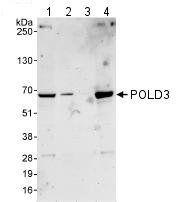
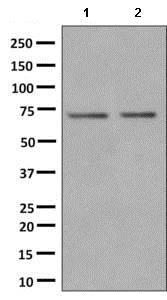
Western blot - Anti-POLD3 antibody [EPR9481] (AB137071)
  • WB

Unknown

Western blot - Anti-POLD3 antibody [EPR9481] (AB137071)

All lanes:

Western blot - Anti-POLD3 antibody [EPR9481] (ab137071) at 1/1000 dilution

Lane 1:

HeLa cell lysate at 10 µg

Lane 2:

293T cell lysate at 10 µg

Secondary

All lanes:

goat anti-rabbit HRP at 1/2000 dilution

Predicted band size: 51 kDa

true

  • Carrier free

    Anti-POLD3 antibody [EPR9481] - BSA and Azide free

Key facts

Host species

Rabbit

Clonality

Monoclonal

Clone number

EPR9481

Isotype

IgG

Carrier free

No

Reacts with

Human

Applications

WB

applications

Immunogen

The exact immunogen used to generate this antibody is proprietary information.

Reactivity data

{ "title": "Reactivity Data", "filters": { "stats": ["", "Species", "Dilution Info", "Notes"], "tabs": { "all-applications": {"fullname" : "All Applications", "shortname": "All Applications"}, "ICCIF" : {"fullname" : "Immunocytochemistry/ Immunofluorescence", "shortname":"ICC/IF"}, "IP" : {"fullname" : "Immunoprecipitation", "shortname":"IP"}, "FlowCyt" : {"fullname" : "Flow Cytometry", "shortname":"Flow Cyt"}, "WB" : {"fullname" : "Western blot", "shortname":"WB"}, "IHCP" : {"fullname" : "Immunohistochemistry (Formalin/PFA-fixed paraffin-embedded sections)", "shortname":"IHC-P"} }, "product-promise": { "all": "all", "testedAndGuaranteed": "tested", "guaranteed": "expected", "predicted": "predicted", "notRecommended": "not-recommended" } }, "values": { "Human": { "ICCIF-species-checked": "notRecommended", "ICCIF-species-dilution-info": "", "ICCIF-species-notes": "<p></p>", "IP-species-checked": "notRecommended", "IP-species-dilution-info": "", "IP-species-notes": "<p></p>", "FlowCyt-species-checked": "notRecommended", "FlowCyt-species-dilution-info": "", "FlowCyt-species-notes": "<p></p>", "WB-species-checked": "testedAndGuaranteed", "WB-species-dilution-info": "1/1000 - 1/10000", "WB-species-notes": "<p></p>", "IHCP-species-checked": "notRecommended", "IHCP-species-dilution-info": "", "IHCP-species-notes": "<p></p>" } } }

Product details

Species reactivity
Mouse, Rat: We have preliminary internal testing data to indicate this antibody may not react with these species.
Please contact us for more information.

Patented technology
Our RabMAb® technology is a patented hybridoma-based technology for making rabbit monoclonal antibodies. For details on our patents, please refer to RabMAb® patents.

What are the advantages of a recombinant monoclonal antibody?
This product is a recombinant monoclonal antibody, which offers several advantages including:

  • - High batch-to-batch consistency and reproducibility
  • - Improved sensitivity and specificity
  • - Long-term security of supply
  • - Animal-free batch production

For more information, read more on recombinant antibodies.

Properties and storage information

Form
Liquid
Purification technique
Affinity purification Protein A
Storage buffer
pH: 7.2 - 7.4 Preservative: 0.01% Sodium azide Constituents: PBS, 40% Glycerol (glycerin, glycerine), 0.05% BSA
Shipped at conditions
Conditional Ambient
Appropriate short-term storage duration
1-2 weeks
Appropriate short-term storage conditions
+4°C
Appropriate long-term storage conditions
-20°C
Aliquoting information
Upon delivery aliquot
Storage information
Avoid freeze / thaw cycle

Supplementary information

This supplementary information is collated from multiple sources and compiled automatically.

POLD3 also known as DNA polymerase delta subunit 3 has an important role in DNA replication and repair. It acts as a regulatory subunit of the DNA polymerase delta complex which is responsible for high-fidelity DNA synthesis. The protein weighs approximately 57 kDa and shows expression in various tissues indicating its widespread role in the body.
Biological function summary

The DNA polymerase delta complex includes POLD3 which helps in DNA replication and repair processes. POLD3 supports the polymerase activity improving the fidelity and stability of the DNA polymerase delta holoenzyme during DNA synthesis. POLD3’s presence in the polymerase delta complex allows it to be integral in ensuring accurate DNA duplication making it an important participant in genomic maintenance.

Pathways

The DNA replication pathway prominently involves the action of POLD3. The protein participates in the DNA damage response pathway too contributing to the repair process. POLD3 interacts with other associated proteins in these pathways like the PCNA (proliferating cell nuclear antigen) enhancing the performance of DNA polymerase delta to achieve precise DNA synthesis and repair.

Abnormal POLD3 function links to malignancies such as colorectal cancer. The mutations or changes in expression levels can affect the DNA replication fidelity promoting genomic instability. Additionally POLD3 connects with RAD9 another protein involved in the DNA damage checkpoint with alterations in these proteins being significant in the progression of specific cancers.

Product protocols

For this product, it's our understanding that no specific protocols are required. You can visit:

Target data

Accessory component of both the DNA polymerase delta complex and the DNA polymerase zeta complex (PubMed : 17317665, PubMed : 22801543, PubMed : 24449906). As a component of the trimeric and tetrameric DNA polymerase delta complexes (Pol-delta3 and Pol-delta4, respectively), plays a role in high fidelity genome replication, including in lagging strand synthesis, and repair. Required for optimal Pol-delta activity. Stabilizes the Pol-delta complex and plays a major role in Pol-delta stimulation by PCNA (PubMed : 10219083, PubMed : 10852724, PubMed : 11595739, PubMed : 16510448, PubMed : 24035200). Pol-delta3 and Pol-delta4 are characterized by the absence or the presence of POLD4. They exhibit differences in catalytic activity. Most notably, Pol-delta3 shows higher proofreading activity than Pol-delta4 (PubMed : 19074196, PubMed : 20334433). Although both Pol-delta3 and Pol-delta4 process Okazaki fragments in vitro, Pol-delta3 may also be better suited to fulfill this task, exhibiting near-absence of strand displacement activity compared to Pol-delta4 and stalling on encounter with the 5'-blocking oligonucleotides. Pol-delta3 idling process may avoid the formation of a gap, while maintaining a nick that can be readily ligated (PubMed : 24035200). Along with DNA polymerase kappa, DNA polymerase delta carries out approximately half of nucleotide excision repair (NER) synthesis following UV irradiation. In this context, POLD3, along with PCNA and RFC1-replication factor C complex, is required to recruit POLD1, the catalytic subunit of the polymerase delta complex, to DNA damage sites (PubMed : 20227374). Under conditions of DNA replication stress, required for the repair of broken replication forks through break-induced replication (BIR) (PubMed : 24310611). Involved in the translesion synthesis (TLS) of templates carrying O6-methylguanine or abasic sites performed by Pol-delta4, independently of DNA polymerase zeta (REV3L) or eta (POLH). Facilitates abasic site bypass by DNA polymerase delta by promoting extension from the nucleotide inserted opposite the lesion (PubMed : 19074196, PubMed : 25628356, PubMed : 27185888). Also involved in TLS, as a component of the tetrameric DNA polymerase zeta complex. Along with POLD2, dramatically increases the efficiency and processivity of DNA synthesis of the DNA polymerase zeta complex compared to the minimal zeta complex, consisting of only REV3L and REV7 (PubMed : 24449906).
See full target information POLD3

Publications (1)

Recent publications for all applications. Explore the full list and refine your search

International journal of molecular sciences 25: PubMed38542224

2024

Mitochondrial Ribosomal Protein MRPS15 Is a Component of Cytosolic Ribosomes and Regulates Translation in Stressed Cardiomyocytes.

Applications

Unspecified application

Species

Unspecified reactive species

Florian David,Emilie Roussel,Carine Froment,Tangra Draia-Nicolau,Françoise Pujol,Odile Burlet-Schiltz,Anthony K Henras,Eric Lacazette,Florent Morfoisse,Florence Tatin,Jean-Jacques Diaz,Frédéric Catez,Barbara Garmy-Susini,Anne-Catherine Prats
View all publications

Product promise

We are committed to supporting your work with high-quality reagents, and we're here for you every step of the way. In the unlikely event that one of our products does not perform as expected, you're protected by our Product Promise.
For full details, please see our Terms & Conditions

Please note: All products are 'FOR RESEARCH USE ONLY. NOT FOR USE IN DIAGNOSTIC OR THERAPEUTIC PROCEDURES'.

For licensing inquiries, please contact partnerships@abcam.com