JavaScript is disabled in your browser. Please enable JavaScript to view this website.
AB134947

Anti-PP1C gamma antibody [EPR8934]

Be the first to review this product! Submit a review

|

(4 Publications )

Rabbit Recombinant Monoclonal PP1C gamma antibody. Suitable for WB and reacts with Human, Mouse, Rat samples. Cited in 4 publications.
3 Images
Western blot - Anti-PP1C gamma antibody [EPR8934] (AB134947)
  • WB

Lab

Western blot - Anti-PP1C gamma antibody [EPR8934] (AB134947)

Lanes 1-4 : Merged signal (red and green). Green - ab134947 observed at 37 kDa. Red - loading control ab7291 observed at 50 kDa.

ab134947 Anti-Protein phosphatase 1 gamma 2 antibody was shown to specifically react with Protein phosphatase 1 gamma 2 in wild-type HeLa cells. Loss of signal was observed when knockout cell line ab264875 (knockout cell lysate ab258131) was used. Wild-type and Protein phosphatase 1 gamma 2 knockout samples were subjected to SDS-PAGE. ab134947 and Anti-alpha Tubulin antibody [DM1A] - Loading Control (ab7291) were incubated overnight at 4°C at 1 in 1000 dilution and 1 in 20000 dilution respectively. Blots were developed with Goat anti-Rabbit IgG H&L (IRDye® 800CW) preadsorbed (ab216773) and Goat anti-Mouse IgG H&L (IRDye® 680RD) preadsorbed (ab216776) secondary antibodies at 1 in 20000 dilution for 1 hour at room temperature before imaging.

All lanes:

Western blot - Anti-PP1C gamma antibody [EPR8934] (ab134947) at 1/1000 dilution

Lane 1:

Wild-type HeLa cell lysate at 20 µg

Lane 2:

Western blot - Human PPP1CC (PP1C gamma) knockout HeLa cell lysate (<a href='/en-us/products/cell-lysates/human-ppp1cc-pp1c-gamma-knockout-hela-cell-lysate-ab258131'>ab258131</a>) at 20 µg

Lane 3:

T-47D cell lysate at 20 µg

Lane 4:

293T cell lysate at 20 µg

Secondary

All lanes:

Western blot - Goat anti-Rabbit IgG H&L (IRDye® 800CW) preadsorbed (<a href='/en-us/products/secondary-antibodies/goat-rabbit-igg-h-l-irdye-800cw-preadsorbed-ab216773'>ab216773</a>) at 1/10000 dilution

Predicted band size: 27 kDa,37 kDa,42 kDa

Observed band size: 28 kDa,37 kDa,38 kDa

false
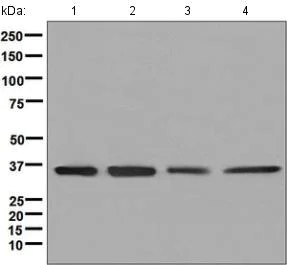
Western blot - Anti-PP1C gamma antibody [EPR8934] (AB134947)
  • WB

Unknown

Western blot - Anti-PP1C gamma antibody [EPR8934] (AB134947)

All lanes:

Western blot - Anti-PP1C gamma antibody [EPR8934] (ab134947) at 1/1000 dilution

Lane 1:

T47D cell lysate at 10 µg

Lane 2:

293T cell lysate at 10 µg

Lane 3:

SKBR3 cell lysate at 10 µg

Lane 4:

HeLa cell lysate at 10 µg

Secondary

All lanes:

Standard HRP labelled goat anti-rabbit at 1/2000 dilution

Predicted band size: 37 kDa

true
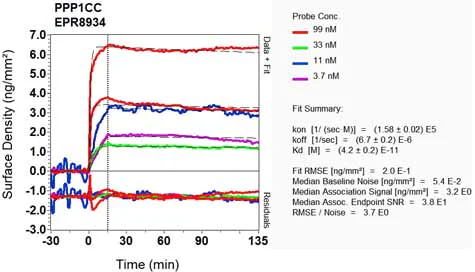
OI-RD Scanning - Anti-PP1C gamma antibody [EPR8934] (AB134947)
  • OI-RD Scanning

Unknown

OI-RD Scanning - Anti-PP1C gamma antibody [EPR8934] (AB134947)

We have systematically measured KD (the equilibrium dissociation constant between the antibody and its antigen), of more than 840 recombinant antibodies to assess not only their individual KD values but also to see the average affinity of antibody. Based on the comparison with published literature values for mouse monoclonal antibodies, Recombinant antibodies appear to be on average 1-2 order of magnitude higher affinity.

  • Carrier free

    Anti-PP1C gamma antibody [EPR8934] - BSA and Azide free

Key facts

Host species

Rabbit

Clonality

Monoclonal

Clone number

EPR8934

Isotype

IgG

Carrier free

No

Reacts with

Human

Applications

WB

applications

Immunogen

The exact immunogen used to generate this antibody is proprietary information.

Reactivity data

{ "title": "Reactivity Data", "filters": { "stats": ["", "Species", "Dilution Info", "Notes"], "tabs": { "all-applications": {"fullname" : "All Applications", "shortname": "All Applications"}, "FlowCyt" : {"fullname" : "Flow Cytometry", "shortname":"Flow Cyt"}, "WB" : {"fullname" : "Western blot", "shortname":"WB"}, "IHCP" : {"fullname" : "Immunohistochemistry (Formalin/PFA-fixed paraffin-embedded sections)", "shortname":"IHC-P"}, "ICCIF" : {"fullname" : "Immunocytochemistry/ Immunofluorescence", "shortname":"ICC/IF"} }, "product-promise": { "all": "all", "testedAndGuaranteed": "tested", "guaranteed": "expected", "predicted": "predicted", "notRecommended": "not-recommended" } }, "values": { "Human": { "FlowCyt-species-checked": "notRecommended", "FlowCyt-species-dilution-info": "", "FlowCyt-species-notes": "<p></p>", "WB-species-checked": "testedAndGuaranteed", "WB-species-dilution-info": "1/1000 - 1/10000", "WB-species-notes": "<p></p>", "IHCP-species-checked": "notRecommended", "IHCP-species-dilution-info": "", "IHCP-species-notes": "<p></p>", "ICCIF-species-checked": "notRecommended", "ICCIF-species-dilution-info": "", "ICCIF-species-notes": "<p></p>" }, "Mouse": { "FlowCyt-species-checked": "notRecommended", "FlowCyt-species-dilution-info": "", "FlowCyt-species-notes": "", "WB-species-checked": "guaranteed", "WB-species-dilution-info": "", "WB-species-notes": "<p></p>", "IHCP-species-checked": "notRecommended", "IHCP-species-dilution-info": "", "IHCP-species-notes": "", "ICCIF-species-checked": "notRecommended", "ICCIF-species-dilution-info": "", "ICCIF-species-notes": "" }, "Rat": { "FlowCyt-species-checked": "notRecommended", "FlowCyt-species-dilution-info": "", "FlowCyt-species-notes": "", "WB-species-checked": "guaranteed", "WB-species-dilution-info": "", "WB-species-notes": "<p></p>", "IHCP-species-checked": "notRecommended", "IHCP-species-dilution-info": "", "IHCP-species-notes": "", "ICCIF-species-checked": "notRecommended", "ICCIF-species-dilution-info": "", "ICCIF-species-notes": "" } } }

Product details

Patented technology
Our RabMAb® technology is a patented hybridoma-based technology for making rabbit monoclonal antibodies. For details on our patents, please refer to RabMAb® patents.

What are the advantages of a recombinant monoclonal antibody?
This product is a recombinant monoclonal antibody, which offers several advantages including:

  • - High batch-to-batch consistency and reproducibility
  • - Improved sensitivity and specificity
  • - Long-term security of supply
  • - Animal-free batch production

For more information, read more on recombinant antibodies.

Properties and storage information

Form
Liquid
Purity
Tissue culture supernatant
Purification technique
Affinity purification Protein A
Storage buffer
pH: 7.2 - 7.4 Preservative: 0.01% Sodium azide Constituents: PBS, 40% Glycerol (glycerin, glycerine), 0.05% BSA
Shipped at conditions
Conditional Ambient
Appropriate short-term storage conditions
+4°C
Appropriate long-term storage conditions
-20°C

Product protocols

For this product, it's our understanding that no specific protocols are required. You can visit:

Target data

Protein phosphatase that associates with over 200 regulatory proteins to form highly specific holoenzymes which dephosphorylate hundreds of biological targets (PubMed : 17936702, PubMed : 25012651). Protein phosphatase 1 (PP1) is essential for cell division, and participates in the regulation of glycogen metabolism, muscle contractility and protein synthesis. Dephosphorylates RPS6KB1 (PubMed : 17936702). Involved in regulation of ionic conductances and long-term synaptic plasticity. May play an important role in dephosphorylating substrates such as the postsynaptic density-associated Ca(2+)/calmodulin dependent protein kinase II. Component of the PTW/PP1 phosphatase complex, which plays a role in the control of chromatin structure and cell cycle progression during the transition from mitosis into interphase (PubMed : 20516061). In balance with CSNK1D and CSNK1E, determines the circadian period length, through the regulation of the speed and rhythmicity of PER1 and PER2 phosphorylation (PubMed : 21712997). May dephosphorylate CSNK1D and CSNK1E (By similarity). Regulates the recruitment of the SKA complex to kinetochores (PubMed : 28982702). Dephosphorylates the 'Ser-418' residue of FOXP3 in regulatory T-cells (Treg) from patients with rheumatoid arthritis, thereby inactivating FOXP3 and rendering Treg cells functionally defective (PubMed : 23396208). Together with PPP1CA (PP1-alpha subunit), dephosphorylates IFIH1/MDA5 and RIG-I leading to their activation and a functional innate immune response (PubMed : 23499489). Core component of the SHOC2-MRAS-PP1c (SMP) holophosphatase complex that regulates the MAPK pathway activation (PubMed : 35768504, PubMed : 35831509). The SMP complex specifically dephosphorylates the inhibitory phosphorylation at 'Ser-259' of RAF1 kinase, 'Ser-365' of BRAF kinase and 'Ser-214' of ARAF kinase, stimulating their kinase activities (PubMed : 35768504, PubMed : 35831509). Dephosphorylates MKI67 at the onset of anaphase (PubMed : 25012651). The SMP complex enhances the dephosphorylation activity and substrate specificity of PP1c (PubMed : 35768504, PubMed : 35831509).
See full target information Serine/threonine-protein phosphatase PP1-gamma catalytic subunit

Alternative Names

Serine/threonine-protein phosphatase PP1-gamma catalytic subunit, PP-1G, Protein phosphatase 1C catalytic subunit, PPP1CC

Publications (4)

Recent publications for all applications. Explore the full listand refine your search

Nucleic acids research 51:3150-3165 PubMed36869674

2023

Heavy metal ions exchange driven protein phosphorylation cascade functions in genomic instability in spermatocytes and male infertility.

Applications

Unspecified application

Species

Unspecified reactive species

Ren-Yan Li,Dan Yang,Yan-Ji He,Yong Zhou,Cheng-Cheng Li,Lian-Bing Li,Ming-Xing Liao,Zhong-Liang Deng,Le-Tian Zhao,Tian-Feng Zhang,Yong Luo,Ying-Xiong Wang,Yan-Fei Gao

Genes 13: PubMed36140764

2022

Short-Term Hypoxia in Cells Induces Expression of Genes Which Are Enhanced in Stressed Cells.

Applications

Unspecified application

Species

Unspecified reactive species

Inga Peciuliene,Egle Jakubauskiene,Laurynas Vilys,Ruta Zinkeviciute,Kotryna Kvedaraviciute,Arvydas Kanopka

Nature communications 8:15870 PubMed28627514

2017

Simultaneous overactivation of Wnt/β-catenin and TGFβ signalling by miR-128-3p confers chemoresistance-associated metastasis in NSCLC.

Applications

Unspecified application

Species

Unspecified reactive species

Junchao Cai,Lishan Fang,Yongbo Huang,Rong Li,Xiaonan Xu,Zhihuang Hu,Le Zhang,Yi Yang,Xun Zhu,Heng Zhang,Jueheng Wu,Yan Huang,Jun Li,Musheng Zeng,Erwei Song,Yukai He,Li Zhang,Mengfeng Li

Molecular and cellular biology 36:2715-2727 PubMed27528620

2016

Hepatic Overexpression of CD36 Improves Glycogen Homeostasis and Attenuates High-Fat Diet-Induced Hepatic Steatosis and Insulin Resistance.

Applications

Unspecified application

Species

Unspecified reactive species

Wojciech G Garbacz,Peipei Lu,Tricia M Miller,Samuel M Poloyac,Nicholas S Eyre,Graham Mayrhofer,Meishu Xu,Songrong Ren,Wen Xie
View all publications

Product promise

We are committed to supporting your work with high-quality reagents, and we're here for you every step of the way. In the unlikely event that one of our products does not perform as expected, you're protected by our Product Promise.
For full details, please see our Terms & Conditions

Please note: All products are 'FOR RESEARCH USE ONLY. NOT FOR USE IN DIAGNOSTIC OR THERAPEUTIC PROCEDURES'.

For licensing inquiries, please contact partnerships@abcam.com