Anti-Prion protein PrP antibody [F89/160.1.5]
Be the first to review this product! Submit a review
|
(2 Publications )
- Flow Cyt
Unknown
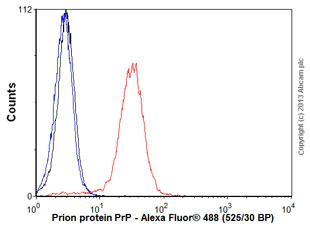
Flow Cytometry - Anti-Prion protein PrP antibody [F89/160.1.5] (AB2777)
Overlay histogram showing SH-SH5Y cells stained with ab2777 (red line). The cells were fixed with 80% methanol (5 min) and then permeabilized with 0.1% PBS-Tween for 20 min. The cells were then incubated in 1x PBS / 10% normal goat serum / 0.3M glycine to block non-specific protein-protein interactions followed by the antibody (ab2777, 0.1μg/1x106 cells) for 30 min at 22°C. The secondary antibody used was Alexa Fluor® 488 goat anti-mouse IgG (H&L) (ab150113) at 1/2000 dilution for 30 min at 22°C. Isotype control antibody (black line) was mouse IgG1 [ICIGG1] (ab91353, 1μg/1x106 cells) used under the same conditions. Unlabelled sample (blue line) was also used as a control. Acquisition of >5,000 events were collected using a 20mW Argon ion laser (488nm) and 525/30 bandpass filter. This antibody gave a positive signal in SH-SY5Y cells fixed with 4% paraformaldehyde (10 min)/permeabilized with 0.1% PBS-Tween for 20 min used under the same conditions.
Alternative Products
Primary Antibodies
AB52604
Anti-Prion protein PrP antibody [EP1802Y]
20ul selling size|BOND RX™ Validated|RabMAb|Recombinant
- 4
- 2
Primary Antibodies
AB238428
Anti-Prion protein PrP antibody [EP1802Y] - BSA and Azide free
BOND RX™ Validated|RabMAb|Recombinant
- 0
- 0

Complementary Products
Primary Antibodies
AB6276
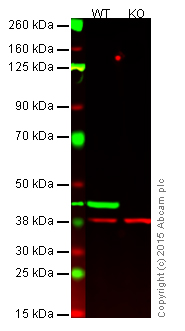
Anti-beta Actin antibody [AC-15] - Loading Control
KO Validated|Lab Essentials
- 5
- 94
Primary Antibodies
AB181602
Anti-GAPDH antibody [EPR16891] - Loading Control
RabMAb|Recombinant|Lab Essentials|20ul selling size

- 5
- 23
Primary Antibodies
AB178846
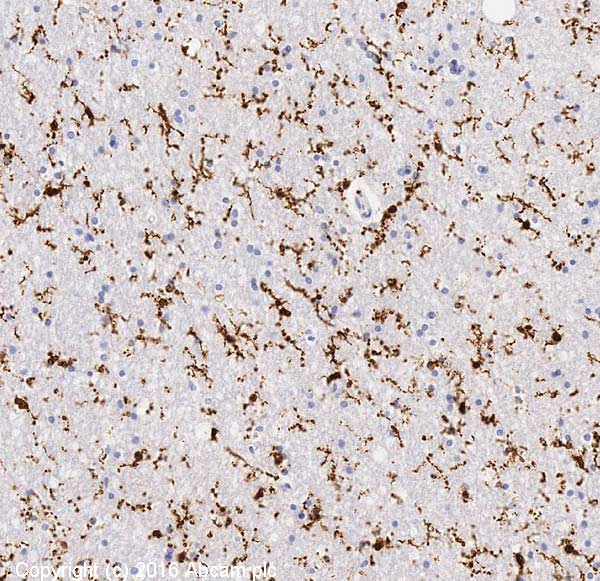
Anti-Iba1 antibody [EPR16588] - Microglia marker
20ul selling size|BOND RX™ Validated|RabMAb|Recombinant|Lab Essentials
- 5
- 50
Reactivity data
Properties and storage information
Form
Purification technique
Storage buffer
Shipped at conditions
Appropriate short-term storage duration
Appropriate short-term storage conditions
Appropriate long-term storage conditions
Aliquoting information
Storage information
Supplementary information
This supplementary information is collated from multiple sources and compiled automatically.
Biological function summary
Prion protein assists in maintaining normal cell activities. Researchers do not fully understand its exact biological role but it might be involved in copper ion uptake and protection against oxidative stress. PrP can form complexes with other cellular proteins some of which help in routing signals inside the cell. Additionally prion protein may have synaptic functions related to neurodevelopment and neuroprotection.
Pathways
Prion protein links to both neuroprotective and neurodegenerative pathways. It participates in signaling pathways that protect neurons from apoptosis. This protein associates closely with copper-dependent pathways possibly related to its capacity to bind copper ions which affects oxidative stress responses. Prion protein also interacts with proteins like synapsin to modulate synaptic transmission.
Product protocols
- Visit the General protocols
- Visit the Troubleshooting
Target data
Alternative Names
Publications (2)
Recent publications for all applications. Explore the full listand refine your search
Experimental biology and medicine (Maywood, N.J.) 236:466-76 PubMed21444369
2011
Applications
WB
Species
Unspecified reactive species
Journal of clinical microbiology 36:1750-5 PubMed9620413
1998
Applications
Unspecified application
Species
Unspecified reactive species
Product promise
Please note: All products are 'FOR RESEARCH USE ONLY. NOT FOR USE IN DIAGNOSTIC OR THERAPEUTIC PROCEDURES'.
For licensing inquiries, please contact partnerships@abcam.com