JavaScript is disabled in your browser. Please enable JavaScript to view this website.
AB138412

Anti-pro Caspase-9 (phospho T125) antibody

Be the first to review this product! Submit a review

|

(33 Publications )
Rabbit Polyclonal Caspase-9 phospho T125 antibody. Suitable for WB and reacts with Human samples. Cited in 33 publications.
1 Images
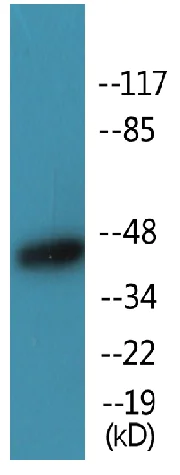
Western blot - Anti-pro Caspase-9 (phospho T125) antibody (AB138412)
  • WB

Unknown

Western blot - Anti-pro Caspase-9 (phospho T125) antibody (AB138412)

All lanes:

Western blot - Anti-pro Caspase-9 (phospho T125) antibody (ab138412) at 1/500 dilution

All lanes:

HeLa cells treated with TNF at 20 ng/ml for 5 minutes and calyculin A at 50 ng/ml for 5 minutes at 30 µg

Predicted band size: 46 kDa

false

Key facts

Host species

Rabbit

Clonality

Polyclonal

Isotype

IgG

Carrier free

No

Reacts with

Human

Applications

WB

applications

Immunogen

The exact immunogen used to generate this antibody is proprietary information.

Specificity

ab138412 detects endogenous levels of pro Caspase 9 only when phosphorylated at T125.

Reactivity data

{ "title": "Reactivity Data", "filters": { "stats": ["", "Species", "Dilution Info", "Notes"], "tabs": { "all-applications": {"fullname" : "All Applications", "shortname": "All Applications"}, "WB" : {"fullname" : "Western blot", "shortname":"WB"} }, "product-promise": { "all": "all", "testedAndGuaranteed": "tested", "guaranteed": "expected", "predicted": "predicted", "notRecommended": "not-recommended" } }, "values": { "Human": { "WB-species-checked": "testedAndGuaranteed", "WB-species-dilution-info": "1/500 - 1/1000", "WB-species-notes": "<p></p>" }, "Mouse": { "WB-species-checked": "predicted", "WB-species-dilution-info": "", "WB-species-notes": "" }, "Rat": { "WB-species-checked": "predicted", "WB-species-dilution-info": "", "WB-species-notes": "" } } }

Properties and storage information

Form
Liquid
Purification technique
Affinity purification Immunogen
Purification notes
ab138412 was purified from rabbit antiserum by affinity-chromatography using epitope-specific phosphopeptide. The antibody against non-phosphopeptide was removed by chromatography using non-phosphopeptide corresponding to the phosphorylation.
Storage buffer
pH: 7.4 Preservative: 0.02% Sodium azide Constituents: PBS, 50% Glycerol (glycerin, glycerine), 0.88% Sodium chloride
Shipped at conditions
Blue Ice
Appropriate short-term storage conditions
+4°C
Appropriate long-term storage conditions
-20°C

Supplementary information

This supplementary information is collated from multiple sources and compiled automatically.

Pro Caspase-9 also known as CASP9 is an inactive precursor of the enzyme caspase-9. This protein plays a significant role in the apoptosis pathway where it gets activated to execute cell death processes. Caspase-9 has a molecular weight of approximately 46 kDa and is prominently expressed in various tissues including the brain lung heart and kidney. It exists mainly in the cytosol waiting for activation signals to perform its function.
Biological function summary

The activation of pro Caspase-9 marks an important step in apoptosis. It becomes part of the apoptosome complex which includes other components like cytochrome c and Apaf-1 (apoptotic protease activating factor 1). Upon formation this complex activates pro Caspase-9 triggering a cascade of downstream caspases including caspase-3 and caspase-7. This cascade leads to the execution phase of apoptosis where cellular components are systematically degraded.

Pathways

Pro Caspase-9 is a central figure in the intrinsic (mitochondrial) apoptotic pathway. This pathway involves upstream regulators such as the Bcl-2 family of proteins which affect mitochondria's permeability and cytochrome c release. Once released cytochrome c supports pro Caspase-9 activation through the apoptosome complex. Pro Caspase-9 is linked closely with other caspases through these apoptotic pathways making it an essential component of controlled cell death.

The malfunction of pro Caspase-9 and its pathway components can lead to various medical conditions including cancer and neurodegenerative diseases like Alzheimer's. In cancer reduced activity or mutations in pro Caspase-9 can result in impaired apoptosis allowing cancer cells to survive beyond normal limits. On the other hand excessive activation may contribute to neurodegenerative diseases where undesired cell death occurs. Proteins such as Bcl-2 which inhibit apoptosis and caspase-3 related to apoptosis execution can influence the disorders connected to dysregulated pro Caspase-9 activity.

Product protocols

For this product, it's our understanding that no specific protocols are required. You can visit:

Target data

Involved in the activation cascade of caspases responsible for apoptosis execution. Binding of caspase-9 to Apaf-1 leads to activation of the protease which then cleaves and activates effector caspases caspase-3 (CASP3) or caspase-7 (CASP7). Promotes DNA damage-induced apoptosis in a ABL1/c-Abl-dependent manner. Proteolytically cleaves poly(ADP-ribose) polymerase (PARP). Cleaves BIRC6 following inhibition of BIRC6-caspase binding by DIABLO/SMAC (PubMed : 36758105, PubMed : 36758106).. Isoform 2. Lacks activity is an dominant-negative inhibitor of caspase-9.
See full target information CASP9 pT125

Alternative Names

MCH6, CASP9, Caspase-9, CASP-9, Apoptotic protease Mch-6, Apoptotic protease-activating factor 3, ICE-like apoptotic protease 6, APAF-3, ICE-LAP6

Publications (33)

Recent publications for all applications. Explore the full listand refine your search

Chemical biology & drug design 103:e14429 PubMed38230769

2024

Stachydrine represses the proliferation and enhances cell cycle arrest and apoptosis of breast cancer cells via PLA2G2A/DCN axis.

Applications

Unspecified application

Species

Unspecified reactive species

Zhen Zhai,Tianlong Mu,Lina Zhao,Dongsheng Zhu,Xin Zhong,Yiliang Li,Chen Liang,Wei Li,Qingyuan Zhou

Environmental toxicology 38:1891-1904 PubMed37195900

2023

Neuroglobin protects against cerebral ischemia/reperfusion injury in rats by suppressing mitochondrial dysfunction and endoplasmic reticulum stress-mediated neuronal apoptosis through synaptotagmin-1.

Applications

Unspecified application

Species

Unspecified reactive species

Lihong Zhang,Di Li,Lin Yin,Ce Zhang,Hong Qu,Jianping Xu

Acta biochimica et biophysica Sinica 54:301-310 PubMed35538029

2022

Mitochondrial fission factor promotes cisplatin resistancein hepatocellular carcinoma.

Applications

Unspecified application

Species

Unspecified reactive species

Xiaoliang Li,Quanlin Wu,Fujun Ma,Xinxin Zhang,Lei Cai,Xuekang Yang

Chinese medical journal 135:606-618 PubMed35191417

2022

Paired box 5 increases the chemosensitivity of esophageal squamous cell cancer cells by promoting p53 signaling activity.

Applications

Unspecified application

Species

Unspecified reactive species

Weiwei Zhang,Wenji Yan,Niansong Qian,Quanli Han,Weitao Zhang,Guanghai Dai

Oncology letters 22:796 PubMed34584571

2021

lncRNA CYTOR promotes cell proliferation and tumor growth via miR-125b/SEMA4C axis in hepatocellular carcinoma.

Applications

Unspecified application

Species

Unspecified reactive species

Qing Tian,Xiaodong Yan,Long Yang,Zirong Liu,Zheyue Yuan,Yamin Zhang

Oncology reports 46: PubMed34396428

2021

Ultrasound‑targeted microbubble destruction‑mediated overexpression of Sirtuin 3 inhibits the progression of ovarian cancer.

Applications

Unspecified application

Species

Unspecified reactive species

Li Cheng,Dongmei Zhang,Wei Yan

Cell transplantation 30:9636897211034452 PubMed34292054

2021

Taxifolin Protects Dental Pulp Stem Cells under Hypoxia and Inflammation Conditions.

Applications

Unspecified application

Species

Unspecified reactive species

Xiaohui Fu,Yimiao Feng,Bingyi Shao,Yanzhen Zhang

American journal of translational research 13:5892-5910 PubMed34306333

2021

RP11-874J12.4, a novel lncRNA, confers chemoresistance in human gastric cancer cells by sponging miR-3972 and upregulating SSR2 expression.

Applications

Unspecified application

Species

Unspecified reactive species

Yi Liu,Jian Cao,Yan-Song Pu,Yu Ma,Min Wu,Jian-Hua Wang

Experimental and therapeutic medicine 21:638 PubMed33968169

2021

Gallic acid suppresses colon cancer proliferation by inhibiting SRC and EGFR phosphorylation.

Applications

Unspecified application

Species

Unspecified reactive species

Xiaoming Lin,Guangfei Wang,Ping Liu,Lei Han,Tong Wang,Kaili Chen,Yonglin Gao

Frontiers in oncology 11:622073 PubMed33842327

2021

Demethylated miR-216a Regulates High Mobility Group Box 3 Promoting Growth of Esophageal Cancer Cells Through Wnt/β-Catenin Pathway.

Applications

Unspecified application

Species

Unspecified reactive species

Cheng-Xi Sun,Feng Zhu,Lei Qi
View all publications

Product promise

We are committed to supporting your work with high-quality reagents, and we're here for you every step of the way. In the unlikely event that one of our products does not perform as expected, you're protected by our Product Promise.
For full details, please see our Terms & Conditions

Please note: All products are 'FOR RESEARCH USE ONLY. NOT FOR USE IN DIAGNOSTIC OR THERAPEUTIC PROCEDURES'.

For licensing inquiries, please contact partnerships@abcam.com