Anti-Prostate Specific Antigen antibody [8301]
5
(1 Review)
|
(9 Publications )
- Trusted since 1999
- IHC-P
Unknown
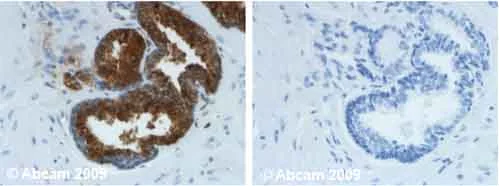
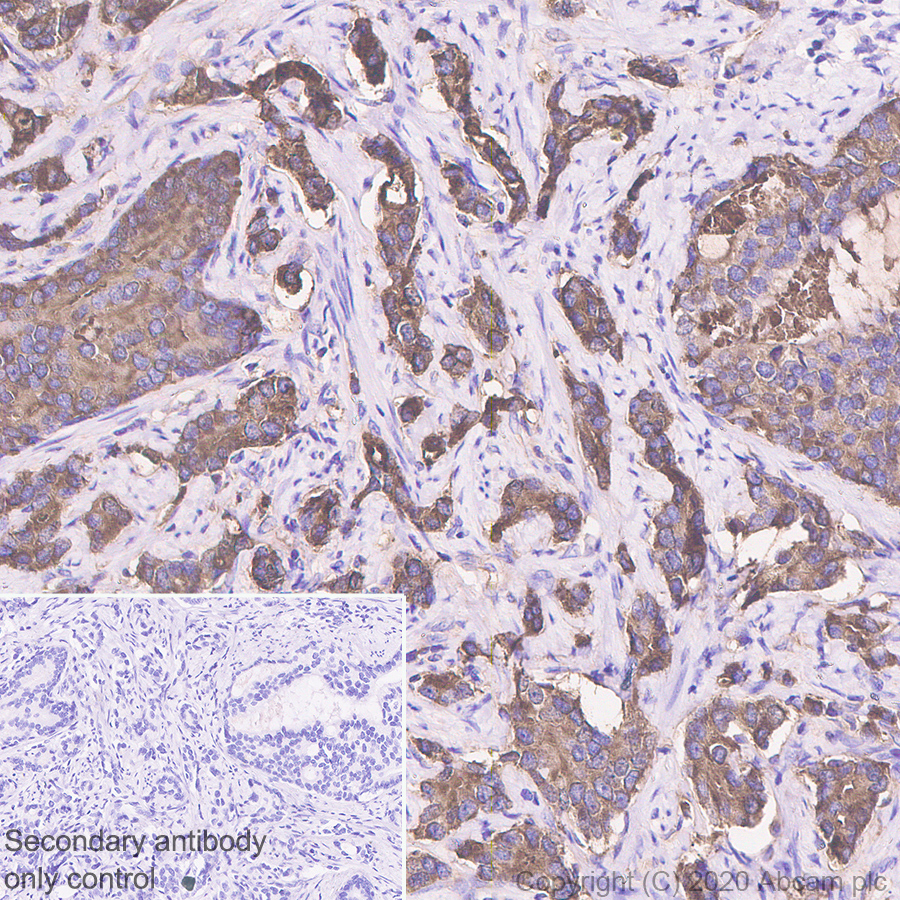
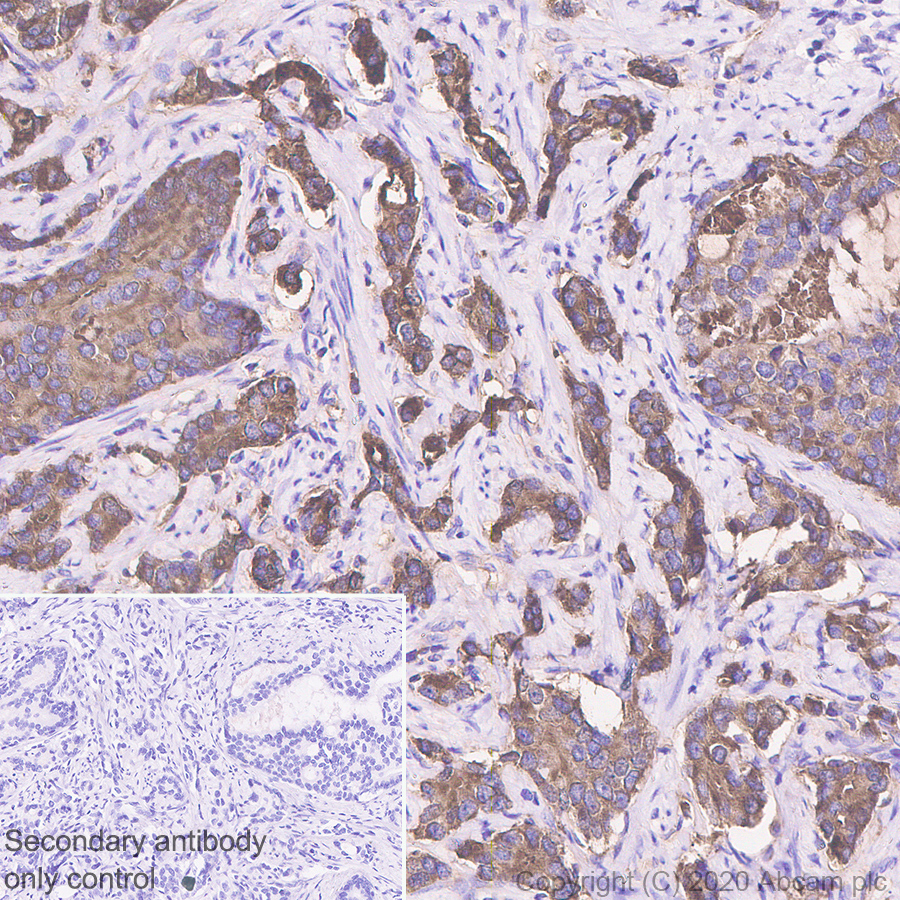
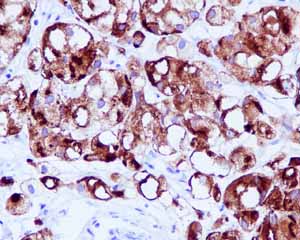
Immunohistochemistry (Formalin/PFA-fixed paraffin-embedded sections) - Anti-Prostate Specific Antigen antibody [8301] (AB403)
Human normal prostate. Staining is localised as cytoplasmic and secreted. Left panel : with primary antibody at 1 ug/ml. Right panel : isotype control. Sections were stained using an automated system, at room temperature : sections were rehydrated and antigen retrieved with buffers (citrate pH 6.1) in a PT Link. Slides were peroxidase blocked in 3% H2O2 in methanol for 10 mins. They were then blocked with protein block for 10 minutes (containing casein 0.25% in PBS) then incubated with primary antibody for 20 min and detected for 30 minutes. Colorimetric detection was completed with Diaminobenzidine for 5 minutes. Slides were counterstained with Haematoxylin and coverslipped under DePeX. Please note that for manual staining we recommend to optimize the primary antibody concentration and incubation time (overnight incubation), and amplification may be required.
Alternative Products
Primary Antibodies
AB271858
Anti-Prostate Specific Antigen antibody [EP1588Y] - BSA and Azide free
BOND RX™ Validated|RabMAb|Advanced Validation|Recombinant
- 0
- 0
Primary Antibodies
AB76113
Anti-Prostate Specific Antigen antibody [EP1588Y]
BOND RX™ Validated|20ul selling size|RabMAb|Advanced Validation|Recombinant
- 0
- 0
Primary Antibodies
AB215983
Anti-Prostate Specific Antigen antibody [EP1588Y] - Low endotoxin, Azide free
BOND RX™ Validated|Recombinant|Advanced Validation|RabMAb
- 0
- 0
Primary Antibodies
AB240982
Anti-Prostate Specific Antigen antibody [SP317] - BSA and Azide free
BOND RX™ Validated|RabMAb|Recombinant

- 0
- 0
Complementary Products


Reactivity data
Product details
Anti-Prostate Specific Antigen antibody [8301] (ab403) is a mouse monoclonal antibody and is validated for use in Immunohistochemistry (IHC-P) in Human samples.
Properties and storage information
Form
Purification technique
Storage buffer
Shipped at conditions
Appropriate short-term storage duration
Appropriate short-term storage conditions
Appropriate long-term storage conditions
Storage information
Supplementary information
This supplementary information is collated from multiple sources and compiled automatically.
Biological function summary
PSA functions by cleaving the gel-forming proteins present in seminal coagulum. It does not operate as part of a larger protein complex. PSA also interacts with substrates like fibronectin and semenogelin which play roles in seminal coagulation and liquefaction. The expression of PSA in prostate tissue has made it a valuable biomarker for prostate function and pathological conditions.
Pathways
PSA is involved in the kallikrein-kinin system which influences inflammation and blood pressure regulation. PSA is not directly a part of key metabolic or signaling pathways but it is co-expressed with key proteins like androgen receptor (AR) which modulates PSA's expression. The interplay between androgens and PSA highlights its role in hormone regulation within the male reproductive system.
Product protocols
- Visit the General protocols
- Visit the Troubleshooting
Target data
Alternative Names
Publications (9)
Recent publications for all applications. Explore the full listand refine your search
Nanoscale 17:11401-11412 PubMed40231544
2025
Applications
Unspecified application
Species
Unspecified reactive species
Communications engineering 2: PubMed38586601
2023
Applications
Unspecified application
Species
Unspecified reactive species
Nature protocols 17:1028-1072 PubMed35181766
2022
Applications
Unspecified application
Species
Unspecified reactive species
The Prostate 80:1145-1156 PubMed32659025
2020
Applications
Unspecified application
Species
Unspecified reactive species
Analytical methods : advancing methods and applications 12:272-280 PubMed32577135
2020
Applications
Unspecified application
Species
Unspecified reactive species
The Journal of biological chemistry 285:33045-53 PubMed20713353
2010
Applications
WB
Species
Human
Analytical chemistry 81:9183-7 PubMed19874062
2009
Applications
Unspecified application
Species
Unspecified reactive species
Proceedings of the National Academy of Sciences of 106:18437-42 PubMed19841273
2009
Applications
Unspecified application
Species
Human
Nature biotechnology 23:1294-301 PubMed16170313
2005
Applications
Unspecified application
Species
Unspecified reactive species
Product promise
Please note: All products are 'FOR RESEARCH USE ONLY. NOT FOR USE IN DIAGNOSTIC OR THERAPEUTIC PROCEDURES'.
For licensing inquiries, please contact partnerships@abcam.com