Anti-Proteasome 20S LMP2 antibody [EPR13785]
- RabMAb
- Recombinant
- KO Validated
- What is this?
Be the first to review this product! Submit a review
|
(10 Publications )
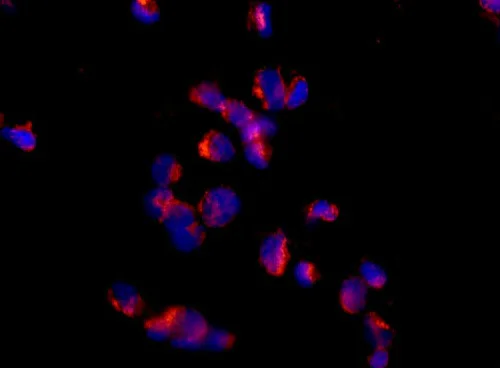
- ICC/IF
Supplier Data
Immunocytochemistry/ Immunofluorescence - Anti-Proteasome 20S LMP2 antibody [EPR13785] (AB184172)
Immunofluorescent analysis of 4% paraformaldehyde fixed HL-60 (Human promyelocytic leukemia cell line) cells labeling Proteasome 20S LMP2 using ab184172 at 1/100 dilution (red). A Goat anti rabbit IgG (Alexa Fluor®555) at 1/200 dilution was used as secondary antibody. Counterstain : DAPI (blue).
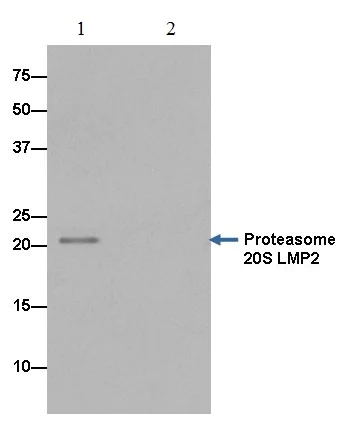
- IP
Supplier Data
Immunoprecipitation - Anti-Proteasome 20S LMP2 antibody [EPR13785] (AB184172)
Immunoprecipitation analysis of Raji cells labeling Proteasome 20S LMP2 using ab184172 at 1/50 dilution (Lane 1). A Anti-Rabbit IgG (HRP), specific to the non-reduced form of IgG at 1/1500 was used as secondary antibody. Lane 2 : PBS instead of Raji lysates. Blocking/dilution buffer and concentration : 5% NFDM/TBST.
All lanes:
Immunoprecipitation - Anti-Proteasome 20S LMP2 antibody [EPR13785] (ab184172)
Predicted band size: 23 kDa
false
- WB
Lab
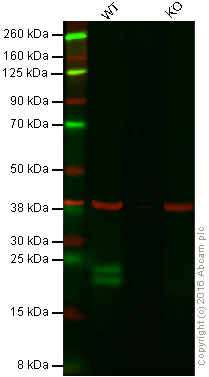
Western blot - Anti-Proteasome 20S LMP2 antibody [EPR13785] (AB184172)
Lane 1 : Wild-type HAP1 cell lysate (20 μg)
Lane 2 : Proteasome 20S LMP2 knockout HAP1 cell lysate (20 μg)
Lanes 1 - 2 : Merged signal (red and green). Green - ab184172 observed at 22 and 24 kDa. Red - loading control, ab8245, observed at 37 kDa.
ab184172 was shown to specifically react with Proteasome 20S LMP2 when Proteasome 20S LMP2 knockout samples were used. Wild-type and Proteasome 20S LMP2 knockout samples were subjected to SDS-PAGE. ab184172 and ab8245 (loading control to GAPDH) were both diluted 1/10 000 and incubated overnight at 4°C. Blots were developed with Goat anti-Rabbit IgG H&L (IRDye® 800CW) preadsorbed (ab216773) and Goat anti-Mouse IgG H&L (IRDye® 680RD) preadsorbed (ab216776) secondary antibodies at 1/10000 dilution for 1 hour at room temperature before imaging.
All lanes:
Western blot - Anti-Proteasome 20S LMP2 antibody [EPR13785] (ab184172)
Predicted band size: 23 kDa
false
- WB
Supplier Data
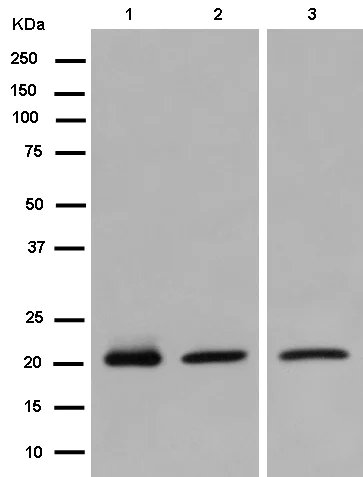
Western blot - Anti-Proteasome 20S LMP2 antibody [EPR13785] (AB184172)
All lanes:
Anti-EXTL1 antibody - C-terminal (<a href='/en-us/products/unavailable/extl1-antibody-c-terminal-ab174172'>ab174172</a>) at 1/100000 dilution
Lane 1:
Ramos cell lysate at 20 µg
Lane 2:
A431 cell lysate at 20 µg
Lane 3:
Raji cell lysate at 20 µg
Secondary
All lanes:
Goat Anti-Rabbit IgG, (H+L), Peroxidase conjugated at 1/1000 dilution
Predicted band size: 23 kDa
false
Related conjugates and formulations (2)
-
Anti-Proteasome 20S LMP2 antibody [EPR13785] - BSA and Azide free
-
665 Alexa Fluor® 647
Alexa Fluor® 647 Anti-Proteasome 20S LMP2 antibody [EPR13785]
Alternative Products
Primary Antibodies
AB187645
Anti-Proteasome 20S LMP2 antibody [EPR13784]
RabMAb|Recombinant|KO Validated

- 0
- 0
Primary Antibodies
AB243556
Anti-Proteasome 20S LMP2 antibody [EPR22042] - BSA and Azide free
RabMAb|Recombinant|KO Validated

- 0
- 0
Primary Antibodies
AB242061
Anti-Proteasome 20S LMP2 antibody [EPR22042]
RabMAb|Recombinant|KO Validated|20ul selling size

- 0
- 0
Complementary Products

Primary Antibodies
AB183506
Anti-PSMB10/MECL1 antibody [EPR14902]
RabMAb|Recombinant|KO Validated

- 0
- 0
Primary Antibodies
AB180606
Anti-Proteasome 20S LMP7 antibody [EPR14482(B)]
20ul selling size|BOND RX™ Validated|RabMAb|Recombinant|KO Validated

- 5
- 1
Primary Antibodies
AB75853
Anti-beta 2 Microglobulin antibody [EP2978Y]
20ul selling size|KO Validated|RabMAb|Recombinant

- 4
- 9

Reactivity data
Product details
Patented technology
Our RabMAb® technology is a patented hybridoma-based technology for making rabbit monoclonal antibodies. For details on our patents, please refer to RabMAb® patents.
What are the advantages of a recombinant monoclonal antibody?
This product is a recombinant monoclonal antibody, which offers several advantages including:
- - High batch-to-batch consistency and reproducibility
- - Improved sensitivity and specificity
- - Long-term security of supply
- - Animal-free batch production
For more information, read more on recombinant antibodies.
Properties and storage information
Form
Purification technique
Storage buffer
Shipped at conditions
Appropriate short-term storage duration
Appropriate short-term storage conditions
Appropriate long-term storage conditions
Aliquoting information
Storage information
Supplementary information
This supplementary information is collated from multiple sources and compiled automatically.
Biological function summary
LMP2 is integral to protein catabolism and regulation of the cellular protein homeostasis. As part of the larger proteasome complex the LMP2 protein functions in degradative pathways that recycle amino acids from ubiquitin-tagged proteins. This proteasome takes part in antigen processing helping convert proteins into peptides that are presented on the surface of cells for immune system recognition.
Pathways
LMP2 is significantly involved in the ubiquitin-proteasome pathway and immune system processes. It interacts with other immunoproteasome subunits like LMP7 and MECL-1 which work together to enhance the proteolytic capacity for antigen presentation. The presence of LMP2 in these pathways demonstrates its role in adaptive immunity contributing to the clearance of misfolded or damaged proteins and therefore maintaining cell health.
Product protocols
- Visit the General protocols
- Visit the Troubleshooting
Target data
Alternative Names
Publications (10)
Recent publications for all applications. Explore the full listand refine your search
International journal of molecular sciences 23: PubMed36498987
2022
Applications
Unspecified application
Species
Unspecified reactive species
Cell death & disease 13:975 PubMed36402750
2022
Applications
Unspecified application
Species
Unspecified reactive species
American journal of cancer research 12:5286-5299 PubMed36504904
2022
Applications
Unspecified application
Species
Unspecified reactive species
Scientific reports 12:14087 PubMed35982220
2022
Applications
Unspecified application
Species
Unspecified reactive species
Antioxidants (Basel, Switzerland) 11: PubMed35453413
2022
Applications
Unspecified application
Species
Unspecified reactive species
Cancer letters 529:37-52 PubMed34974132
2022
Applications
Unspecified application
Species
Unspecified reactive species
Nature communications 12:2099 PubMed33833239
2021
Applications
Unspecified application
Species
Unspecified reactive species
Journal of neuroinflammation 17:184 PubMed32532298
2020
Applications
Unspecified application
Species
Unspecified reactive species
Frontiers in physiology 11:403 PubMed32508664
2020
Applications
Unspecified application
Species
Unspecified reactive species
Nature methods 15:909-912 PubMed30377371
2018
Applications
Unspecified application
Species
Unspecified reactive species
Product promise
Please note: All products are 'FOR RESEARCH USE ONLY. NOT FOR USE IN DIAGNOSTIC OR THERAPEUTIC PROCEDURES'.
For licensing inquiries, please contact partnerships@abcam.com