Anti-PSMB10/MECL1 antibody [EPR14903] - BSA and Azide free
- RabMAb
- Recombinant
- What is this?
Be the first to review this product! Submit a review
|
(0 Publication)
- ICC/IF
Lab
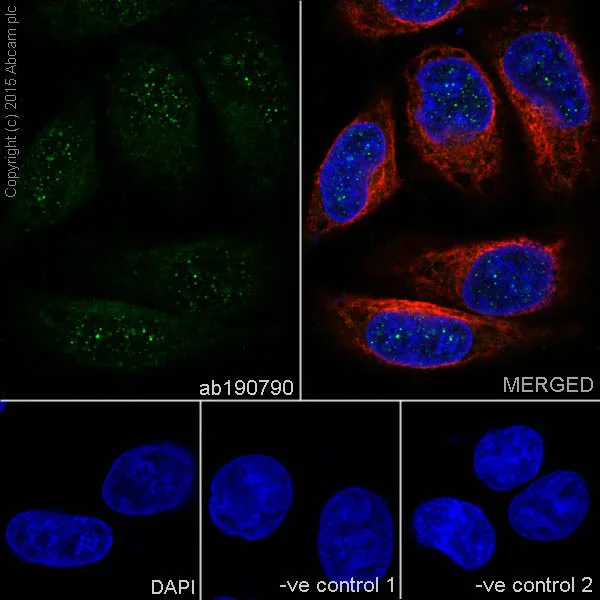
Immunocytochemistry/ Immunofluorescence - Anti-PSMB10/MECL1 antibody [EPR14903] - BSA and Azide free (AB251034)
This data was developed using ab190790, the same antibody clone in a different buffer formulation.
Immunofluorescent analysis of 4% paraformaldehyde-fixed HeLa cells labeling PSMB10/MECL1 with ab190790 at 1/250 dilution, followed by Goat anti rabbit IgG (Alexa Fluor555) secondary antibody at 1/200 dilution. Counter stained with DAPI.
- WB
Supplier Data
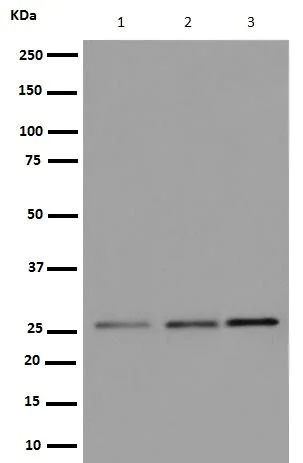
Western blot - Anti-PSMB10/MECL1 antibody [EPR14903] - BSA and Azide free (AB251034)
This data was developed using ab190790, the same antibody clone in a different buffer formulation.
All lanes:
Western blot - Anti-PSMB10/MECL1 antibody [EPR14903] (<a href='/en-us/products/primary-antibodies/psmb10-mecl1-antibody-epr14903-ab190790'>ab190790</a>) at 1/1000 dilution
Lane 1:
Human fetal thymus lysate at 20 µg
Lane 2:
Daudi cell lysate at 20 µg
Lane 3:
Raji cell lysate at 20 µg
Secondary
All lanes:
Goat Anti-Rabbit IgG, (H+L), Peroxidase conjugate at 1/1000 dilution
Predicted band size: 29 kDa
Observed band size: 29 kDa
false
Related conjugates and formulations (1)
-
Anti-PSMB10/MECL1 antibody [EPR14903]
Alternative Products
Primary Antibodies
AB246782
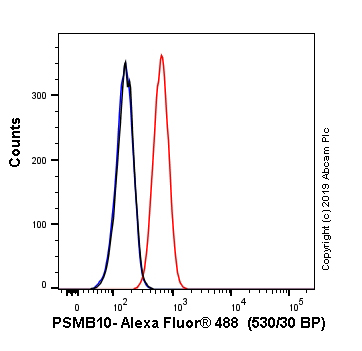
Alexa Fluor® 488 Anti-PSMB10/MECL1 antibody [EPR14902]
RabMAb|Recombinant
- 0
- 0
Complementary Products
Primary Antibodies
AB180606
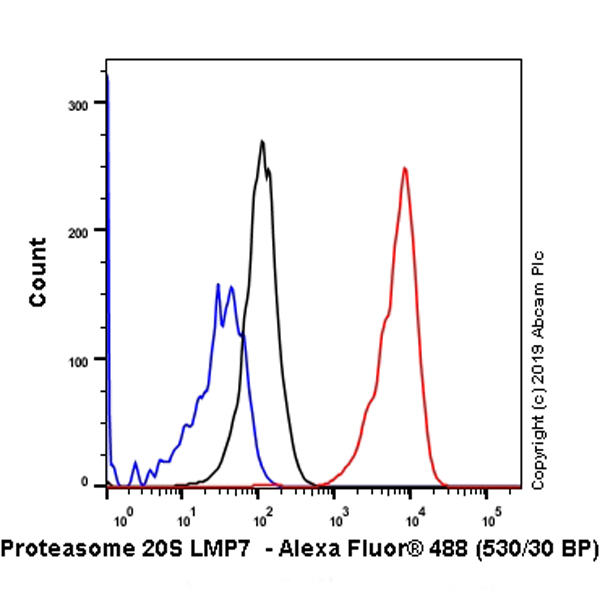
Anti-Proteasome 20S LMP7 antibody [EPR14482(B)]
20ul selling size|BOND RX™ Validated|RabMAb|Recombinant|KO Validated
- 5
- 1
Primary Antibodies
AB16669
Anti-CD3 epsilon antibody [SP7]
BOND RX™ Validated|RabMAb|Advanced Validation|Recombinant|Lab Essentials|20ul selling size

- 4
- 80
Primary Antibodies
AB242061
Anti-Proteasome 20S LMP2 antibody [EPR22042]
RabMAb|Recombinant|KO Validated|20ul selling size
- 0
- 0
Reactivity data
Product details
ab251034 is the carrier-free version of ab190790.
Patented technology
Our RabMAb® technology is a patented hybridoma-based technology for making rabbit monoclonal antibodies. For details on our patents, please refer to RabMAb® patents.
What are the advantages of a recombinant monoclonal antibody?
This product is a recombinant monoclonal antibody, which offers several advantages including:
- - High batch-to-batch consistency and reproducibility
- - Improved sensitivity and specificity
- - Long-term security of supply
- - Animal-free batch production
For more information, read more on recombinant antibodies.
Conjugation ready
Our carrier-free antibodies are typically supplied in a PBS-only formulation, purified and free of BSA, sodium azide and glycerol. This conjugation-ready format is designed for use with fluorochromes, metal isotopes, oligonucleotides, and enzymes, which makes them ideal for antibody labelling, functional and cell-based assays, flow-based assays (e.g. mass cytometry) and Multiplex Imaging applications.
Use our conjugation kits for antibody conjugates that are ready-to-use in as little as 20 minutes with 1 minute hands-on-time and 100% antibody recovery: available for fluorescent dyes, HRP, biotin and gold.
Compatibility
This product is compatible with the Maxpar® Antibody Labeling Kit from Fluidigm, without the need for antibody preparation. Maxpar® is a trademark of Fluidigm Canada Inc.
Properties and storage information
Form
Storage buffer
Shipped at conditions
Appropriate short-term storage conditions
Appropriate long-term storage conditions
Storage information
Supplementary information
This supplementary information is collated from multiple sources and compiled automatically.
Biological function summary
PSMB10/MECL1 plays a significant role in immune responses. It forms part of the immunoproteasome a variant of the proteasome complex which enhances the generation of antigenic peptides presented on MHC class I molecules. This function is essential for effective immune surveillance and initializing adaptive immunity. In particular PSMB10's influence on antigen processing positions it as an important player in modulating immune system activity.
Pathways
PSMB10/MECL1 participates in pathways associated with protein catabolism and immune signaling. It is involved in the ubiquitin-proteasome pathway which is critical for maintaining cellular protein balance. The function of PSMB10 within the immunoproteasome links it to immune signaling pathways. It has associations with other 20S proteasome subunits such as PSMB8 and PSMB9 which also contribute to the formation of the immunoproteasome complex.
Product protocols
- Visit the General protocols
- Visit the Troubleshooting
Target data
Alternative Names
Product promise
Please note: All products are 'FOR RESEARCH USE ONLY. NOT FOR USE IN DIAGNOSTIC OR THERAPEUTIC PROCEDURES'.
For licensing inquiries, please contact partnerships@abcam.com