Anti-PTPN12 antibody [EPR25171-63]
- KD Validated
- 20ul selling size
- RabMAb
- Recombinant
- What is this?
Be the first to review this product! Submit a review
|
(0 Publication)
- Flow Cyt (Intra)
Supplier Data
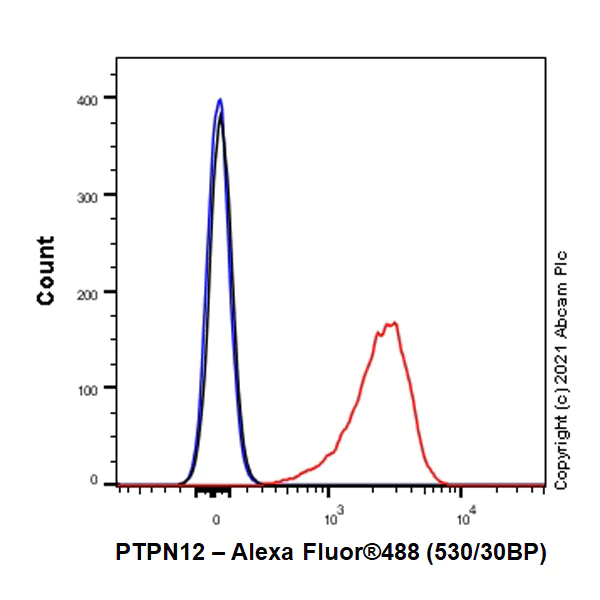
Flow Cytometry (Intracellular) - Anti-PTPN12 antibody [EPR25171-63] (AB289859)
Flow cytometric analysis of 4% paraformaldehyde-fixed, 90% methanol permeabilised THP-1 (human monocytic leukemia monocyte cell line) cells labelling PTPN12 with ab289859 at 1/500 dilution (Red) compared with a Rabbit IgG, monoclonal - Isotype Control (ab172730) (Black) and an unlabelled control (cells without incubation with primary antibody and secondary antibody) (Blue). Goat Anti-Rabbit IgG H&L (Alexa Fluor® 488) (ab150081) at 1/2000 dilution was used as the secondary antibody.
- ICC/IF
Supplier Data
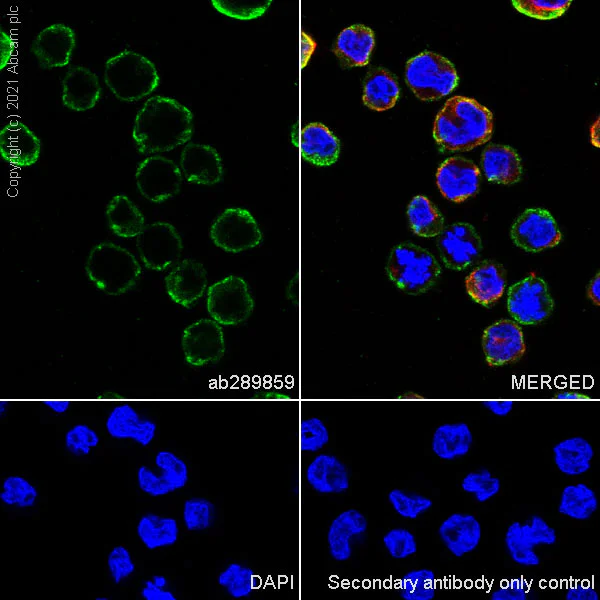
Immunocytochemistry/ Immunofluorescence - Anti-PTPN12 antibody [EPR25171-63] (AB289859)
Immunofluorescent analysis of 4% paraformaldehyde-fixed, 0.1% Triton X-100 permeabilized THP-1 (human monocytic leukemia monocyte) cells labeling PTPN12 with ab289859 at 1/200 dilution, followed by ab150081 Goat Anti-Rabbit IgG H&L (Alexa Fluor® 488) preadsorbed secondary antibody at 1/1000 dilution (Green). Confocal image showing membranous and cytoplasmic staining in THP-1 cell line. The nuclear counterstain is DAPI (Blue). Tubulin is labeled using ab195889 Anti-alpha Tubulin mouse monoclonal antibody - Microtubule Marker (Alexa Fluor® 594) at 1/200 dilution (Red).
Secondary antibody only control : Used PBS instead of primary antibody, followed by ab150081 Goat Anti-Rabbit IgG H&L (Alexa Fluor® 488) preadsorbed secondary antibody at 1/1000 dilution.
- IP
Supplier Data
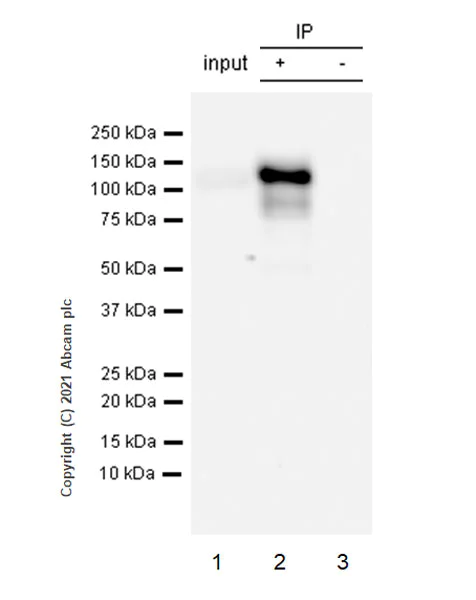
Immunoprecipitation - Anti-PTPN12 antibody [EPR25171-63] (AB289859)
PTPN12 was immunoprecipitated from THP-1 (human monocytic leukemia monocyte) whole cell lysate with ab289859 at 1/30 dilution (2 μg in 0.35 mg lysate). VeriBlot for IP secondary antibody(HRP) (ab131366) was used as secondary antibody at 1/5000 dilution.
Lane 1 : THP-1 (human monocytic leukemia monocyte), whole cell lysate 10 μg (Input)
Lane 2 : ab289859 IP in THP-1 whole cell lysate
Lane 3 : Rabbit monoclonal IgG (ab172730) instead of ab289859 in THP-1 whole cell lysate
Blocking and dilution buffer and concentration : 5% NFDM/TBST
Exposure time : 5 seconds
All lanes:
Immunoprecipitation - Anti-PTPN12 antibody [EPR25171-63] (ab289859)
Predicted band size: 88 kDa
Observed band size: 110-125 kDa
false
Exposure time: 5s
- WB
Supplier Data
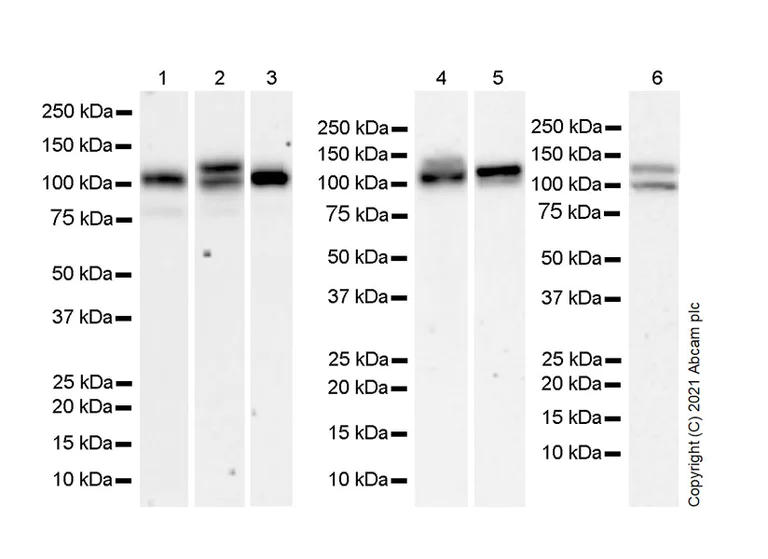
Western blot - Anti-PTPN12 antibody [EPR25171-63] (AB289859)
5% NFDM/TBST was used as a blocking and diluting buffer.
Exposure times :
Lanes 1 - 2 : 125 seconds
Lane 3 : 92 seconds
Lanes 4 - 6 : 3 minutes
Lysates were made fresh and used immediately to minimize protein degradation.
The expression profile/ molecular weight observed is consistent with what has been described in the literature (PMID : 10625692).
All lanes:
Western blot - Anti-PTPN12 antibody [EPR25171-63] (ab289859) at 1/1000 dilution
Lane 1:
U937 (human histiocytic lymphoma monocyte), whole cell lysate at 20 µg
Lane 2:
HeLa (human epithelial cell line from cervix adenocarcinoma), whole cell lysate at 20 µg
Lane 3:
THP-1 (human monocytic leukemia monocyte), whole cell lysate at 20 µg
Lane 4:
PC-12 (rat adrenal gland pheochromocytoma), whole cell lysate at 20 µg
Lane 5:
C6 (rat glial tumor glial cell), whole cell lysate at 20 µg
Lane 6:
RAW264.7 (mouse Abelson murine leukemia virus-induced tumor macrophage), whole cell lysate at 20 µg
Secondary
All lanes:
Western blot - Goat Anti-Rabbit IgG H&L (HRP) (<a href='/en-us/products/secondary-antibodies/goat-rabbit-igg-h-l-hrp-ab97051'>ab97051</a>) at 1/100000 dilution
Predicted band size: 88 kDa
Observed band size: 110-125 kDa
false
- WB
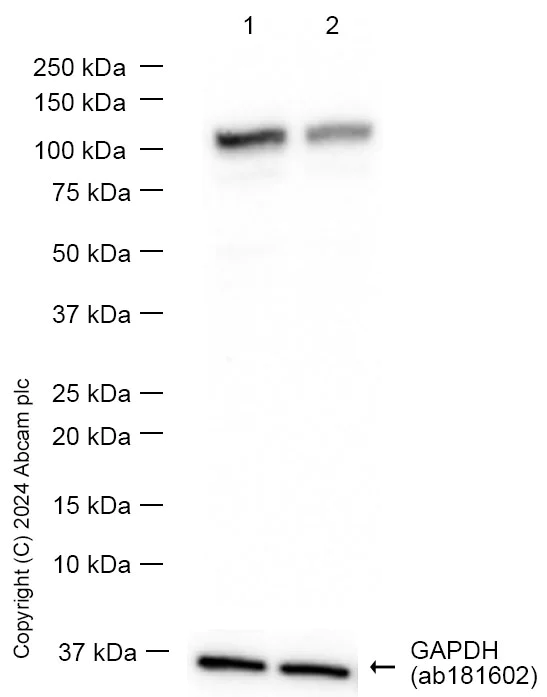
Supplier Data
Western blot - Anti-PTPN12 antibody [EPR25171-63] (AB289859)
Blocking and diluting buffer : 5% NFDM/TBST.
ab181602 was used as a loading control at 1/1000000 dilution.
All lanes:
Western blot - Anti-PTPN12 antibody [EPR25171-63] (ab289859) at 1/1000 dilution
Lane 1:
THP-1 (human monocytic leukemia monocyte) transfected with scrambled siRNA control whole cell lysate at 20 µg
Lane 2:
THP-1 transfected with siRNA specifically targeting PTPN12 whole cell lysate at 20 µg
Secondary
All lanes:
Western blot - Goat Anti-Rabbit IgG H&L (HRP) (<a href='/en-us/products/secondary-antibodies/goat-rabbit-igg-h-l-hrp-ab97051'>ab97051</a>) at 1/20000 dilution
Predicted band size: 88 kDa
Observed band size: 110 - 125 kDa
false
Exposure time: 20s
Related conjugates and formulations (1)
-
Anti-PTPN12 antibody [EPR25171-63] - BSA and Azide free
Complementary Products

Primary Antibodies
AB32084
BOND RX™ Validated|RabMAb|Recombinant|KO Validated|20ul selling size

- 5
- 21
Primary Antibodies
AB40854
20ul selling size|Recombinant|KO Validated|Advanced Validation|RabMAb

- 5
- 10

Primary Antibodies
AB179471
Anti-Integrin beta 1 antibody [EPR16895]
20ul selling size|RabMAb|Recombinant|KO Validated

- 5
- 5
Reactivity data
Product details
Patented technology
Our RabMAb® technology is a patented hybridoma-based technology for making rabbit monoclonal antibodies. For details on our patents, please refer to RabMAb® patents.
What are the advantages of a recombinant monoclonal antibody?
This product is a recombinant monoclonal antibody, which offers several advantages including:
- - High batch-to-batch consistency and reproducibility
- - Improved sensitivity and specificity
- - Long-term security of supply
- - Animal-free batch production
For more information, read more on recombinant antibodies.
Properties and storage information
Form
Purification technique
Storage buffer
Shipped at conditions
Appropriate short-term storage duration
Appropriate short-term storage conditions
Appropriate long-term storage conditions
Aliquoting information
Storage information
Supplementary information
This supplementary information is collated from multiple sources and compiled automatically.
Biological function summary
As a non-receptor type phosphatase PTPN12 partners with several proteins to perform essential cellular functions. It interacts with multiple components in the cell participating in the assembly of protein complexes that manage cytoskeletal dynamics and cell movement. PTPN12 influences signal transduction pathways by interacting with adapter proteins such as p130Cas and Paxillin which are vital for cell adhesion and migration. It also plays a role in maintaining cellular homeostasis by controlling signaling cascades that prevent excessive cell proliferation.
Pathways
PTPN12 takes part in critical signal transduction networks most notably the Integrin signaling and RhoA pathways. In the Integrin pathway PTPN12 negatively regulates signaling by dephosphorylating focal adhesion-associated proteins. This regulation affects cell attachment to the extracellular matrix and cell motility. The interaction of PTPN12 with proteins such as Src and FAK (Focal Adhesion Kinase) illustrates its involvement in these processes. In the RhoA pathway PTPN12 influences cytoskeletal rearrangement and cell shape regulation linking to its role in cell migration.
Product protocols
- Visit the General protocols
- Visit the Troubleshooting
Target data
Alternative Names
Product promise
Please note: All products are 'FOR RESEARCH USE ONLY. NOT FOR USE IN DIAGNOSTIC OR THERAPEUTIC PROCEDURES'.
For licensing inquiries, please contact partnerships@abcam.com