JavaScript is disabled in your browser. Please enable JavaScript to view this website.
AB205954

Anti-RanBP9 antibody

Be the first to review this product! Submit a review

|

(1 Publication)

Rabbit Polyclonal RanBP9 antibody. Suitable for IP, WB and reacts with Human samples. Cited in 1 publication. Immunogen corresponding to Synthetic Peptide within Human RANBP9 aa 100-200.

View Alternative Names

RANBPM, RANBP9, Ran-binding protein 9, RanBP9, BPM-L, BPM90, Ran-binding protein M, RanBP7, RanBPM
2 Images
Immunoprecipitation - Anti-RanBP9 antibody (AB205954)
  • IP

Supplier Data

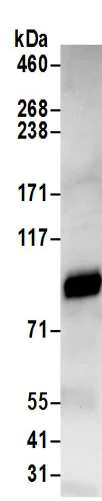
Immunoprecipitation - Anti-RanBP9 antibody (AB205954)

Detection of RanBP9 in Immunoprecipitates of 293T whole cell lysates (1 mg for IP, 20% of IP loaded) using ab205954 at 6 μg/mg lysate for IP. For WB detection an ab205954 was used at 0.4 μg/ml. Detection : Chemiluminescence with an exposure time of 30 seconds.

All lanes:

Immunoprecipitation - Anti-RanBP9 antibody (ab205954)

Predicted band size: 78 kDa

false
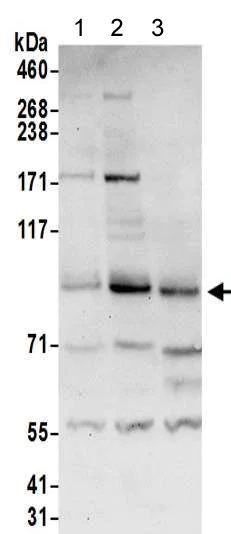
Western blot - Anti-RanBP9 antibody (AB205954)
  • WB

Supplier Data

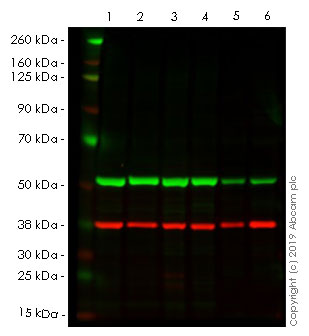
Western blot - Anti-RanBP9 antibody (AB205954)

All lanes:

Western blot - Anti-RanBP9 antibody (ab205954) at 0.1 µg/mL

Lane 1:

HeLa whole cell lysate at 50 µg

Lane 2:

293T whole cell lysate at 50 µg

Lane 3:

Jurkat whole cell lysate at 50 µg

Predicted band size: 78 kDa

true

Exposure time: 30s

Key facts

Host species

Rabbit

Clonality

Polyclonal

Isotype

IgG

Carrier free

No

Reacts with

Human

Applications

IP, WB

applications

Immunogen

Synthetic Peptide within Human RANBP9 aa 100-200. The exact immunogen used to generate this antibody is proprietary information.

Q96S59

Reactivity data

{ "title": "Reactivity Data", "filters": { "stats": ["", "Species", "Dilution Info", "Notes"], "tabs": { "all-applications": {"fullname" : "All Applications", "shortname": "All Applications"}, "IP" : {"fullname" : "Immunoprecipitation", "shortname":"IP"}, "WB" : {"fullname" : "Western blot", "shortname":"WB"} }, "product-promise": { "all": "all", "testedAndGuaranteed": "tested", "guaranteed": "expected", "predicted": "predicted", "notRecommended": "not-recommended" } }, "values": { "Human": { "IP-species-checked": "testedAndGuaranteed", "IP-species-dilution-info": "2-10 µg/mg of lysate", "IP-species-notes": "<p></p>", "WB-species-checked": "testedAndGuaranteed", "WB-species-dilution-info": "1/2000 - 1/10000", "WB-species-notes": "<p></p>" }, "Mouse": { "IP-species-checked": "predicted", "IP-species-dilution-info": "", "IP-species-notes": "", "WB-species-checked": "predicted", "WB-species-dilution-info": "", "WB-species-notes": "" }, "Chimpanzee": { "IP-species-checked": "predicted", "IP-species-dilution-info": "", "IP-species-notes": "", "WB-species-checked": "predicted", "WB-species-dilution-info": "", "WB-species-notes": "" }, "Horse": { "IP-species-checked": "predicted", "IP-species-dilution-info": "", "IP-species-notes": "", "WB-species-checked": "predicted", "WB-species-dilution-info": "", "WB-species-notes": "" }, "Orangutan": { "IP-species-checked": "predicted", "IP-species-dilution-info": "", "IP-species-notes": "", "WB-species-checked": "predicted", "WB-species-dilution-info": "", "WB-species-notes": "" }, "Rhesus monkey": { "IP-species-checked": "predicted", "IP-species-dilution-info": "", "IP-species-notes": "", "WB-species-checked": "predicted", "WB-species-dilution-info": "", "WB-species-notes": "" } } }

Properties and storage information

Form
Liquid
Purification technique
Affinity purification Immunogen
Storage buffer
pH: 7 - 8 Preservative: 0.09% Sodium azide Constituents: 99% Tris citrate/phosphate
Shipped at conditions
Blue Ice
Appropriate short-term storage duration
1-2 weeks
Appropriate short-term storage conditions
+4°C
Appropriate long-term storage conditions
+4°C
Aliquoting information
Upon delivery aliquot
Storage information
Avoid freeze / thaw cycle

Supplementary information

This supplementary information is collated from multiple sources and compiled automatically.

RanBP9 also known as Ran-binding protein 9 is a multifunctional protein with a molecular mass of approximately 85 kDa. It plays a significant role in various cellular functions by interacting with Ran a small GTPase involved in nucleocytoplasmic transport. RanBP9 is expressed in multiple tissues with higher levels observed in the brain testis and kidney indicating its diverse involvement in cellular processes. The protein has functional domains that allow it to interact with other proteins and contribute to cell signaling and structure.
Biological function summary

This protein acts as an adaptor within a variety of cellular complexes where it mediates protein-protein interactions. It influences several processes including cell migration cytoskeletal organization and neurite outgrowth. RanBP9 forms complexes with several key signaling proteins and structural components which enables it to modulate cellular dynamics and developmental pathways. It also plays a role in apoptosis and gene transcription indicating its far-reaching effects on cellular behavior.

Pathways

Several cell signaling and transportation pathways involve RanBP9. It is notably active in the Wnt and MAPK pathways where it modulates signal transduction and cellular responses to environmental cues. In the Wnt pathway RanBP9 interacts with proteins like Dishevelled and β-Catenin influencing cell fate decisions and morphogenesis. In the MAPK pathway RanBP9 associates with key kinases that regulate cell growth differentiation and stress responses.

Alterations in RanBP9 expression or function are linked to conditions such as Alzheimer's disease and cancer. In Alzheimer's RanBP9 is thought to interact with amyloid precursor protein (APP) influencing amyloid-beta production a hallmark of the disease. In cancer RanBP9 modulates pathways that affect cell proliferation and survival involving proteins such as c-Met which is associated with tumor growth and metastasis. Understanding RanBP9's role in these diseases may offer targets for therapeutic interventions.

Product protocols

For this product, it's our understanding that no specific protocols are required. You can visit:

Target data

May act as scaffolding protein, and as adapter protein to couple membrane receptors to intracellular signaling pathways (Probable). Acts as a mediator of cell spreading and actin cytoskeleton rearrangement (PubMed : 18710924). Core component of the CTLH E3 ubiquitin-protein ligase complex that selectively accepts ubiquitin from UBE2H and mediates ubiquitination and subsequent proteasomal degradation of the transcription factor HBP1 (PubMed : 29911972). May be involved in signaling of ITGB2/LFA-1 and other integrins (PubMed : 14722085). Enhances HGF-MET signaling by recruiting Sos and activating the Ras pathway (PubMed : 12147692). Enhances dihydrotestosterone-induced transactivation activity of AR, as well as dexamethasone-induced transactivation activity of NR3C1, but not affect estrogen-induced transactivation (PubMed : 12361945, PubMed : 18222118). Stabilizes TP73 isoform Alpha, probably by inhibiting its ubiquitination, and increases its proapoptotic activity (PubMed : 15558019). Inhibits the kinase activity of DYRK1A and DYRK1B. Inhibits FMR1 binding to RNA.
See full target information RANBP9

Publications (1)

Recent publications for all applications. Explore the full list and refine your search

Frontiers in molecular neuroscience 14:688050 PubMed34630032

2021

Tandem Mass Tag-Based Quantitative Proteomic Analysis Reveals Pathways Involved in Brain Injury Induced by Chest Exposure to Shock Waves.

Applications

Unspecified application

Species

Unspecified reactive species

Changci Tong,Peifang Cong,Ying Liu,Xiuyun Shi,Lin Shi,Shun Mao,Yan Zhao,Mingxiao Hou,Yunen Liu
View all publications

Product promise

We are committed to supporting your work with high-quality reagents, and we're here for you every step of the way. In the unlikely event that one of our products does not perform as expected, you're protected by our Product Promise.
For full details, please see our Terms & Conditions

Please note: All products are 'FOR RESEARCH USE ONLY. NOT FOR USE IN DIAGNOSTIC OR THERAPEUTIC PROCEDURES'.

For licensing inquiries, please contact partnerships@abcam.com