JavaScript is disabled in your browser. Please enable JavaScript to view this website.
AB156002

Anti-Rapsyn antibody [EPR9759]

Be the first to review this product! Submit a review

|

(10 Publications )
Rabbit Recombinant Monoclonal Rapsyn antibody. Suitable for WB and reacts with Rat, Mouse samples. Cited in 10 publications.
1 Images
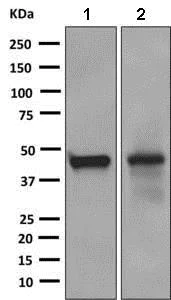
Western blot - Anti-Rapsyn antibody [EPR9759] (AB156002)
  • WB

Unknown

Western blot - Anti-Rapsyn antibody [EPR9759] (AB156002)

All lanes:

Western blot - Anti-Rapsyn antibody [EPR9759] (ab156002) at 1/1000 dilution

Lane 1:

L6 cell lysate at 10 µg

Lane 2:

C2C12 cell lysate at 10 µg

Secondary

All lanes:

HRP labelled goat anti-rabbit at 1/2000 dilution

Predicted band size: 46 kDa

Observed band size: 43 kDa

false

  • Carrier free

    Anti-Rapsyn antibody [EPR9759] - BSA and Azide free

Key facts

Host species

Rabbit

Clonality

Monoclonal

Clone number

EPR9759

Isotype

IgG

Carrier free

No

Reacts with

Mouse, Rat

Applications

WB

applications

Immunogen

The exact immunogen used to generate this antibody is proprietary information.

Reactivity data

{ "title": "Reactivity Data", "filters": { "stats": ["", "Species", "Dilution Info", "Notes"], "tabs": { "all-applications": {"fullname" : "All Applications", "shortname": "All Applications"}, "IP" : {"fullname" : "Immunoprecipitation", "shortname":"IP"}, "FlowCyt" : {"fullname" : "Flow Cytometry", "shortname":"Flow Cyt"}, "WB" : {"fullname" : "Western blot", "shortname":"WB"}, "IHCP" : {"fullname" : "Immunohistochemistry (Formalin/PFA-fixed paraffin-embedded sections)", "shortname":"IHC-P"}, "ICCIF" : {"fullname" : "Immunocytochemistry/ Immunofluorescence", "shortname":"ICC/IF"} }, "product-promise": { "all": "all", "testedAndGuaranteed": "tested", "guaranteed": "expected", "predicted": "predicted", "notRecommended": "not-recommended" } }, "values": { "Human": { "IP-species-checked": "notRecommended", "IP-species-dilution-info": "", "IP-species-notes": "", "FlowCyt-species-checked": "notRecommended", "FlowCyt-species-dilution-info": "", "FlowCyt-species-notes": "", "WB-species-checked": "predicted", "WB-species-dilution-info": "", "WB-species-notes": "", "IHCP-species-checked": "notRecommended", "IHCP-species-dilution-info": "", "IHCP-species-notes": "", "ICCIF-species-checked": "notRecommended", "ICCIF-species-dilution-info": "", "ICCIF-species-notes": "" }, "Mouse": { "IP-species-checked": "notRecommended", "IP-species-dilution-info": "", "IP-species-notes": "<p></p>", "FlowCyt-species-checked": "notRecommended", "FlowCyt-species-dilution-info": "", "FlowCyt-species-notes": "<p></p>", "WB-species-checked": "testedAndGuaranteed", "WB-species-dilution-info": "1/1000 - 1/10000", "WB-species-notes": "<p></p>", "IHCP-species-checked": "notRecommended", "IHCP-species-dilution-info": "", "IHCP-species-notes": "<p></p>", "ICCIF-species-checked": "notRecommended", "ICCIF-species-dilution-info": "", "ICCIF-species-notes": "<p></p>" }, "Rat": { "IP-species-checked": "notRecommended", "IP-species-dilution-info": "", "IP-species-notes": "<p></p>", "FlowCyt-species-checked": "notRecommended", "FlowCyt-species-dilution-info": "", "FlowCyt-species-notes": "<p></p>", "WB-species-checked": "testedAndGuaranteed", "WB-species-dilution-info": "1/1000 - 1/10000", "WB-species-notes": "<p></p>", "IHCP-species-checked": "notRecommended", "IHCP-species-dilution-info": "", "IHCP-species-notes": "<p></p>", "ICCIF-species-checked": "notRecommended", "ICCIF-species-dilution-info": "", "ICCIF-species-notes": "<p></p>" } } }

Product details

Patented technology
Our RabMAb® technology is a patented hybridoma-based technology for making rabbit monoclonal antibodies. For details on our patents, please refer to RabMAb® patents.

What are the advantages of a recombinant monoclonal antibody?
This product is a recombinant monoclonal antibody, which offers several advantages including:

  • - High batch-to-batch consistency and reproducibility
  • - Improved sensitivity and specificity
  • - Long-term security of supply
  • - Animal-free batch production

For more information, read more on recombinant antibodies.

Properties and storage information

Form
Liquid
Purification technique
Affinity purification Protein A
Storage buffer
pH: 7.2 - 7.4 Preservative: 0.01% Sodium azide Constituents: PBS, 40% Glycerol (glycerin, glycerine), 0.05% BSA
Shipped at conditions
Conditional Ambient
Appropriate short-term storage conditions
+4°C
Appropriate long-term storage conditions
-20°C
Aliquoting information
Upon delivery aliquot
Storage information
Avoid freeze / thaw cycle

Supplementary information

This supplementary information is collated from multiple sources and compiled automatically.

Rapsyn also known as receptor-associated protein of the synapse or 43 kDa postsynaptic protein has a mass of 43 kilodaltons. Rapsyn is mainly expressed in skeletal muscle tissues. Mechanically it plays a role as a scaffolding protein that links nicotinic acetylcholine receptors (nAChRs) to the postsynaptic cytoskeleton at neuromuscular junctions. This association ensures proper clustering of nAChRs which is essential for efficient synaptic transmission.
Biological function summary

Rapsyn facilitates the organization and stabilization of acetylcholine receptors at the neuromuscular junction. It acts as part of a larger protein complex that anchors these receptors to the skeletal muscle surface. Macromolecular complexes like those involving Rapsyn are important for the formation and maintenance of the postsynaptic membrane which ensures effective muscle contraction in response to nerve signals. Additionally Rapsyn assists in the aggregation of receptors during synaptogenesis the process by which synapses form between neurons and muscle fibers.

Pathways

Rapsyn contributes to signal transduction and synaptic transmission processes. It associates closely with Dystrophin-glycoprotein complex (DGC) pathway maintaining the structural integrity of the neuromuscular junction. Rapsyn interacts with proteins such as MuSK (Muscle-Specific Kinase) to facilitate nAChR clustering during synapse formation. This interaction also involves agrin-mediated signaling which is critical in neuromuscular development and function.

Mutations or dysfunctions in Rapsyn can be linked to conditions such as congenital myasthenic syndromes (CMS). CMS involves impaired neuromuscular transmission causing muscle weakness and fatigue. Rapsyn mutations can disrupt its interaction with proteins like nAChRs and MuSK compromising synaptic stability and efficiency. Another related disorder is limb-girdle muscular dystrophy where pathways involving Rapsyn and DGC proteins are affected leading to progressive muscle weakness and degeneration.

Product protocols

For this product, it's our understanding that no specific protocols are required. You can visit:

Target data

Postsynaptic protein required for clustering of nicotinic acetylcholine receptors (nAChRs) at the neuromuscular junction. It may link the receptor to the underlying postsynaptic cytoskeleton, possibly by direct association with actin or spectrin.
See full target information RAPSN

Alternative Names

RNF205, RAPSN, 43 kDa receptor-associated protein of the synapse, RAPsyn, 43 kDa postsynaptic protein, Acetylcholine receptor-associated 43 kDa protein, RING finger protein 205

Publications (10)

Recent publications for all applications. Explore the full listand refine your search

Experimental physiology 110:127-146 PubMed39501426

2024

Acute high-intensity muscle contraction moderates AChR gene expression independent of rapamycin-sensitive mTORC1 pathway in rat skeletal muscle.

Applications

Unspecified application

Species

Unspecified reactive species

Yuhei Makanae,Satoru Ato,Karina Kouzaki,Yuki Tamura,Koichi Nakazato

International journal of molecular sciences 22: PubMed34502296

2021

Drebrin Regulates Acetylcholine Receptor Clustering and Organization of Microtubules at the Postsynaptic Machinery.

Applications

Unspecified application

Species

Unspecified reactive species

Paloma Alvarez-Suarez,Natalia Nowak,Anna Protasiuk-Filipunas,Hiroyuki Yamazaki,Tomasz J Prószyński,Marta Gawor

American journal of cancer research 11:2990-3001 PubMed34249440

2021

Muscle weakness caused by cancer and chemotherapy is associated with loss of motor unit connectivity.

Applications

Unspecified application

Species

Unspecified reactive species

Joshua R Huot,Fabrizio Pin,Andrea Bonetto

Neural regeneration research 15:1678-1685 PubMed32209772

2020

Stability of motor endplates is greater in the biceps than in the interossei in a rat model of obstetric brachial plexus palsy.

Applications

Unspecified application

Species

Unspecified reactive species

Bo Li,Liang Chen,Yu-Dong Gu

Scientific reports 10:4524 PubMed32161296

2020

An improved method for culturing myotubes on laminins for the robust clustering of postsynaptic machinery.

Applications

Unspecified application

Species

Unspecified reactive species

Marcin Pęziński,Patrycja Daszczuk,Bhola Shankar Pradhan,Hanns Lochmüller,Tomasz J Prószyński

Medicine and science in sports and exercise 52:1477-1484 PubMed31985575

2020

Modification of Neuromuscular Junction Protein Expression by Exercise and Doxorubicin.

Applications

Unspecified application

Species

Unspecified reactive species

Andres Mor Huertas,Aaron B Morton,J Matthew Hinkey,Noriko Ichinoseki-Sekine,Ashley J Smuder

Molecular biology of the cell 30:2571-2583 PubMed31411944

2019

Vezatin is required for the maturation of the neuromuscular synapse.

Applications

Unspecified application

Species

Unspecified reactive species

Natasha Koppel,Matthew B Friese,Helene L Cardasis,Thomas A Neubert,Steven J Burden

The Journal of cell biology 218:1686-1705 PubMed30842214

2019

MACF1 links Rapsyn to microtubule- and actin-binding proteins to maintain neuromuscular synapses.

Applications

Unspecified application

Species

Unspecified reactive species

Julien Oury,Yun Liu,Ana Töpf,Slobodanka Todorovic,Esthelle Hoedt,Veeramani Preethish-Kumar,Thomas A Neubert,Weichun Lin,Hanns Lochmüller,Steven J Burden

Journal of applied physiology (Bethesda, Md. : 1985) 124:888-898 PubMed29357501

2018

Effects of aging and Parkinson's disease on motor unit remodeling: influence of resistance exercise training.

Applications

Unspecified application

Species

Unspecified reactive species

Neil A Kelly,Kelley G Hammond,C Scott Bickel,Samuel T Windham,S Craig Tuggle,Marcas M Bamman

Scientific reports 7:9116 PubMed28831123

2017

Liprin-α-1 is a novel component of the murine neuromuscular junction and is involved in the organization of the postsynaptic machinery.

Applications

Unspecified application

Species

Unspecified reactive species

Krzysztof M Bernadzki,Marta Gawor,Marcin Pęziński,Paula Mazurek,Paweł Niewiadomski,Maria J Rędowicz,Tomasz J Prószyński
View all publications

Product promise

We are committed to supporting your work with high-quality reagents, and we're here for you every step of the way. In the unlikely event that one of our products does not perform as expected, you're protected by our Product Promise.
For full details, please see our Terms & Conditions

Please note: All products are 'FOR RESEARCH USE ONLY. NOT FOR USE IN DIAGNOSTIC OR THERAPEUTIC PROCEDURES'.

For licensing inquiries, please contact partnerships@abcam.com