Rabbit Polyclonal RHOC antibody. Suitable for WB, ICC/IF and reacts with Human, Mouse samples. Cited in 7 publications. Immunogen corresponding to Recombinant Fragment Protein within Human RHOC aa 1 to C-terminus.
View Alternative Names
ARH9, ARHC, RHOC, Rho-related GTP-binding protein RhoC, Rho cDNA clone 9, h9
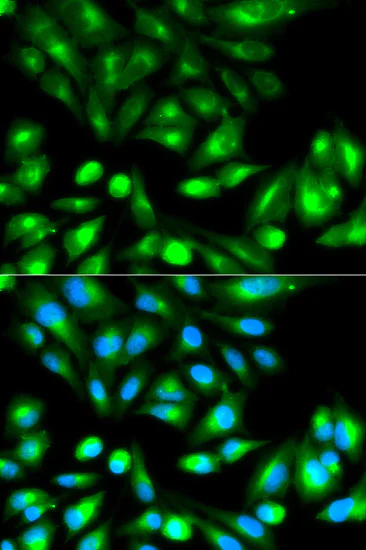
- ICC/IF
Unknown
Immunocytochemistry/ Immunofluorescence - Anti-RHOC antibody (AB180785)
Immunocytochemistry/Immunofluorescence analysis of HeLa cells labeling RHOC with ab180785 (shown in green) at a dilution of 1/50. Nuclear DNA was labelled with DAPI (shown in blue).
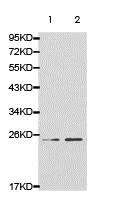
- WB
Supplier Data
Western blot - Anti-RHOC antibody (AB180785)
All lanes:
Western blot - Anti-RHOC antibody (ab180785) at 1/500 dilution
Lane 1:
A549 cell lysate
Lane 2:
NIH 3T3 cell lysate
Predicted band size: 22 kDa
false
Alternative Products
Complementary Products
Primary Antibodies
AB187027
20ul selling size|RabMAb|Recombinant|KO Validated
- 4
- 1
Primary Antibodies
AB187643
Anti-CDC42 antibody [EPR15620]
RabMAb|Recombinant|KO Validated|20ul selling size

- 4
- 2
Primary Antibodies
AB45171
Anti-ROCK2 + ROCK1 antibody [EP786Y]
20ul selling size|RabMAb|Recombinant
- 4
- 9
Primary Antibodies
AB183734
RabMAb|Recombinant|Lab Essentials|20ul selling size
- 5
- 24
Reactivity data
Properties and storage information
Form
Purification technique
Storage buffer
Shipped at conditions
Appropriate short-term storage duration
Appropriate short-term storage conditions
Appropriate long-term storage conditions
Aliquoting information
Storage information
Supplementary information
This supplementary information is collated from multiple sources and compiled automatically.
Biological function summary
RHOC influences cell migration invasion and proliferation key processes in cancer progression. It functions within the Rho family of GTPases interacting with other proteins like ROCK and mDia to regulate cytoskeletal dynamics. RHOC does not operate alone; it works as part of signaling complexes that affect cellular mechanisms such as adhesion and vesicle trafficking. Its activity modulates the balance between cell stability and movement making it significant in tissue remodeling and repair.
Pathways
RHOC plays pivotal roles in the Rho/ROCK and PI3K/Akt signaling pathways. Through these pathways it interacts with related GTPases like RHOA and RAC1. In the Rho/ROCK pathway RHOC influences actin cytoskeleton rearrangement impacting cell contractility and motility. Via the PI3K/Akt pathway RHOC is linked to cell survival and growth involving other proteins like PTEN and mTOR highlighting its function in integrating external signals for cellular response.
Product protocols
- Visit the General protocols
- Visit the Troubleshooting
Target data
Publications (7)
Recent publications for all applications. Explore the full list and refine your search
International journal of experimental pathology 104:33-42 PubMed36576072
2022
Applications
Unspecified application
Species
Unspecified reactive species
Analytical cellular pathology (Amsterdam) 2022:3770715 PubMed36247874
2022
Applications
Unspecified application
Species
Unspecified reactive species
Analytical cellular pathology (Amsterdam) 2021:6683391 PubMed33828938
2021
Applications
Unspecified application
Species
Unspecified reactive species
Journal of oncology 2021:6644077 PubMed33519932
2021
Applications
Unspecified application
Species
Unspecified reactive species
Arteriosclerosis, thrombosis, and vascular biology 41:668-682 PubMed33297751
2020
Applications
Unspecified application
Species
Unspecified reactive species
Molecular medicine reports 23: PubMed33179074
2020
Applications
Unspecified application
Species
Unspecified reactive species
European journal of pain (London, England) 24:1968-1978 PubMed32841448
2020
Applications
Unspecified application
Species
Unspecified reactive species
Product promise
Please note: All products are 'FOR RESEARCH USE ONLY. NOT FOR USE IN DIAGNOSTIC OR THERAPEUTIC PROCEDURES'.
For licensing inquiries, please contact partnerships@abcam.com