Anti-RIP3 antibody [EPR24374-9]
- 20ul selling size
- Recombinant
- RabMAb
- What is this?
Be the first to review this product! Submit a review
|
(1 Publication)
- IP
Supplier Data
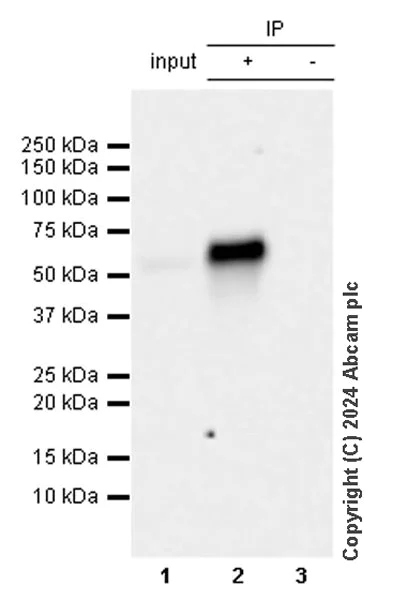
Immunoprecipitation - Anti-RIP3 antibody [EPR24374-9] (AB316957)
RIP3 was immunoprecipitated from 0.35 mg THP-1 (human monocytic leukemia monocyte) whole cell lysate with ab316957 at 1/30 dilution (2ug in 0.35mg lysates). Western blot was performed on the immunoprecipitate using ab316957 at 1/1000 dilution. VeriBlot for IP secondary antibody(HRP)(ab131366) was used at 1/5000 dilution.
Blocking and diluting buffer and concentration : 5% NFDM/TBST.
Lysates were freshly made and used for Western blotting immediately to minimize protein degradation.
All lanes:
Immunoprecipitation - Anti-RIP3 antibody [EPR24374-9] (ab316957) at 1/1000 dilution
Lane 1:
THP-1 (human monocytic leukemia monocyte) whole cell lysate at 10 µg
Lane 2:
ab316957 at 1/30 IP in THP-1 (human monocytic leukemia monocyte) whole cell lysate
Lane 3:
Rabbit monoclonal IgG (<a href='/en-us/products/primary-antibodies/rabbit-igg-monoclonal-epr25a-isotype-control-ab172730'>ab172730</a>) instead of ab316957 in THP-1 whole cell lysate
Secondary
All lanes:
Immunoprecipitation - VeriBlot for IP Detection Reagent (HRP) (<a href='/en-us/products/reagents/veriblot-for-ip-detection-reagent-hrp-ab131366'>ab131366</a>) at 1/5000 dilution
false
Exposure time: 10s
- WB
Supplier Data
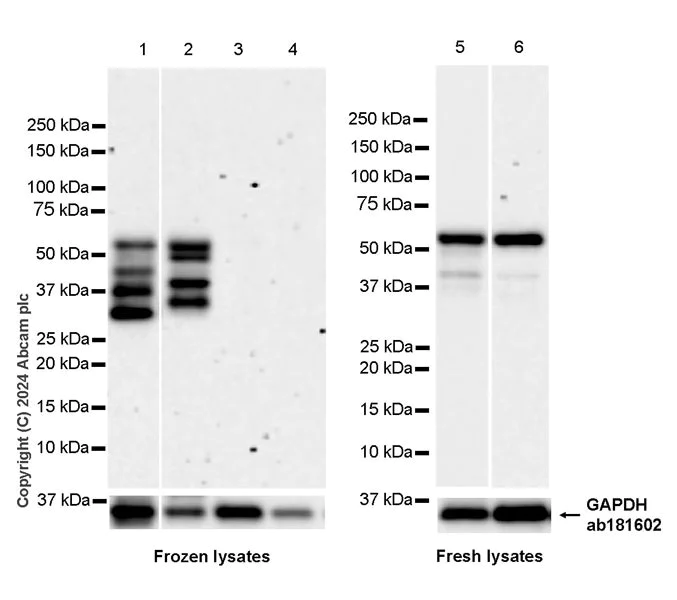
Western blot - Anti-RIP3 antibody [EPR24374-9] (AB316957)
Blocking and diluting buffer and concentration : 5% NFDM/TBST.
Negative control : HeLa (PMID : 26269957, PMID : 28179994), HepG2 (PMID : 25675296).
In lanes 1-4, the lysate was stored at -80℃ prior to Western Blotting. The bands beneath the target band (56 kDa) are likey to be degradation products. In lanes 5-6, the lysates were freshly made and used for Western Blotting immediately to minimize protein degradation.
In Western blot, Anti-GAPDH antibody [EPR16891] - Loading Control (ab181602) staining at 1/200000 dilution.
Exposure time : Lane 5 : 10 seconds, lanes 1-4, 6 : 180 seconds
All lanes:
Western blot - Anti-RIP3 antibody [EPR24374-9] (ab316957) at 1/1000 dilution
Lane 1:
COLO 205 (human colon adenocarcinoma tumor ascitic epithelial cell) whole cell lysate at 20 µg
Lanes 2 and 5:
THP-1 (human monocytic leukemia monocyte) whole cell lysate at 20 µg
Lane 3:
HeLa (human cervix adenocarcinoma epithelial cell) whole cell lysate at 20 µg
Lane 4:
HepG2 (human hepatocellar carcinoma epithelial cell) whole cell lysate at 20 µg
Lane 6:
Jurkat (human T cell leukemia T lymphocyte) whole cell lysate at 20 µg
Secondary
All lanes:
Western blot - Goat Anti-Rabbit IgG H&L (HRP) (<a href='/en-us/products/secondary-antibodies/goat-rabbit-igg-h-l-hrp-ab97051'>ab97051</a>) at 1/100000 dilution
Predicted band size: 57 kDa
Observed band size: 56 kDa,36 kDa
false
- WB
Supplier Data
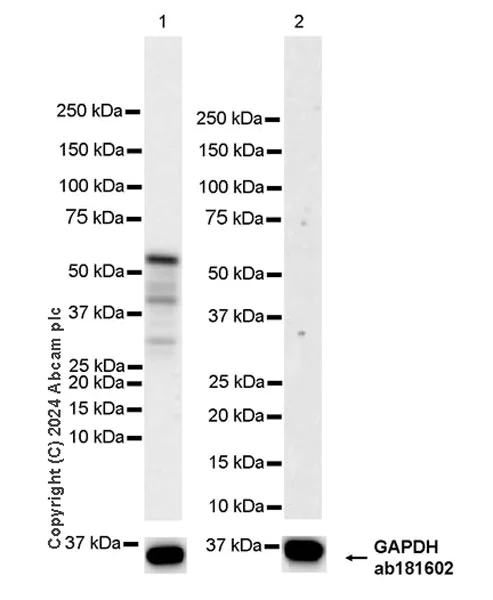
Western blot - Anti-RIP3 antibody [EPR24374-9] (AB316957)
Blocking and diluting buffer and concentration : 5% NFDM/TBST.
Negative control : MCF7 (PMID : 25675296, PMID : 28179994).
Lysates were freshly made and used for Western blotting immediately to minimize protein degradation.
In Western blot, Anti-GAPDH antibody [EPR16891] - Loading Control (ab181602) staining at 1/200000 dilution.
All lanes:
Western blot - Anti-RIP3 antibody [EPR24374-9] (ab316957) at 1/1000 dilution
Lane 1:
U937 (human histiocytic lymphoma monocyte) whole cell lysate at 20 µg
Lane 2:
MCF7 (human breast adenocarcinoma epithelial cell) whole cell lysate at 20 µg
Secondary
All lanes:
Western blot - Goat Anti-Rabbit IgG H&L (HRP) (<a href='/en-us/products/secondary-antibodies/goat-rabbit-igg-h-l-hrp-ab97051'>ab97051</a>) at 1/100000 dilution
Predicted band size: 57 kDa
Observed band size: 56 kDa,36 kDa
false
Exposure time: 180s
Related conjugates and formulations (2)
-
Anti-RIP3 antibody [EPR24374-9] - BSA and Azide free (Capture)
-
Anti-RIP3 antibody [EPR24374-9] - BSA and Azide free
Complementary Products
Primary Antibodies
AB187091
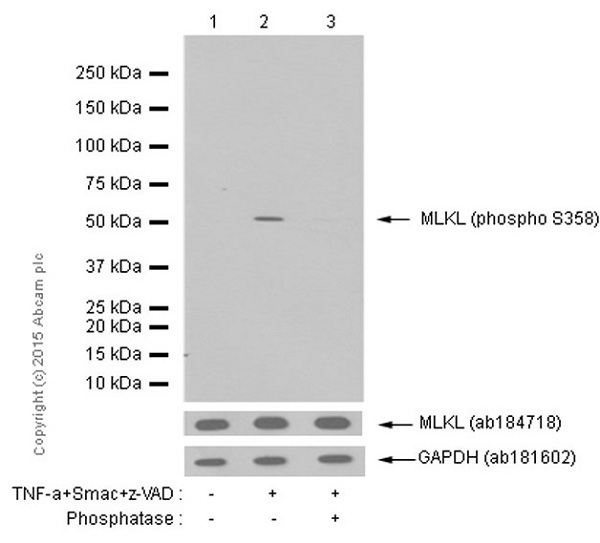
Anti-MLKL (phospho S358) antibody [EPR9514]
RabMAb|Recombinant|20ul selling size
- 4
- 18
Primary Antibodies
AB316923
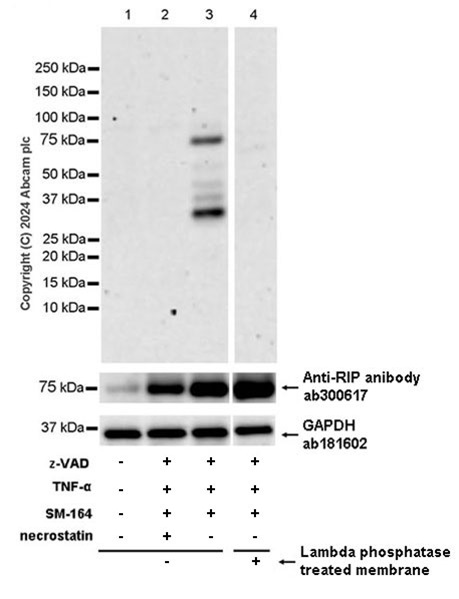
Anti-RIP (phospho S166) antibody [EPR25654-166]
20ul selling size|Recombinant|RabMAb|KO Validated
- 0
- 0
Primary Antibodies
AB209384
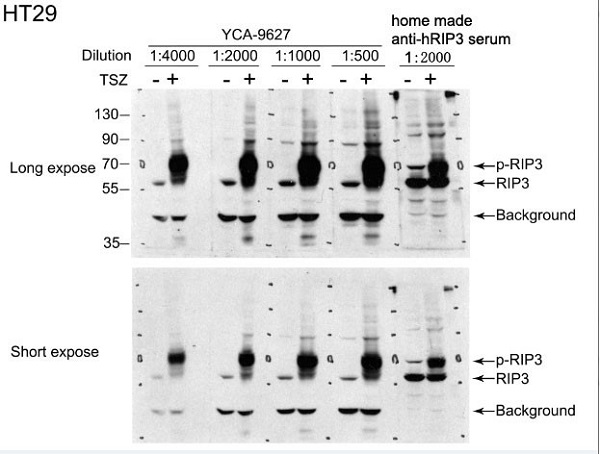
Anti-RIP3 (phospho S227) antibody [EPR9627]
RabMAb|Recombinant|20ul selling size
- 0
- 0
Primary Antibodies
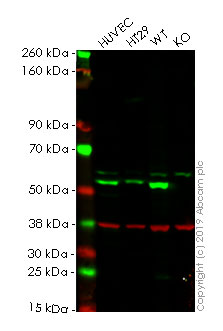
AB184718
RabMAb|Recombinant|KO Validated|20ul selling size
- 5
- 5
Reactivity data
Product details
Patented technology
Our RabMAb® technology is a patented hybridoma-based technology for making rabbit monoclonal antibodies. For details on our patents, please refer to RabMAb® patents.
What are the advantages of a recombinant monoclonal antibody?
This product is a recombinant monoclonal antibody, which offers several advantages including:
- - High batch-to-batch consistency and reproducibility
- - Improved sensitivity and specificity
- - Long-term security of supply
- - Animal-free batch production
For more information, read more on recombinant antibodies.
Properties and storage information
Form
Purification technique
Storage buffer
Shipped at conditions
Appropriate short-term storage duration
Appropriate short-term storage conditions
Appropriate long-term storage conditions
Aliquoting information
Storage information
Supplementary information
This supplementary information is collated from multiple sources and compiled automatically.
Biological function summary
RIP3 facilitates the execution of necroptosis a form of programmed cell death distinct from apoptosis. It becomes activated upon binding with RIP1 forming a necrosome complex that is essential for this pathway. This complex promotes phosphorylation events that subsequently lead to membrane rupture and cell death. Apart from its role in necroptosis RIP3 also engages in metabolic regulation processes linking energy status and cell death under conditions of stress.
Pathways
RIP3 is a principal component of the necroptotic pathway interacting closely with RIP1 to trigger cell death in conditions where caspase activation is inhibited. Alternatively it integrates into metabolic pathways participating in sensing and responding to changes in cellular energy states. The interplay between RIP3 and RIP1 within these pathways illustrates their shared involvement in maintaining cellular homeostasis and triggering cell death when necessary.
Product protocols
- Visit the General protocols
- Visit the Troubleshooting
Target data
Alternative Names
Publications (1)
Recent publications for all applications. Explore the full listand refine your search
Apoptosis : an international journal on programmed cell death 30:880-893 PubMed39833632
2025
Applications
Unspecified application
Species
Unspecified reactive species
Product promise
Please note: All products are 'FOR RESEARCH USE ONLY. NOT FOR USE IN DIAGNOSTIC OR THERAPEUTIC PROCEDURES'.
For licensing inquiries, please contact partnerships@abcam.com