Anti-RRP7A antibody [EPR14412] - C-terminal
- RabMAb
- Recombinant
- What is this?
Be the first to review this product! Submit a review
|
(1 Publication)
Rabbit Recombinant Monoclonal RRP7A antibody. C-terminal. Suitable for WB, ICC/IF and reacts with Human samples. Cited in 1 publication.
View Alternative Names
CGI-96, RRP7A, Ribosomal RNA-processing protein 7 homolog A, Gastric cancer antigen Zg14
- ICC/IF
Supplier Data
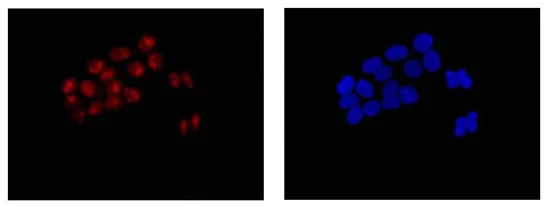
Immunocytochemistry/ Immunofluorescence - Anti-RRP7A antibody [EPR14412] - C-terminal (AB185225)
Immunofluorescent analysis of 293T cells (4% paraformaldehyde-fixed) labeling RRP7A with ab185225 at 1/100 dilution followed by Goat anti rabbit IgG (AlexaFluor® 555) secondary at 1/200 dilution and counter-stained with DAPI (blue).
- WB
Supplier Data
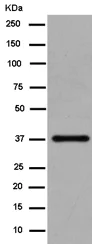
Western blot - Anti-RRP7A antibody [EPR14412] - C-terminal (AB185225)
All lanes:
Western blot - Anti-RRP7A antibody [EPR14412] - C-terminal (ab185225) at 1/1000 dilution
All lanes:
HeLa cell lysate at 20 µg
Secondary
All lanes:
Goat Anti-Rabbit IgG, (H+L), Peroxidase conjugate at 1/1000 dilution
Predicted band size: 32 kDa
false
- WB
Supplier Data
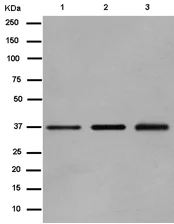
Western blot - Anti-RRP7A antibody [EPR14412] - C-terminal (AB185225)
All lanes:
Western blot - Anti-RRP7A antibody [EPR14412] - C-terminal (ab185225) at 1/5000 dilution
Lane 1:
MCF7 cell lysate at 20 µg
Lane 2:
293T cell lysate at 20 µg
Lane 3:
A431 cell lysate at 20 µg
Secondary
All lanes:
Goat Anti-Rabbit IgG, (H+L), Peroxidase conjugate at 1/1000 dilution
Predicted band size: 32 kDa
false
Related conjugates and formulations (1)
-
Anti-RRP7A antibody [EPR14412] - BSA and Azide free
Complementary Products


Primary Antibodies
AB248203
Anti-5HT7 Receptor antibody [EPR6271] - BSA and Azide free
RabMAb|Recombinant

- 0
- 0

Reactivity data
Product details
Patented technology
Our RabMAb® technology is a patented hybridoma-based technology for making rabbit monoclonal antibodies. For details on our patents, please refer to RabMAb® patents.
What are the advantages of a recombinant monoclonal antibody?
This product is a recombinant monoclonal antibody, which offers several advantages including:
- - High batch-to-batch consistency and reproducibility
- - Improved sensitivity and specificity
- - Long-term security of supply
- - Animal-free batch production
For more information, read more on recombinant antibodies.
Properties and storage information
Form
Purification technique
Storage buffer
Shipped at conditions
Appropriate short-term storage duration
Appropriate short-term storage conditions
Appropriate long-term storage conditions
Aliquoting information
Storage information
Supplementary information
This supplementary information is collated from multiple sources and compiled automatically.
Biological function summary
RRP7A plays an important role in ribosome biogenesis an essential process for the synthesis of proteins. It is part of the small-subunit (SSU) processome complex which is involved in the maturation of 18S rRNA a critical component of the small ribosomal subunit. The SSU processome is essential for early steps of 40S ribosomal subunit assembly. RRP7A acts in association with other proteins within this complex to facilitate the accurate processing of pre-rRNA into functional rRNA molecules necessary for proper ribosomal function.
Pathways
Ribosomal RNA processing represents a critical aspect of translation and protein synthesis. RRP7A fits into the ribosome biogenesis pathway ensuring the correct formation and function of ribosomes. This pathway involves several other proteins including FBL (Fibrillarin) and DDX5 which work alongside RRP7A within the SSU processome. Together these components contribute to the intricate steps of rRNA processing from transcription to the assembly and transport of ribosomal subunits. This makes RRP7A integral to maintaining cellular protein synthesis capacity.
Product protocols
- Visit the General protocols
- Visit the Troubleshooting
Target data
Publications (1)
Recent publications for all applications. Explore the full list and refine your search
Nature communications 14:5853 PubMed37730811
2023
Applications
Unspecified application
Species
Unspecified reactive species
Product promise
Please note: All products are 'FOR RESEARCH USE ONLY. NOT FOR USE IN DIAGNOSTIC OR THERAPEUTIC PROCEDURES'.
For licensing inquiries, please contact partnerships@abcam.com