JavaScript is disabled in your browser. Please enable JavaScript to view this website.
AB200485

Anti-SAA1 antibody [D9H4L41]

Be the first to review this product! Submit a review

|

(2 Publications )
Rabbit Recombinant Monoclonal Serum Amyloid A 1 antibody. Suitable for WB and reacts with Mouse samples. Cited in 2 publications.
1 Images
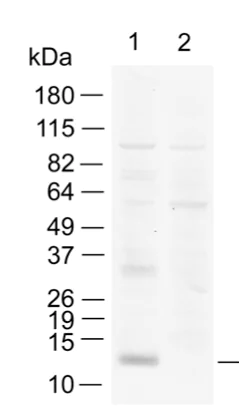
Western blot - Anti-SAA1 antibody [D9H4L41] (AB200485)
  • WB

Supplier Data

Western blot - Anti-SAA1 antibody [D9H4L41] (AB200485)

All lanes:

Western blot - Anti-SAA1 antibody [D9H4L41] (ab200485) at 2.5 µg/mL

Lane 1:

LPS treated Mouse spleen lysate at 30 µg

Lane 2:

untreated Mouse spleen lysate at 30 µg

Predicted band size: 14 kDa

false

Key facts

Host species

Rabbit

Clonality

Monoclonal

Clone number

D9H4L41

Isotype

IgG

Carrier free

No

Reacts with

Mouse

Applications

WB

applications

Reactivity data

{ "title": "Reactivity Data", "filters": { "stats": ["", "Species", "Dilution Info", "Notes"], "tabs": { "all-applications": {"fullname" : "All Applications", "shortname": "All Applications"}, "WB" : {"fullname" : "Western blot", "shortname":"WB"} }, "product-promise": { "all": "all", "testedAndGuaranteed": "tested", "guaranteed": "expected", "predicted": "predicted", "notRecommended": "not-recommended" } }, "values": { "Mouse": { "WB-species-checked": "testedAndGuaranteed", "WB-species-dilution-info": "2-5 µg/mL", "WB-species-notes": "<p></p>" } } }

Properties and storage information

Form
Liquid
Purification technique
Affinity purification Protein A
Storage buffer
Preservative: 0.09% Sodium azide Constituents: PBS
Shipped at conditions
Blue Ice
Appropriate short-term storage duration
1-2 weeks
Appropriate short-term storage conditions
+4°C
Appropriate long-term storage conditions
-20°C
Aliquoting information
Upon delivery aliquot
Storage information
Avoid freeze / thaw cycle

Supplementary information

This supplementary information is collated from multiple sources and compiled automatically.

Serum amyloid A1 (SAA1) is a small protein with a molecular mass of approximately 12 kDa. Researchers also call it SAA or acute phase serum amyloid protein. Hepatocytes mainly express SAA1 during the acute phase response but some expression occurs in other tissues. SAA1 significantly increases in response to inflammatory stimuli acting as an important player in the body's reaction to injury or infection.
Biological function summary

This protein regulates cholesterol metabolism and serves as a chemoattractant directing cell movement towards the sites of inflammation. SAA1 does not exist alone often associating with high-density lipoproteins (HDL) in circulation. By binding to HDL it can aid in transporting cholesterol from tissues to the liver for excretion linking it with both immunological and metabolic processes.

Pathways

Researchers place SAA1 within the inflammation and immune response strategies. It significantly contributes to the acute-phase response and relates to cytokine signaling pathways. SAA1 interacts with proteins such as interleukin-6 (IL-6) and tumor necrosis factor-alpha (TNF-alpha) which are central to the activation and propagation of inflammatory responses in tissues.

SAA1 closely associates with chronic inflammatory conditions and amyloidosis. Excessive SAA1 levels can lead to amyloid A (AA) amyloidosis where protein fragments deposit abnormally in organs. It also plays a role in conditions like rheumatoid arthritis where inflammation perpetuates disease progression. Interestingly SAA1 levels correlate with C-reactive protein (CRP) another marker of inflammation frequent in similar disorders.

Product protocols

For this product, it's our understanding that no specific protocols are required. You can visit:

Target data

Major acute phase protein.
See full target information Serum amyloid A-1 protein

Alternative Names

Serum amyloid A-1 protein, Saa1

Publications (2)

Recent publications for all applications. Explore the full listand refine your search

Frontiers in aging neuroscience 17:1608631 PubMed40860217

2025

Increased tau-induced inflammatory responses are associated with a greater degree of atherosclerosis in progressive supranuclear palsy.

Applications

Unspecified application

Species

Unspecified reactive species

Yi-Xin He,Rui Zhang,Chen Xie,Si-Fan Ji,Wen-Jing Deng,Jun-Fang Teng

Scientific reports 14:13390 PubMed38862642

2024

Identification of a risk model for prognostic and therapeutic prediction in renal cell carcinoma based on infiltrating M0 cells.

Applications

Unspecified application

Species

Unspecified reactive species

Shiyong Xin,Junjie Su,Ruixin Li,Qiong Cao,Haojie Wang,Zhihao Wei,Chengliang Wang,Chengdong Zhang
View all publications

Product promise

We are committed to supporting your work with high-quality reagents, and we're here for you every step of the way. In the unlikely event that one of our products does not perform as expected, you're protected by our Product Promise.
For full details, please see our Terms & Conditions

Please note: All products are 'FOR RESEARCH USE ONLY. NOT FOR USE IN DIAGNOSTIC OR THERAPEUTIC PROCEDURES'.

For licensing inquiries, please contact partnerships@abcam.com