Anti-SEPT7 antibody [EPR12610]
- RabMAb
- Recombinant
- What is this?
Be the first to review this product! Submit a review
|
(5 Publications )
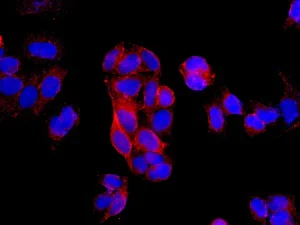
- ICC/IF
Supplier Data
Immunocytochemistry/ Immunofluorescence - Anti-SEPT7 antibody [EPR12610] (AB175229)
Immunofluorescent analysis of HeLa cells labeling SEPT7 with ab175229 at 1/50 dilution. DAPI nuclear staining (blue).
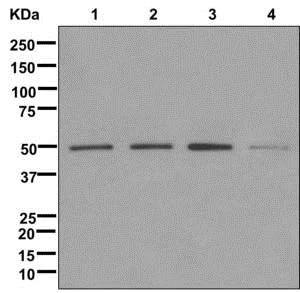
- WB
Supplier Data
Western blot - Anti-SEPT7 antibody [EPR12610] (AB175229)
All lanes:
Western blot - Anti-SEPT7 antibody [EPR12610] (ab175229) at 1/1000 dilution
Lane 1:
Jurkat cell lysate at 10 µg
Lane 2:
HeLa cell lysate at 10 µg
Lane 3:
MCF7 cell lysate at 10 µg
Lane 4:
HepG2 cell lysate at 10 µg
Predicted band size: 51 kDa
false
Related conjugates and formulations (1)
-
Anti-SEPT7 antibody [EPR12610] - BSA and Azide free
Alternative Products
Complementary Products


Primary Antibodies
AB314670
Anti-RGS5 antibody [EPR28539-64]
BOND RX™ Validated|20ul selling size|RabMAb|Recombinant
- 0
- 1
Reactivity data
Product details
Patented technology
Our RabMAb® technology is a patented hybridoma-based technology for making rabbit monoclonal antibodies. For details on our patents, please refer to RabMAb® patents.
What are the advantages of a recombinant monoclonal antibody?
This product is a recombinant monoclonal antibody, which offers several advantages including:
- - High batch-to-batch consistency and reproducibility
- - Improved sensitivity and specificity
- - Long-term security of supply
- - Animal-free batch production
For more information, read more on recombinant antibodies.
Properties and storage information
Form
Purification technique
Storage buffer
Shipped at conditions
Appropriate short-term storage duration
Appropriate short-term storage conditions
Appropriate long-term storage conditions
Aliquoting information
Storage information
Supplementary information
This supplementary information is collated from multiple sources and compiled automatically.
Biological function summary
In cellular environments SEPT7 is a part of the septin complex which is important for maintaining cell shape and polarity. It participates in processes involving cell division particularly during cytokinesis where it helps in forming the contractile ring necessary for dividing cells. SEPT7 also interacts with actin and microtubules facilitating cell movement and intracellular transport. This protein's dynamics contribute to the stability and segregation of cellular components during cell division.
Pathways
SEPT7 plays a role in the regulation of the actin cytoskeleton and cell cycle pathways. It interacts with proteins like actin an important component in cellular motion and structure. SEPT7's involvement in the cellular cycle pathway connects it to proteins such as CDC42 which regulate cell proliferation and differentiation. These interactions make SEPT7 significant in controlling the proper progression through different cell cycle phases.
Product protocols
- Visit the General protocols
- Visit the Troubleshooting
Target data
Alternative Names
Publications (5)
Recent publications for all applications. Explore the full listand refine your search
Cell reports 41:111766 PubMed36476872
2022
Applications
Unspecified application
Species
Unspecified reactive species
The Journal of cell biology 220: PubMed33861319
2021
Applications
Unspecified application
Species
Unspecified reactive species
The Journal of cell biology 219: PubMed31865373
2019
Applications
Unspecified application
Species
Unspecified reactive species
Biochemical and biophysical research communication 506:522-528 PubMed30361092
2018
Applications
Unspecified application
Species
Unspecified reactive species
Journal of Alzheimer's disease : JAD 59:1123-1137 PubMed28731446
2017
Applications
Unspecified application
Species
Unspecified reactive species
Product promise
Please note: All products are 'FOR RESEARCH USE ONLY. NOT FOR USE IN DIAGNOSTIC OR THERAPEUTIC PROCEDURES'.
For licensing inquiries, please contact partnerships@abcam.com