JavaScript is disabled in your browser. Please enable JavaScript to view this website.
AB113984

Anti-SETD1B antibody

5

(1 Review)

|

(3 Publications)

Rabbit Polyclonal SETD1B antibody. Suitable for IHC-P, IP and reacts with Human samples. Cited in 3 publications. Immunogen corresponding to Synthetic Peptide within Human SETD1B aa 350-400.

View Alternative Names

KIAA1076, KMT2G, SET1B, SETD1B, Histone-lysine N-methyltransferase SETD1B, Lysine N-methyltransferase 2G, SET domain-containing protein 1B, hSET1B
2 Images
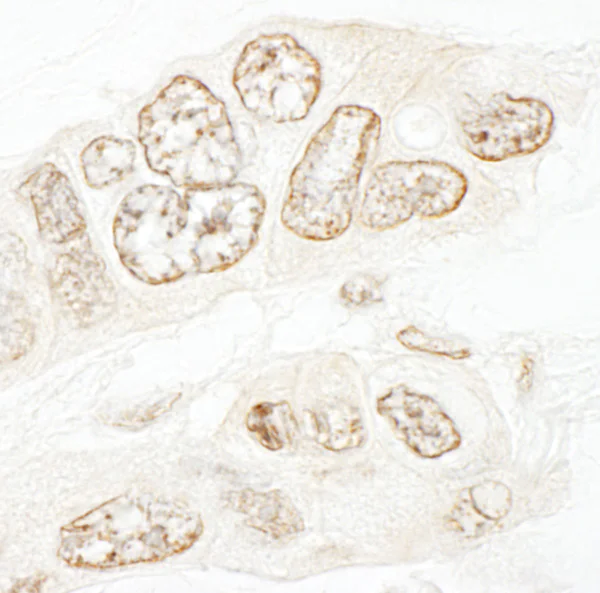
Immunohistochemistry (Formalin/PFA-fixed paraffin-embedded sections) - Anti-SETD1B antibody (AB113984)
  • IHC-P

Unknown

Immunohistochemistry (Formalin/PFA-fixed paraffin-embedded sections) - Anti-SETD1B antibody (AB113984)

Immunohistochemistry (Formalin/PFA-fixed paraffin-embedded sections) analysis of human ovarian carcinoma tissue labelling KMT2G / hSET1B with ab113984 at 1/1000 (1µg/ml). Detection : DAB.
Immunoprecipitation - Anti-SETD1B antibody (AB113984)
  • IP

Unknown

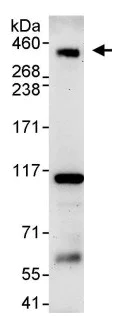
Immunoprecipitation - Anti-SETD1B antibody (AB113984)

ab113984 used at 10 μg/mg of lysate staining SETD1B in HeLa whole cell lysate (1 mg for IP, 20% of IP loaded) by immunoprecipitation. For blotting immunoprecipitated SETD1B, ab113984 was used at 1 μg/ml.

Detection : Chemiluminescence with an exposure time of 3 minutes.

All lanes:

Immunoprecipitation - Anti-SETD1B antibody (ab113984)

Predicted band size: 209 kDa

false

Key facts

Host species

Rabbit

Clonality

Polyclonal

Isotype

IgG

Carrier free

No

Reacts with

Human

Applications

IHC-P, IP

applications

Immunogen

Synthetic Peptide within Human SETD1B aa 350-400. The exact immunogen used to generate this antibody is proprietary information.

Q9UPS6

Reactivity data

{ "title": "Reactivity Data", "filters": { "stats": ["", "Species", "Dilution Info", "Notes"], "tabs": { "all-applications": {"fullname" : "All Applications", "shortname": "All Applications"}, "IHCP" : {"fullname" : "Immunohistochemistry (Formalin/PFA-fixed paraffin-embedded sections)", "shortname":"IHC-P"}, "IP" : {"fullname" : "Immunoprecipitation", "shortname":"IP"} }, "product-promise": { "all": "all", "testedAndGuaranteed": "tested", "guaranteed": "expected", "predicted": "predicted", "notRecommended": "not-recommended" } }, "values": { "Human": { "IHCP-species-checked": "testedAndGuaranteed", "IHCP-species-dilution-info": "1/500 - 1/2000", "IHCP-species-notes": "<p></p> Perform heat-mediated antigen retrieval with citrate buffer pH 6 before commencing with IHC staining protocol.", "IP-species-checked": "testedAndGuaranteed", "IP-species-dilution-info": "10 µg/mg of lysate", "IP-species-notes": "<p></p>" }, "Chimpanzee": { "IHCP-species-checked": "predicted", "IHCP-species-dilution-info": "", "IHCP-species-notes": "", "IP-species-checked": "predicted", "IP-species-dilution-info": "", "IP-species-notes": "" }, "Cow": { "IHCP-species-checked": "predicted", "IHCP-species-dilution-info": "", "IHCP-species-notes": "", "IP-species-checked": "predicted", "IP-species-dilution-info": "", "IP-species-notes": "" }, "Gorilla": { "IHCP-species-checked": "predicted", "IHCP-species-dilution-info": "", "IHCP-species-notes": "", "IP-species-checked": "predicted", "IP-species-dilution-info": "", "IP-species-notes": "" }, "Rabbit": { "IHCP-species-checked": "predicted", "IHCP-species-dilution-info": "", "IHCP-species-notes": "", "IP-species-checked": "predicted", "IP-species-dilution-info": "", "IP-species-notes": "" } } }

Properties and storage information

Form
Liquid
Purification technique
Affinity purification Immunogen
Purification notes
ab113984 is affinity purified using an epitope specific to SETD1B immobilized on solid support.
Storage buffer
pH: 7 - 8 Preservative: 0.09% Sodium azide Constituents: 99% Tris citrate/phosphate
Shipped at conditions
Blue Ice
Appropriate short-term storage conditions
+4°C
Appropriate long-term storage conditions
+4°C
Aliquoting information
Upon delivery aliquot
Storage information
Avoid freeze / thaw cycle

Supplementary information

This supplementary information is collated from multiple sources and compiled automatically.

SETD1B also known as KMT2G is a histone methyltransferase protein with a molecular mass of approximately 200 kDa. It functions mechanically by specifically methylating lysine 4 on histone H3 (H3K4) a critical action for chromatin modification. This methylation regulates gene transcription and the enzyme predominantly exerts its effects in the nucleus. SETD1B expresses across various tissues which suggests a broad regulatory role in different cellular environments.
Biological function summary

The role of SETD1B extends to functioning as part of the SET1/MLL complex which is responsible for the mono- di- and tri-methylation of histone H3 at lysine 4 (H3K4). The complex plays a significant role in transcriptional regulation influencing gene activation and silencing across different cellular processes. SETD1B's activity modulates the expression of genes involved in the regulation of development differentiation and cellular proliferation impacting numerous biological outcomes.

Pathways

The involvement of SETD1B in gene expression regulation positions it notably in the Wnt signaling pathway. This pathway is important for controlling cell fate and proliferation. Furthermore SETD1B interacts with other proteins like β-catenin enhancing transcription of Wnt target genes. Additionally SETD1B takes part in the regulation of pathways involving chromatin remodeling associating closely with proteins such as ASH2L which affects histone methylation states.

Alterations in SETD1B are linked to intellectual disability and autism spectrum disorders. Disruptions in the protein's methylation function can lead to improper gene expression patterns emphasizing its association with neurodevelopmental conditions. SETD1B also connects with the CBP protein in certain cancer pathways where abnormal histone modification can drive oncogenesis. These interactions highlight SETD1B's significance in maintaining regular cellular function and its potential impact when mutant or dysregulated.

Product protocols

For this product, it's our understanding that no specific protocols are required. You can visit:

Target data

Histone methyltransferase that catalyzes methyl group transfer from S-adenosyl-L-methionine to the epsilon-amino group of 'Lys-4' of histone H3 (H3K4) via a non-processive mechanism (PubMed : 17355966, PubMed : 25561738). Part of chromatin remodeling machinery, forms H3K4me1, H3K4me2 and H3K4me3 methylation marks at active chromatin sites where transcription and DNA repair take place (PubMed : 17355966, PubMed : 25561738). Plays an essential role in regulating the transcriptional programming of multipotent hematopoietic progenitor cells and lymphoid lineage specification during hematopoiesis (By similarity).
See full target information SETD1B

Publications (3)

Recent publications for all applications. Explore the full list and refine your search

Cell death & disease 11:147 PubMed32094334

2020

EMT transcription factor ZEB1 alters the epigenetic landscape of colorectal cancer cells.

Applications

Unspecified application

Species

Unspecified reactive species

Pablo Lindner,Sushmita Paul,Markus Eckstein,Chuanpit Hampel,Julienne K Muenzner,Katharina Erlenbach-Wuensch,Husayn P Ahmed,Vijayalakshmi Mahadevan,Thomas Brabletz,Arndt Hartmann,Julio Vera,Regine Schneider-Stock

International journal of cancer 145:2986-2995 PubMed30977120

2019

SET domain containing 1B gene is mutated in primary hepatic neuroendocrine tumors.

Applications

Unspecified application

Species

Unspecified reactive species

Penghui Yang,Xuanlin Huang,Chengcai Lai,Lin Li,Tieling Li,Peide Huang,Songying Ouyang,Jin Yan,Sijie Cheng,Guanglin Lei,Zhaohai Wang,Linxiang Yu,Zhixian Hong,Ruisheng Li,Hui Dong,Cheng Wang,Yinghao Yu,Xuan Wang,Xianghong Li,Liming Wang,Fudong Lv,Ye Yin,Huanming Yang,Jianxun Song,Qiang Gao,Xiliang Wang,Shaogeng Zhang

Molecular medicine reports 19:1587-1594 PubMed30628696

2019

High‑level SETD1B gene expression is associated with unfavorable prognosis in hepatocellular carcinoma.

Applications

Unspecified application

Species

Unspecified reactive species

Dong Chen,Tieling Li,Cheng Wang,Guanglin Lei,Ruilan Wang,Zhaohai Wang,Linxiang Yu,Jin Yan,Peirui Zhang,Xiliang Wang,Shaogeng Zhang,Penghui Yang
View all publications

Product promise

We are committed to supporting your work with high-quality reagents, and we're here for you every step of the way. In the unlikely event that one of our products does not perform as expected, you're protected by our Product Promise.
For full details, please see our Terms & Conditions

Please note: All products are 'FOR RESEARCH USE ONLY. NOT FOR USE IN DIAGNOSTIC OR THERAPEUTIC PROCEDURES'.

For licensing inquiries, please contact partnerships@abcam.com