JavaScript is disabled in your browser. Please enable JavaScript to view this website.
AB14685

Anti-SGLT1 antibody

5

(2 Reviews)

|

(27 Publications )
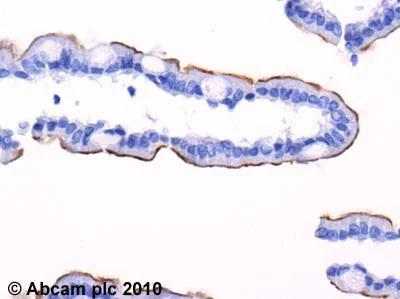
Rabbit Polyclonal SGLT1 antibody. Suitable for IHC-P and reacts with Human samples. Cited in 27 publications. Immunogen corresponding to Synthetic Peptide within Human SLC5A1 aa 600-650.
1 Images
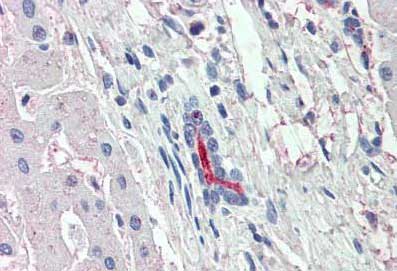
Immunohistochemistry (Formalin/PFA-fixed paraffin-embedded sections) - Anti-SGLT1 antibody (AB14685)
  • IHC-P

Unknown

Immunohistochemistry (Formalin/PFA-fixed paraffin-embedded sections) - Anti-SGLT1 antibody (AB14685)

ab14685 (2µg/ml) staining SGLT1 in human ileum using an automated system (DAKO Autostainer Plus). Using this protocol there is staining of the apical epithelium cells of the villi.
Sections were rehydrated and antigen retrieved with the Dako 3 in 1 AR buffers EDTA pH 9.0 in a DAKO PT link. Slides were peroxidase blocked in 3% H2O2 in methanol for 10 mins. They were then blocked with Dako Protein block for 10 minutes (containing casein 0.25% in PBS) then incubated with primary antibody for 20 min and detected with Dako envision flex amplification kit for 30 minutes. Colorimetric detection was completed with Diaminobenzidine for 5 minutes. Slides were counterstained with Haematoxylin and coverslipped under DePeX. Please note that, for manual staining, optimization of primary antibody concentration and incubation time is recommended. Signal amplification may be required.

Key facts

Host species

Rabbit

Clonality

Polyclonal

Isotype

IgG

Carrier free

No

Reacts with

Human

Applications

IHC-P

applications

Immunogen

Synthetic Peptide within Human SLC5A1 aa 600-650. The exact immunogen used to generate this antibody is proprietary information.

P13866

Specificity

The immunogen used for this product shares 75% homology with SGLT5. Cross-reactivity with this protein has not been confirmed experimentally.

Reactivity data

{ "title": "Reactivity Data", "filters": { "stats": ["", "Species", "Dilution Info", "Notes"], "tabs": { "all-applications": {"fullname" : "All Applications", "shortname": "All Applications"}, "IHCP" : {"fullname" : "Immunohistochemistry (Formalin/PFA-fixed paraffin-embedded sections)", "shortname":"IHC-P"} }, "product-promise": { "all": "all", "testedAndGuaranteed": "tested", "guaranteed": "expected", "predicted": "predicted", "notRecommended": "not-recommended" } }, "values": { "Human": { "IHCP-species-checked": "testedAndGuaranteed", "IHCP-species-dilution-info": "2 µg/mL", "IHCP-species-notes": "<p></p>" } } }

Properties and storage information

Form
Liquid
Purification technique
Affinity purification Immunogen
Storage buffer
Preservative: 0.02% Sodium azide Constituents: HEPES, Tris glycine, 30% Glycerol (glycerin, glycerine), 0.5% BSA
Shipped at conditions
Blue Ice
Appropriate short-term storage duration
1-2 weeks
Appropriate short-term storage conditions
+4°C
Appropriate long-term storage conditions
-20°C
Aliquoting information
Upon delivery aliquot
Storage information
Avoid freeze / thaw cycle

Supplementary information

This supplementary information is collated from multiple sources and compiled automatically.

SGLT1 also known as sodium/glucose cotransporter 1 or SLC5A1 is a membrane protein actively responsible for glucose and galactose uptake in the small intestine and renal tubules. It has a molecular mass of approximately 73 kDa. Expressed mainly in the brush border of the enterocytes in the small intestinal lining and to a lesser degree in the kidney SGLT1 functions by coupling the transport of glucose to sodium ions' electrochemical gradient enabling effective nutrient absorption.
Biological function summary

SGLT1's main role is in facilitating nutrient absorption in the gastrointestinal tract. It operates as part of the larger SGLT protein family but does not form a complex with other proteins. The protein is essential for the transport of monosaccharides from the gut into circulation. By ensuring glucose and galactose absorption during digestive processes SGLT1 provides necessary carbohydrates for cellular metabolism and systemic energy homeostasis.

Pathways

The transport protein SGLT1 is integral to the glucose uptake pathway. This pathway intersects with the insulin signaling pathway because the glucose absorbed by SGLT1 later enters systemic circulation. SGLT1 also complements the GLUT family of transporters especially GLUT2 which function downstream by facilitating glucose transport across the intestinal basolateral membrane into the bloodstream. The interplay between these transport mechanisms maintains glucose levels post-ingestion.

SGLT1 dysfunction is linked to glucose-galactose malabsorption a genetic disorder causing severe dehydration and diarrhea due to glucose and galactose accumulation in the lumen. Additionally research investigates SGLT1's contribution to diabetes management given its role in glucose absorption. The protein's activity along with related proteins like GLUT2 and GLUT4 could influence insulin resistance and glucose homeostasis in metabolic syndromes. Understanding SGLT1 in these contexts enables potential therapeutic interventions for conditions involving disordered glucose metabolism.

Product protocols

For this product, it's our understanding that no specific protocols are required. You can visit:

Target data

Electrogenic Na(+)-coupled sugar symporter that actively transports D-glucose or D-galactose at the plasma membrane, with a Na(+) to sugar coupling ratio of 2 : 1. Transporter activity is driven by a transmembrane Na(+) electrochemical gradient set by the Na(+)/K(+) pump (PubMed : 20980548, PubMed : 34880492, PubMed : 35077764, PubMed : 8563765, PubMed : 37217492). Has a primary role in the transport of dietary monosaccharides from enterocytes to blood. Responsible for the absorption of D-glucose or D-galactose across the apical brush-border membrane of enterocytes, whereas basolateral exit is provided by GLUT2. Additionally, functions as a D-glucose sensor in enteroendocrine cells, triggering the secretion of the incretins GCG and GIP that control food intake and energy homeostasis (By similarity) (PubMed : 8563765). Together with SGLT2, functions in reabsorption of D-glucose from glomerular filtrate, playing a nonredundant role in the S3 segment of the proximal tubules (By similarity). Transports D-glucose into endometrial epithelial cells, controlling glycogen synthesis and nutritional support for the embryo as well as the decidual transformation of endometrium prior to conception (PubMed : 28974690). Acts as a water channel enabling passive water transport across the plasma membrane in response to the osmotic gradient created upon sugar and Na(+) uptake. Has high water conductivity, comparable to aquaporins, and therefore is expected to play an important role in transepithelial water permeability, especially in the small intestine.
See full target information SLC5A1

Alternative Names

NAGT, SGLT1, SLC5A1, Sodium/glucose cotransporter 1, Na(+)/glucose cotransporter 1, High affinity sodium-glucose cotransporter, Solute carrier family 5 member 1

Publications (27)

Recent publications for all applications. Explore the full listand refine your search

Basic research in cardiology 119:733-749 PubMed39088085

2024

SGLT1 contributes to glucose-mediated exacerbation of ischemia-reperfusion injury in ex vivo rat heart.

Applications

Unspecified application

Species

Unspecified reactive species

Alhanoof Almalki,Sapna Arjun,Idris Harding,Hussain Jasem,Maria Kolatsi-Joannou,Daniyal J Jafree,Gideon Pomeranz,David A Long,Derek M Yellon,Robert M Bell

Nutrients 15: PubMed37836505

2023

Predictive Potential of Biomarkers of Intestinal Barrier Function for Therapeutic Management with Teduglutide in Patients with Short Bowel Syndrome.

Applications

Unspecified application

Species

Unspecified reactive species

Janine Büttner,Elisabeth Blüthner,Sophie Greif,Anja Kühl,Sefer Elezkurtaj,Jan Ulrich,Sebastian Maasberg,Christoph Jochum,Frank Tacke,Ulrich-Frank Pape

iScience 26:107260 PubMed37520739

2023

SGLT1/2 inhibition improves glycemic control and multi-organ protection in type 1 diabetes.

Applications

Unspecified application

Species

Unspecified reactive species

Lakshini Yasaswi Herat,Jennifer Rose Matthews,Moira Hibbs,Elizabeth Piroska Rakoczy,Markus Peter Schlaich,Vance Bruce Matthews

Scientific reports 13:10838 PubMed37407613

2023

Regulatory mechanisms of glucose absorption in the mouse proximal small intestine during fasting and feeding.

Applications

Unspecified application

Species

Unspecified reactive species

Chisato Nakamura,Noriko Ishizuka,Kanako Yokoyama,Yuyu Yazaki,Fumiya Tatsumi,Naotaka Ikumi,Wendy Hempstock,Akira Ikari,Yuta Yoshino,Hisayoshi Hayashi

BMC cancer 22:116 PubMed35090421

2022

The expression and survival significance of sodium glucose transporters in pancreatic cancer.

Applications

Unspecified application

Species

Unspecified reactive species

Jiali Du,Jichun Gu,Junyuan Deng,Lei Kong,Yujie Guo,Chen Jin,Yun Bao,Deliang Fu,Ji Li

Kidney360 2:1441-1454 PubMed34651140

2021

Peroxisomal L-bifunctional protein (EHHADH) deficiency causes male-specific kidney hypertrophy and proximal tubular injury in mice.

Applications

Unspecified application

Species

Unspecified reactive species

Pablo Ranea-Robles,Kensey Portman,Aaron Bender,Kyung Lee,John Cijiang He,David J Mulholland,Carmen Argmann,Sander M Houten

Cardiovascular diabetology 20:65 PubMed33726768

2021

Angiotensin II-induced upregulation of SGLT1 and 2 contributes to human microparticle-stimulated endothelial senescence and dysfunction: protective effect of gliflozins.

Applications

Unspecified application

Species

Unspecified reactive species

Sin-Hee Park,Eugenia Belcastro,Hira Hasan,Kensuke Matsushita,Benjamin Marchandot,Malak Abbas,Florence Toti,Cyril Auger,Laurence Jesel,Patrick Ohlmann,Olivier Morel,Valérie B Schini-Kerth

International journal of molecular sciences 21: PubMed33008107

2020

Glucose, Fructose, and Urate Transporters in the Choroid Plexus Epithelium.

Applications

Unspecified application

Species

Unspecified reactive species

Yoichi Chiba,Ryuta Murakami,Koichi Matsumoto,Keiji Wakamatsu,Wakako Nonaka,Naoya Uemura,Ken Yanase,Masaki Kamada,Masaki Ueno

Biochimica et biophysica acta. Molecular basis of disease 1866:165898 PubMed32711050

2020

HNF1α controls glucagon secretion in pancreatic α-cells through modulation of SGLT1.

Applications

Unspecified application

Species

Unspecified reactive species

Yoshifumi Sato,Md Mostafizur Rahman,Masaki Haneda,Tomonori Tsuyama,Tomoya Mizumoto,Tatsuya Yoshizawa,Tadahiro Kitamura,Frank J Gonzalez,Ken-Ichi Yamamura,Kazuya Yamagata

Neuropathology : official journal of the Japanese 40:482-491 PubMed32488949

2020

Sodium/glucose cotransporter 2 is expressed in choroid plexus epithelial cells and ependymal cells in human and mouse brains.

Applications

Unspecified application

Species

Unspecified reactive species

Yoichi Chiba,Yasunori Sugiyama,Nozomu Nishi,Wakako Nonaka,Ryuta Murakami,Masaki Ueno
View all publications

Product promise

We are committed to supporting your work with high-quality reagents, and we're here for you every step of the way. In the unlikely event that one of our products does not perform as expected, you're protected by our Product Promise.
For full details, please see our Terms & Conditions

Please note: All products are 'FOR RESEARCH USE ONLY. NOT FOR USE IN DIAGNOSTIC OR THERAPEUTIC PROCEDURES'.

For licensing inquiries, please contact partnerships@abcam.com