JavaScript is disabled in your browser. Please enable JavaScript to view this website.
AB111619

Anti-Siglec 7 antibody

Be the first to review this product! Submit a review

|

(1 Publication)

Rabbit Polyclonal Siglec 7 antibody. Suitable for WB, ICC/IF and reacts with Human samples. Cited in 1 publication. Immunogen corresponding to Recombinant Fragment Protein within Human SIGLEC7 aa 150 to C-terminus.
2 Images
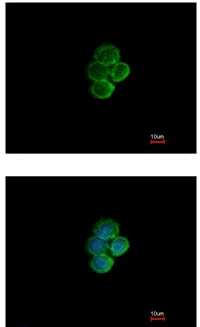
Immunocytochemistry/ Immunofluorescence - Anti-Siglec 7 antibody (AB111619)
  • ICC/IF

Unknown

Immunocytochemistry/ Immunofluorescence - Anti-Siglec 7 antibody (AB111619)

ab111619 at 1/200 dilution staining Siglec 7 in methanol-fixed A431 cells by Immunofluorescence. Lower image shows cells co-stained with Hoechst 33342.
Western blot - Anti-Siglec 7 antibody (AB111619)
  • WB

Supplier Data

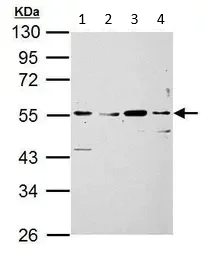
Western blot - Anti-Siglec 7 antibody (AB111619)

Samples were separated by 10% SDS-PAGE.

All lanes:

Western blot - Anti-Siglec 7 antibody (ab111619) at 1/1000 dilution

Lane 1:

K562 whole cell lysate at 30 µg

Lane 2:

THP-1 whole cell lysate at 30 µg

Lane 3:

HL-60 whole cell lysate at 30 µg

Lane 4:

NCI-H929 whole cell lysate at 30 µg

Secondary

All lanes:

HRP-conjugated anti-rabbit IgG antibody

Predicted band size: 51 kDa

false

Key facts

Host species

Rabbit

Clonality

Polyclonal

Isotype

IgG

Carrier free

No

Reacts with

Human

Applications

WB, ICC/IF

applications

Immunogen

Recombinant Fragment Protein within Human SIGLEC7 aa 150 to C-terminus. The exact immunogen used to generate this antibody is proprietary information.

Q9Y286

Reactivity data

{ "title": "Reactivity Data", "filters": { "stats": ["", "Species", "Dilution Info", "Notes"], "tabs": { "all-applications": {"fullname" : "All Applications", "shortname": "All Applications"}, "WB" : {"fullname" : "Western blot", "shortname":"WB"}, "ICCIF" : {"fullname" : "Immunocytochemistry/ Immunofluorescence", "shortname":"ICC/IF"} }, "product-promise": { "all": "all", "testedAndGuaranteed": "tested", "guaranteed": "expected", "predicted": "predicted", "notRecommended": "not-recommended" } }, "values": { "Human": { "WB-species-checked": "testedAndGuaranteed", "WB-species-dilution-info": "1/500 - 1/3000", "WB-species-notes": "<p></p>", "ICCIF-species-checked": "testedAndGuaranteed", "ICCIF-species-dilution-info": "1/100 - 1/1000", "ICCIF-species-notes": "<p></p>" } } }

Properties and storage information

Form
Liquid
Purification technique
Affinity purification Immunogen
Storage buffer
pH: 7 Preservative: 0.01% Thimerosal (merthiolate) Constituents: PBS, 20% Glycerol (glycerin, glycerine), 1% BSA
Shipped at conditions
Blue Ice
Appropriate short-term storage conditions
+4°C
Appropriate long-term storage conditions
-20°C
Aliquoting information
Upon delivery aliquot
Storage information
Avoid freeze / thaw cycle

Product protocols

For this product, it's our understanding that no specific protocols are required. You can visit:

Target data

Putative adhesion molecule that mediates sialic-acid dependent binding to cells. Preferentially binds to alpha-2,3- and alpha-2,6-linked sialic acid. Also binds disialogangliosides (disialogalactosyl globoside, disialyl lactotetraosylceramide and disialyl GalNAc lactotetraoslylceramide). The sialic acid recognition site may be masked by cis interactions with sialic acids on the same cell surface. In the immune response, may act as an inhibitory receptor upon ligand induced tyrosine phosphorylation by recruiting cytoplasmic phosphatase(s) via their SH2 domain(s) that block signal transduction through dephosphorylation of signaling molecules. Mediates inhibition of natural killer cells cytotoxicity. May play a role in hemopoiesis. Inhibits differentiation of CD34+ cell precursors towards myelomonocytic cell lineage and proliferation of leukemic myeloid cells (in vitro).
See full target information SIGLEC7

Alternative Names

CD328, AIRM1, SIGLEC7, Sialic acid-binding Ig-like lectin 7, Siglec-7, Adhesion inhibitory receptor molecule 1, CDw328, D-siglec, QA79 membrane protein, p75, AIRM-1

Publications (1)

Recent publications for all applications. Explore the full listand refine your search

Frontiers in aging neuroscience 14:990679 PubMed36337694

2022

Sevoflurane exposure causes neuronal apoptosis and cognitive dysfunction by inducing ER stress activation of the inositol 1, 4, 5-trisphosphate receptor.

Applications

Unspecified application

Species

Unspecified reactive species

Qi Zhang,Yanan Li,Xupeng Wang,Chunping Yin,Qi Zhou,Junfei Guo,Juan Zhao,Xiaohui Xian,Zhiyong Hou,Qiujun Wang
View all publications

Product promise

We are committed to supporting your work with high-quality reagents, and we're here for you every step of the way. In the unlikely event that one of our products does not perform as expected, you're protected by our Product Promise.
For full details, please see our Terms & Conditions

Please note: All products are 'FOR RESEARCH USE ONLY. NOT FOR USE IN DIAGNOSTIC OR THERAPEUTIC PROCEDURES'.

For licensing inquiries, please contact partnerships@abcam.com