JavaScript is disabled in your browser. Please enable JavaScript to view this website.
AB198690

Anti-SIGLEC8 antibody - C-terminal

5

(6 Reviews)

|

(4 Publications )
Rabbit Polyclonal SIGLEC8 antibody. C-terminal. Suitable for IHC-P, WB and reacts with Human samples. Cited in 4 publications. Immunogen corresponding to Synthetic Peptide within Human SIGLEC8.
2 Images
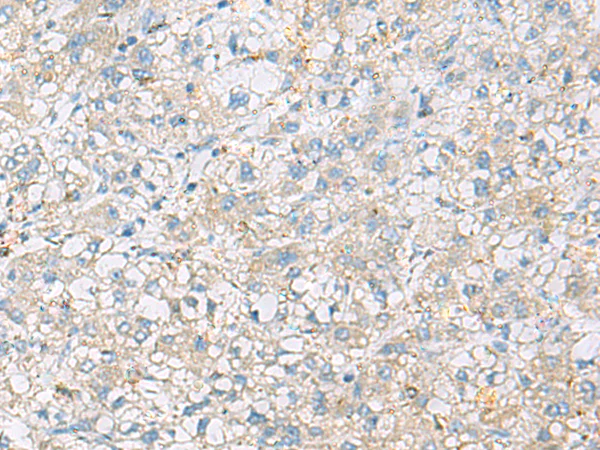
Immunohistochemistry (Formalin/PFA-fixed paraffin-embedded sections) - Anti-SIGLEC8 antibody - C-terminal (AB198690)
  • IHC-P

Unknown

Immunohistochemistry (Formalin/PFA-fixed paraffin-embedded sections) - Anti-SIGLEC8 antibody - C-terminal (AB198690)

Immunohistochemical analysis of paraffin-embedded Human liver cancer tissue using ab198690 at dilution 1/75.

Immunohistochemistry (Formalin/PFA-fixed paraffin-embedded sections) - Anti-SIGLEC8 antibody - C-terminal (AB198690)
  • IHC-P

Unknown

Immunohistochemistry (Formalin/PFA-fixed paraffin-embedded sections) - Anti-SIGLEC8 antibody - C-terminal (AB198690)

Immunohistochemical analysis of paraffin-embedded Human prostate cancer tissue using ab198690 at dilution 1/75.

Key facts

Host species

Rabbit

Clonality

Polyclonal

Isotype

IgG

Carrier free

No

Reacts with

Human

Applications

WB, IHC-P

applications

Immunogen

Synthetic Peptide within Human SIGLEC8. The exact immunogen used to generate this antibody is proprietary information.

Q9NYZ4

Reactivity data

{ "title": "Reactivity Data", "filters": { "stats": ["", "Species", "Dilution Info", "Notes"], "tabs": { "all-applications": {"fullname" : "All Applications", "shortname": "All Applications"}, "IHCP" : {"fullname" : "Immunohistochemistry (Formalin/PFA-fixed paraffin-embedded sections)", "shortname":"IHC-P"}, "WB" : {"fullname" : "Western blot", "shortname":"WB"} }, "product-promise": { "all": "all", "testedAndGuaranteed": "tested", "guaranteed": "expected", "predicted": "predicted", "notRecommended": "not-recommended" } }, "values": { "Human": { "IHCP-species-checked": "testedAndGuaranteed", "IHCP-species-dilution-info": "1/25 - 1/100", "IHCP-species-notes": "<p></p> Perform heat-mediated antigen retrieval with citrate buffer pH 6 before commencing with IHC staining protocol.", "WB-species-checked": "testedAndGuaranteed", "WB-species-dilution-info": "1/500 - 1/2000", "WB-species-notes": "<p></p>" } } }

Product details

Sialic acid-binding immunoglobulin (Ig)-like lectins, or SIGLECs (e.g., CD33 (MIM 159590)), are a family of type 1 transmembrane proteins each having a unique expression pattern, mostly in hemopoietic cells. SIGLEC8 is a member of the CD33-like subgroup of SIGLECs, which are localized to 19q13.3-q13.4 and have 2 conserved cytoplasmic tyrosine-based motifs: an immunoreceptor tyrosine-based inhibitory motif, or ITIM (see MIM 604964), and a motif homologous to one identified in signaling lymphocyte activation molecule (SLAM; MIM 603492) that mediates an association with SLAM-associated protein.

Properties and storage information

Form
Liquid
Purification technique
Affinity purification Immunogen
Storage buffer
pH: 7.4 Preservative: 0.05% Sodium azide Constituents: PBS, 50% Glycerol (glycerin, glycerine)
Shipped at conditions
Blue Ice
Appropriate short-term storage duration
1-2 weeks
Appropriate short-term storage conditions
+4°C
Appropriate long-term storage conditions
-20°C
Aliquoting information
Upon delivery aliquot
Storage information
Avoid freeze / thaw cycle

Supplementary information

This supplementary information is collated from multiple sources and compiled automatically.

SIGLEC8 also known as Sialic acid-binding Ig-like lectin 8 is a protein that functions primarily as a receptor. It has a molecular mass of approximately 50 kDa. SIGLEC8 is expressed on the surface of certain immune cells specifically eosinophils basophils and to a lesser extent mast cells. This receptor plays an important role in the immune responses especially those involving inflammatory processes due to its ability to recognize and bind sialylated glycan ligands.
Biological function summary

SIGLEC8 serves as an inhibitory receptor on these immune cells which can help regulate their activation and survival. It does not form part of a large protein complex but its action can affect various cellular functions such as cell apoptosis and signaling processes. By binding to its specific glycan ligands SIGLEC8 reduces the lifespan of eosinophils which are often involved in allergic responses and asthma thereby helping to control inflammatory responses in tissues.

Pathways

SIGLEC8 is involved in pathways that regulate the immune system particularly those controlling eosinophil apoptosis and inflammation. It interacts with signaling pathways that include the Src family kinases which are central to signal transduction in immune cells. Additionally it shares functional relationships with other receptors in the SIGLEC family which modulate immune responses through similar mechanisms.

SIGLEC8 is significantly associated with asthma and other allergic diseases. The protein's ability to induce apoptosis in eosinophils makes it an important target for therapies aimed at controlling eosinophil-mediated inflammation in asthma. It is also related to the IL-5 signaling pathway as IL-5 plays a role in the survival and activation of eosinophils. By influencing these pathways SIGLEC8 holds potential as a therapeutic target for reducing symptoms and exacerbations in allergic conditions.

Product protocols

For this product, it's our understanding that no specific protocols are required. You can visit:

Target data

Putative adhesion molecule that mediates sialic-acid dependent binding to blood cells (PubMed : 10625619, PubMed : 10856141). Preferentially binds to alpha-2,3-linked sialic acid. Also binds to alpha-2,6-linked sialic acid. The sialic acid recognition site may be masked by cis interactions with sialic acids on the same cell surface (PubMed : 10625619). Recognizes simultaneously epitopes having a terminal N-acetylneuraminic acid (sialic acid) and an underlying 6-O-sulfated galactose. Preferentially binds to Gal-6-sulfated sialyl-Lewis X glycan epitopes (PubMed : 27357658).
See full target information SIGLEC8

Alternative Names

SAF2, SIGLEC8, Sialic acid-binding Ig-like lectin 8, Siglec-8, Sialoadhesin family member 2, SAF-2

Publications (4)

Recent publications for all applications. Explore the full listand refine your search

Bioengineering & translational medicine 9:e10651 PubMed39553435

2024

Siglec15/TGF-β bispecific antibody mediates synergistic anti-tumor response against 4T1 triple negative breast cancer in mice.

Applications

Unspecified application

Species

Unspecified reactive species

Limei Shen,Alison M Schaefer,Karthik Tiruthani,Whitney Wolf,Samuel K Lai

Cell reports 42:112525 PubMed37243592

2023

Systemic alterations in neutrophils and their precursors in early-stage chronic obstructive pulmonary disease.

Applications

Unspecified application

Species

Unspecified reactive species

Theodore S Kapellos,Kevin Baßler,Wataru Fujii,Christina Nalkurthi,Anna C Schaar,Lorenzo Bonaguro,Tal Pecht,Izabela Galvao,Shobhit Agrawal,Adem Saglam,Erica Dudkin,Amit Frishberg,Elena de Domenico,Arik Horne,Chantal Donovan,Richard Y Kim,David Gallego-Ortega,Tessa E Gillett,Meshal Ansari,Jonas Schulte-Schrepping,Nina Offermann,Ignazio Antignano,Burcu Sivri,Wenying Lu,Mathew S Eapen,Martina van Uelft,Collins Osei-Sarpong,Maarten van den Berge,Hylke C Donker,Harry J M Groen,Sukhwinder S Sohal,Johanna Klein,Tina Schreiber,Andreas Feißt,Ali Önder Yildirim,Herbert B Schiller,Martijn C Nawijn,Matthias Becker,Kristian Händler,Marc Beyer,Melania Capasso,Thomas Ulas,Jan Hasenauer,Carmen Pizarro,Fabian J Theis,Philip M Hansbro,Dirk Skowasch,Joachim L Schultze

Cancers 14: PubMed36428768

2022

Activated Eosinophils Predict Longer Progression-Free Survival under Immune Checkpoint Inhibition in Melanoma.

Applications

Unspecified application

Species

Unspecified reactive species

Nadine L Ammann,Yasmin F Schwietzer,Christian Mess,Julia-Christina Stadler,Glenn Geidel,Julian Kött,Klaus Pantel,Stefan W Schneider,Jochen Utikal,Alexander T Bauer,Christoffer Gebhardt

Molecular systems biology 16:e9819 PubMed33289969

2020

Phosphoproteomics identifies microglial Siglec-F inflammatory response during neurodegeneration.

Applications

Unspecified application

Species

Unspecified reactive species

Nader Morshed,William T Ralvenius,Alexi Nott,L Ashley Watson,Felicia H Rodriguez,Leyla A Akay,Brian A Joughin,Ping-Chieh Pao,Jay Penney,Lauren LaRocque,Diego Mastroeni,Li-Huei Tsai,Forest M White
View all publications

Product promise

We are committed to supporting your work with high-quality reagents, and we're here for you every step of the way. In the unlikely event that one of our products does not perform as expected, you're protected by our Product Promise.
For full details, please see our Terms & Conditions

Please note: All products are 'FOR RESEARCH USE ONLY. NOT FOR USE IN DIAGNOSTIC OR THERAPEUTIC PROCEDURES'.

For licensing inquiries, please contact partnerships@abcam.com