Anti-SIK1 (phospho T182) + SIK2 (phospho T175) + SIK3 (phospho T163) antibody [EPR19196]
- RabMAb
- Recombinant
- What is this?
5
(3 Reviews)
|
(6 Publications )
- WB
Lab
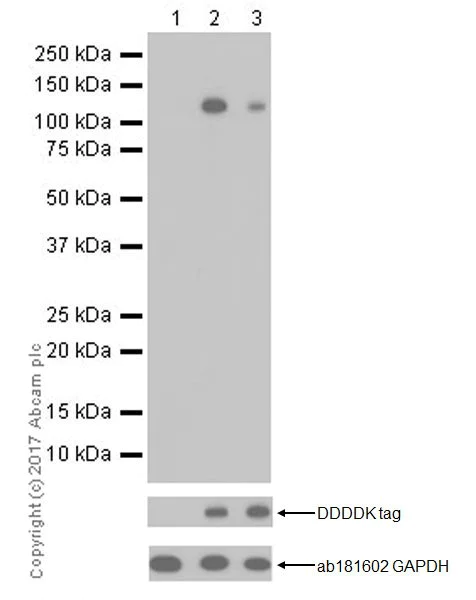
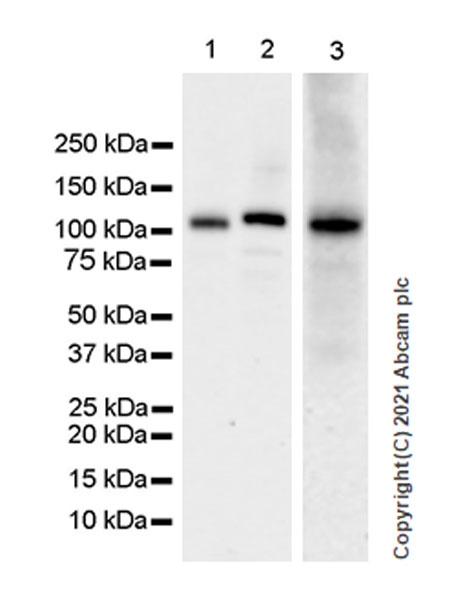
Western blot - Anti-SIK1 (phospho T182) + SIK2 (phospho T175) + SIK3 (phospho T163) antibody [EPR19196] (AB199474)
Blocking and dilution buffer and concentration : 5% NFDM/TBST.
The plasmids were kindly provided by our collaborator Dr. Yi Rao, Peking University.
All lanes:
Western blot - Anti-SIK1 (phospho T182) + SIK2 (phospho T175) + SIK3 (phospho T163) antibody [EPR19196] (ab199474) at 1/1000 dilution
Lane 1:
HEK-293T (human epithelial cell line from embryonic kidney transformed with large T antigen) transfected with an empty vector (control), whole cell lysate at 10 µg
Lane 2:
HEK-293T transfected with a human SIK2 (WT) expression vector, whole cell lysate at 10 µg
Lane 3:
HEK-293T transfected with a human SIK2 (WT) expression vector, then treated with alkaline phosphatase for 1 hour, whole cell lysate at 10 µg
Secondary
All lanes:
Western blot - Goat Anti-Rabbit IgG H&L (HRP) (<a href='/en-us/products/secondary-antibodies/goat-rabbit-igg-h-l-hrp-ab97051'>ab97051</a>) at 1/20000 dilution
Observed band size: 104 kDa
false
Exposure time: 30s
- WB
Lab
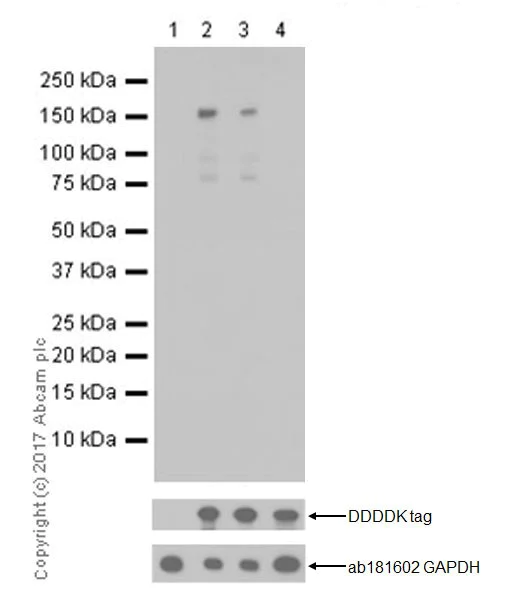
Western blot - Anti-SIK1 (phospho T182) + SIK2 (phospho T175) + SIK3 (phospho T163) antibody [EPR19196] (AB199474)
Blocking and dilution buffer and concentration : 5% NFDM/TBST.
The plasmids were kindly provided by our collaborator Dr. Yi Rao, Peking University.
All lanes:
Western blot - Anti-SIK1 (phospho T182) + SIK2 (phospho T175) + SIK3 (phospho T163) antibody [EPR19196] (ab199474) at 1/1000 dilution
Lane 1:
HEK-293T (human epithelial cell line from embryonic kidney transformed with large T antigen) transfected with empty vector (control), whole cell lysate at 10 µg
Lane 2:
HEK-293T transfected with a human SIK3 (WT) expression vector, whole cell lysate at 10 µg
Lane 3:
HEK-293T transfected with a human SIK3 (WT) expression vector, then treated with alkaline phosphatase for 1 hour, whole cell lysate at 10 µg
Lane 4:
HEK-293T transfected with a human SIK3 T163A mutant expression vector, whole cell lysate at 10 µg
Secondary
All lanes:
Western blot - Goat Anti-Rabbit IgG H&L (HRP) (<a href='/en-us/products/secondary-antibodies/goat-rabbit-igg-h-l-hrp-ab97051'>ab97051</a>) at 1/100000 dilution
Observed band size: 140 kDa
false
Exposure time: 1min
- WB
Lab
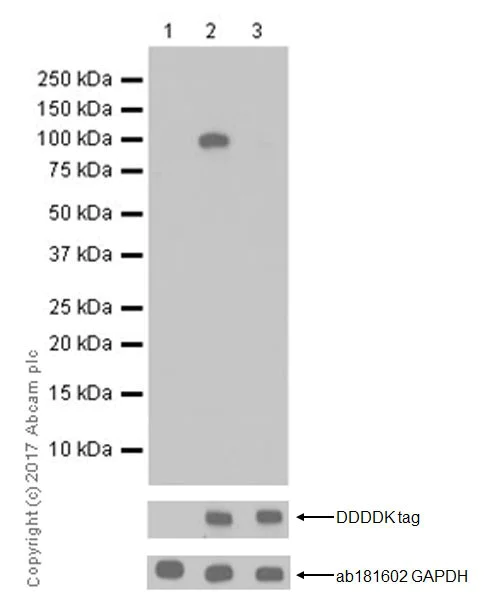
Western blot - Anti-SIK1 (phospho T182) + SIK2 (phospho T175) + SIK3 (phospho T163) antibody [EPR19196] (AB199474)
Blocking and dilution buffer and concentration : 5% NFDM/TBST.
The plasmids were kindly provided by our collaborator Dr. Yi Rao, Peking University.
All lanes:
Western blot - Anti-SIK1 (phospho T182) + SIK2 (phospho T175) + SIK3 (phospho T163) antibody [EPR19196] (ab199474) at 1/5000 dilution
Lane 1:
HEK-293T (human epithelial cell line from embryonic kidney transformed with large T antigen) transfected with an empty vector (control), whole cell lysate at 10 µg
Lane 2:
HEK-293T transfected with a human SIK1 (WT) expression vector, whole cell lysate at 10 µg
Lane 3:
HEK-293T transfected with a human SIK1 (WT) expression vector, then treated with alkaline phosphatase for 1 hour, whole cell lysate at 10 µg
Secondary
All lanes:
Western blot - Goat Anti-Rabbit IgG H&L (HRP) (<a href='/en-us/products/secondary-antibodies/goat-rabbit-igg-h-l-hrp-ab97051'>ab97051</a>) at 1/100000 dilution
Observed band size: 85 kDa
false
Exposure time: 3min
- Dot
Lab
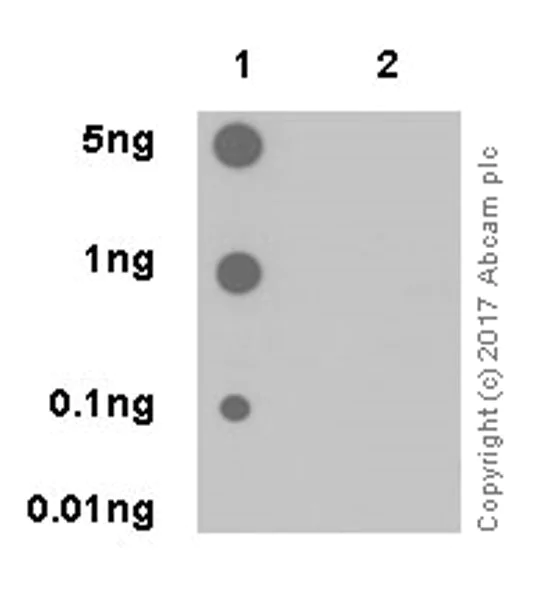
Dot Blot - Anti-SIK1 (phospho T182) + SIK2 (phospho T175) + SIK3 (phospho T163) antibody [EPR19196] (AB199474)
Dot blot analysis of Snf1lk2 (phospho T175) labeled with ab199474 at 1/1000 dilution.
Lane 1 : Snf1lk2 (phospho T175) peptide
Lane 2 : Snf1lk2 non-phospho peptide
Goat Anti-Rabbit IgG H&L (HRP) (ab97051) at 1/100000 dilution was used as secondary antibody.
Blocking/Dilution buffer : 5% NFDM/TBST.
Exposure time : 3 minutes.
Related conjugates and formulations (1)
-
Anti-SIK1 (pT182) + SIK2 (pT175) + SIK3 (pT163) antibody [EPR19196] - BSA and Azide free
Complementary Products
Primary Antibodies
AB245211
Anti-SIK2 antibody [EPR22722-23]
20ul selling size|RabMAb|Recombinant
- 0
- 0
Primary Antibodies
AB255701
Anti-SIK3 antibody [EPR23554-71]
BOND RX™ Validated|20ul selling size|RabMAb|Recombinant|KO Validated|Trial Size
- 0
- 0
Primary Antibodies
AB225634
Anti-SIK3 (phospho S551) antibody [EPR20878-12]
BOND RX™ Validated|20ul selling size|RabMAb|Recombinant|Trial Size

- 0
- 0

Reactivity data
Product details
Patented technology
Our RabMAb® technology is a patented hybridoma-based technology for making rabbit monoclonal antibodies. For details on our patents, please refer to RabMAb® patents.
What are the advantages of a recombinant monoclonal antibody?
This product is a recombinant monoclonal antibody, which offers several advantages including:
- - High batch-to-batch consistency and reproducibility
- - Improved sensitivity and specificity
- - Long-term security of supply
- - Animal-free batch production
For more information, read more on recombinant antibodies.
Properties and storage information
Form
Purification technique
Storage buffer
Shipped at conditions
Appropriate short-term storage duration
Appropriate short-term storage conditions
Appropriate long-term storage conditions
Aliquoting information
Storage information
Supplementary information
This supplementary information is collated from multiple sources and compiled automatically.
Biological function summary
These kinases regulate various processes essential for maintaining cellular homeostasis. They are not part of any well-known complex but interact with several cellular components. SIKs influence gene expression by inhibiting transcriptional regulators and also regulate metabolism and cell survival. Their action impacts how cells respond to external stimuli largely through modification of transcriptional activity in response to hormonal signals and nutrient availability.
Pathways
SIK1 SIK2 and SIK3 are integral to the AMP-activated protein kinase (AMPK) signaling pathway and the cAMP response element-binding protein (CREB) pathway. These pathways control energy balance and respond to stress conditions. SIKs act alongside AMPK to modulate cellular energy status and also influence the CREB signaling pathway by impacting phosphorylation state. Regulatory relationships exist with proteins like 14-3-3 and HDACs which themselves are key players in cellular metabolism and gene expression.
Product protocols
- Visit the General protocols
- Visit the Troubleshooting
Target data
Additional targets
Alternative Names
Publications (6)
Recent publications for all applications. Explore the full listand refine your search
Mediators of inflammation 2025:3540219 PubMed39959414
2025
Applications
Unspecified application
Species
Unspecified reactive species
EMBO molecular medicine 15:e17719 PubMed37966164
2023
Applications
Unspecified application
Species
Unspecified reactive species
Cancer discovery 13:1002-1025 PubMed36715544
2023
Applications
Unspecified application
Species
Unspecified reactive species
The Journal of biological chemistry 298:101929 PubMed35413286
2022
Applications
Unspecified application
Species
Unspecified reactive species
Nature communications 12:773 PubMed33536439
2021
Applications
Unspecified application
Species
Unspecified reactive species
Journal of tissue science & engineering 12: PubMed39055131
2021
Applications
Unspecified application
Species
Unspecified reactive species
Product promise
Please note: All products are 'FOR RESEARCH USE ONLY. NOT FOR USE IN DIAGNOSTIC OR THERAPEUTIC PROCEDURES'.
For licensing inquiries, please contact partnerships@abcam.com