Anti-SIRT6 antibody [EPR5079(N)] - BSA and Azide free
- RabMAb
- Recombinant
- KO Validated
- What is this?
Be the first to review this product! Submit a review
|
(0 Publication)
- WB
Lab
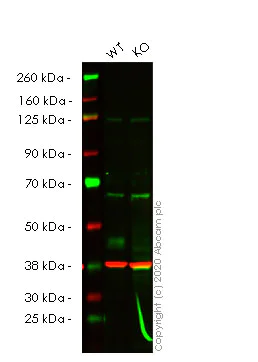
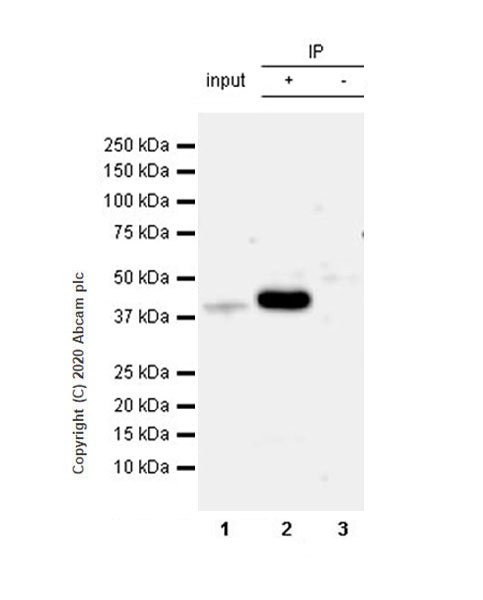
Western blot - Anti-SIRT6 antibody [EPR5079(N)] - BSA and Azide free (AB249918)
This data was developed using the same antibody clone in a different buffer formulation (ab176345).
Lanes 1-2 : Merged signal (red and green). Green - ab176345 observed at 45 kDa. Red - loading control ab8245 observed at 37 kDa.
ab176345 Anti-SIRT6 antibody [EPR5079(N)] was shown to specifically react with SIRT6 in wild-type HeLa cells. Loss of signal was observed when knockout cell line ab265054 (knockout cell lysate ab257673) was used. Wild-type and SIRT6 knockout samples were subjected to SDS-PAGE. ab176345 and Anti-GAPDH antibody [6C5] - Loading Control (ab8245) were incubated overnight at 4°C at 1 in 1000 Dilution and 1 in 20000 dilution respectively. Blots were developed with Goat anti-Rabbit IgG H&L (IRDye® 800CW) preadsorbed (ab216773) and Goat anti-Mouse IgG H&L (IRDye® 680RD) preadsorbed (ab216776) secondary antibodies at 1 in 20000 dilution for 1 hour at room temperature before imaging.
All lanes:
Western blot - Anti-SIRT6 antibody [EPR5079(N)] (<a href='/en-us/products/primary-antibodies/sirt6-antibody-epr5079n-ab176345'>ab176345</a>) at 1/1000 dilution
Lane 1:
Wild-type HeLa cell lysate at 20 µg
Lane 2:
SIRT6 knockout HeLa cell lysate at 20 µg
Lane 2:
Western blot - Human SIRT6 knockout HeLa cell line (<a href='/en-us/products/cell-lines/human-sirt6-knockout-hela-cell-line-ab265054'>ab265054</a>)
Predicted band size: 39 kDa
Observed band size: 45 kDa
false
Related conjugates and formulations (1)
-
Anti-SIRT6 antibody [EPR5079(N)]
Complementary Products
Primary Antibodies
AB189494
Anti-SIRT1 antibody [EPR18239]
20ul selling size|KO Validated|RabMAb|Recombinant
- 4
- 4
Primary Antibodies
AB259968
Anti-SIRT7 antibody [EPR23811-15]
20ul selling size|BOND RX™ Validated|RabMAb|Recombinant
- 0
- 0
Primary Antibodies
AB259967
Anti-SIRT5 antibody [EPR23787-116]
20ul selling size|KO Validated|RabMAb|Recombinant

- 0
- 0
Reactivity data
Product details
ab249918 is the carrier-free version of ab176345.
Species reactivity
Mouse, Rat: We have preliminary internal testing data to indicate this antibody may not react with these species.
Please contact us for more information.
Patented technology
Our RabMAb® technology is a patented hybridoma-based technology for making rabbit monoclonal antibodies. For details on our patents, please refer to RabMAb® patents.
What are the advantages of a recombinant monoclonal antibody?
This product is a recombinant monoclonal antibody, which offers several advantages including:
- - High batch-to-batch consistency and reproducibility
- - Improved sensitivity and specificity
- - Long-term security of supply
- - Animal-free batch production
For more information, read more on recombinant antibodies.
Conjugation ready
Our carrier-free antibodies are typically supplied in a PBS-only formulation, purified and free of BSA, sodium azide and glycerol. This conjugation-ready format is designed for use with fluorochromes, metal isotopes, oligonucleotides, and enzymes, which makes them ideal for antibody labelling, functional and cell-based assays, flow-based assays (e.g. mass cytometry) and Multiplex Imaging applications.
Use our conjugation kits for antibody conjugates that are ready-to-use in as little as 20 minutes with 1 minute hands-on-time and 100% antibody recovery: available for fluorescent dyes, HRP, biotin and gold.
Compatibility
This product is compatible with the Maxpar® Antibody Labeling Kit from Fluidigm, without the need for antibody preparation. Maxpar® is a trademark of Fluidigm Canada Inc.
Properties and storage information
Form
Purification technique
Storage buffer
Shipped at conditions
Appropriate short-term storage conditions
Appropriate long-term storage conditions
Storage information
Supplementary information
This supplementary information is collated from multiple sources and compiled automatically.
Biological function summary
SIRT6 influences DNA repair metabolism and inflammation. It participates in maintaining genomic stability by promoting base excision repair a critical DNA repair process. Moreover SIRT6 contributes to glucose homeostasis by influencing gluconeogenesis and glycolysis. This protein is not known to be part of any larger protein complexes but it interacts individually with other proteins to exert its biological effects.
Pathways
SIRT6 plays a significant role in two key biological pathways: DNA damage response and metabolism regulation. In the DNA damage response pathway SIRT6 works with other proteins like PARP1 to facilitate DNA repair under stress conditions. In the regulation of metabolism SIRT6 interacts with transcription factors like HIF1α which influences the expression of genes involved in glycolytic metabolism and glucose homeostasis.
Product protocols
- Visit the General protocols
- Visit the Troubleshooting
Target data
Alternative Names
Product promise
Please note: All products are 'FOR RESEARCH USE ONLY. NOT FOR USE IN DIAGNOSTIC OR THERAPEUTIC PROCEDURES'.
For licensing inquiries, please contact partnerships@abcam.com