JavaScript is disabled in your browser. Please enable JavaScript to view this website.
AB203205

Anti-SLC10A2/ASBT antibody

Be the first to review this product! Submit a review

|

(10 Publications )
Rabbit Polyclonal SLC10A2/ASBT antibody. Suitable for WB and reacts with Mouse, Rat samples. Cited in 10 publications. Immunogen corresponding to Synthetic Peptide within Human SLC10A2 aa 150-200 conjugated to Keyhole Limpet Haemocyanin.
1 Images
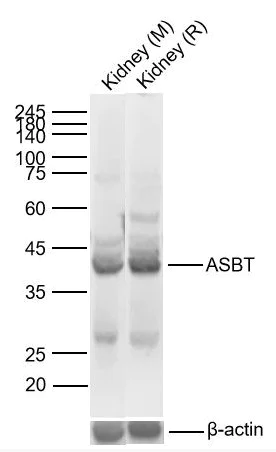
Western blot - Anti-SLC10A2/ASBT antibody (AB203205)
  • WB

Supplier Data

Western blot - Anti-SLC10A2/ASBT antibody (AB203205)

All lanes:

Western blot - Anti-SLC10A2/ASBT antibody (ab203205) at 1/1000 dilution

Lane 1:

Mouse Kidney lysates

Lane 2:

Rat Kidney lysates

Secondary

All lanes:

IRDye800CW Goat Anti-Rabbit IgG at 1/20000 dilution

Observed band size: 38 kDa

false

Key facts

Host species

Rabbit

Clonality

Polyclonal

Isotype

IgG

Carrier free

No

Reacts with

Mouse, Rat

Applications

WB

applications

Immunogen

Synthetic Peptide within Human SLC10A2 aa 150-200 conjugated to Keyhole Limpet Haemocyanin. The exact immunogen used to generate this antibody is proprietary information.

Q12908

Reactivity data

{ "title": "Reactivity Data", "filters": { "stats": ["", "Species", "Dilution Info", "Notes"], "tabs": { "all-applications": {"fullname" : "All Applications", "shortname": "All Applications"}, "WB" : {"fullname" : "Western blot", "shortname":"WB"} }, "product-promise": { "all": "all", "testedAndGuaranteed": "tested", "guaranteed": "expected", "predicted": "predicted", "notRecommended": "not-recommended" } }, "values": { "Human": { "WB-species-checked": "predicted", "WB-species-dilution-info": "", "WB-species-notes": "" }, "Mouse": { "WB-species-checked": "testedAndGuaranteed", "WB-species-dilution-info": "", "WB-species-notes": "<p></p>" }, "Rat": { "WB-species-checked": "testedAndGuaranteed", "WB-species-dilution-info": "", "WB-species-notes": "<p></p>" } } }

Properties and storage information

Form
Liquid
Purification technique
Affinity purification Protein A
Storage buffer
pH: 7.4 Preservative: 0.02% Proclin 300 Constituents: 50% Glycerol (glycerin, glycerine), 48.98% TBS, 1X, 1% BSA
Shipped at conditions
Blue Ice
Appropriate short-term storage duration
1-2 weeks
Appropriate short-term storage conditions
+4°C
Appropriate long-term storage conditions
-20°C
Aliquoting information
Upon delivery aliquot
Storage information
Avoid freeze / thaw cycle

Supplementary information

This supplementary information is collated from multiple sources and compiled automatically.

The SLC10A2 also known as the apical sodium-dependent bile acid transporter (ASBT) functions as a sodium/bile acid symporter. It facilitates the uptake of bile acids from the intestinal lumen into enterocytes. SLC10A2 has a mass of about 48 kDa and is highly expressed in the ileal section of the small intestine. This transporter is important in the enterohepatic circulation of bile acids. By importing bile acids SLC10A2 aids in maintaining the bile acid pool and promotes fat digestion and absorption.
Biological function summary

SLC10A2 assists in the absorption and recycling of bile acids to help maintain liver function and lipid metabolism. Although not part of a larger protein complex it tightly works with other transporters to ensure efficient bile acid retrieval. The action of this transporter supports energy balance and nutrient absorption in the body providing a mechanistic link between nutrient availability and metabolic regulation.

Pathways

SLC10A2 plays an essential role in the enterohepatic circulation of bile acids. This pathway reconciles bile acid reabsorption in the intestine with their secretion by the liver. The transporter works in conjunction with other proteins like FXR (Farnesoid X Receptor) and NTCP (SLC10A1) in this pathway to regulate bile acid concentrations impacting cholesterol and lipid homeostasis.

Dysfunctions in SLC10A2 correlate with bile acid malabsorption which can lead to conditions such as chronic diarrhea and Crohn's disease. The Bile Acid Binding Protein (BABP) is related to SLC10A2 in these disorders as it helps solubilize bile acids in the intestinal cells. Proper functioning of SLC10A2 is essential to avoid these disorders and support normal gastrointestinal health.

Product protocols

For this product, it's our understanding that no specific protocols are required. You can visit:

Target data

Plays a critical role in the sodium-dependent reabsorption of bile acids from the lumen of the small intestine (PubMed : 10101301). Transports various bile acids, unconjugated or conjugated, such as cholate and taurocholate (PubMed : 10101301). Also responsible for bile acid transport in the renal proximal tubules, a salvage mechanism that helps conserve bile acids. Works collaboratively with the Na(+)-taurocholate cotransporting polypeptide (NTCP), the organic solute transporter (OST), and the bile salt export pump (BSEP), to ensure efficacious biological recycling of bile acids during enterohepatic circulation (By similarity).
See full target information Slc10a2

Alternative Names

Ntcp2, Ileal sodium/bile acid cotransporter, Apical sodium-dependent bile acid transporter, Ileal Na(+)/bile acid cotransporter, Ileal sodium-dependent bile acid transporter, Na(+)-dependent ileal bile acid transporter, Solute carrier family 10 member 2, ASBT, IBAT, ISBT

Publications (10)

Recent publications for all applications. Explore the full listand refine your search

Scientific reports 15:15319 PubMed40312444

2025

The role of gut microbiota on skeletal muscle strength in LDLR knockdown aging mice.

Applications

Unspecified application

Species

Unspecified reactive species

Ying Li,Ziyang Fang,Yinjun Luo,Huiling Liu,Dianchen Zhao,Tao Feng,Xin Zhang,Songyi Mo,Xiaoyan Fang,Lingling Huang,Jinhua Wang

Environmental health perspectives 132:87007 PubMed39177951

2024

Exposure of Mice to a PFAS Mixture and Outcomes Related to Circulating Lipids, Bile Acid Excretion, and the Intestinal Transporter ASBT.

Applications

Unspecified application

Species

Unspecified reactive species

Katherine Roth,Zhao Yang,Manisha Agarwal,Johnna Birbeck,Judy Westrick,Todd Lydic,Katherine Gurdziel,Michael C Petriello

Advanced healthcare materials 13:e2302912 PubMed38128045

2023

Bioengineered Tubular Biliary Organoids.

Applications

Unspecified application

Species

Unspecified reactive species

Bilge Sen Elci,Mikhail Nikolaev,Saba Rezakhani,Matthias P Lutolf

Frontiers in pharmacology 14:1163694 PubMed37089915

2023

Vitamin C and vitamin D alleviate metabolic-associated fatty liver disease by regulating the gut microbiota and bile acid metabolism the gut-liver axis.

Applications

Unspecified application

Species

Unspecified reactive species

Qingling Chen,Lili Zhao,Ling Mei,Xiaotong Zhao,Ping Han,Jie Liu,Chao Meng,Ruifang Li,Rui Zhong,Kai Wang,Jia Li

Science advances 8:eabo2794 PubMed36026454

2022

Inhibition of microbial deconjugation of micellar bile acids protects against intestinal permeability and liver injury.

Applications

Unspecified application

Species

Unspecified reactive species

Darrick K Li,Snehal N Chaudhari,Yoojin Lee,Mozhdeh Sojoodi,Arijit A Adhikari,Lawrence Zukerberg,Stuti Shroff,Stephen Cole Barrett,Kenneth Tanabe,Raymond T Chung,A Sloan Devlin

iScience 25:104708 PubMed35856025

2022

MiR-203 is an anti-obese microRNA by targeting apical sodium-dependent bile acid transporter.

Applications

Unspecified application

Species

Unspecified reactive species

Xin Liu,Feiran Cheng,Xue Bai,Tong Zhao,Limin Zhao,Lei Wang,Mingqi Li,Xianxian Wu,Xiaohui Chen,Pingping Tang,Mengxue Wang,Lintong Jiang,Chaoqi Yan,Fenghua Pei,Xu Gao,Ning Ma,Baofeng Yang,Yong Zhang

British journal of pharmacology 176:2848-2863 PubMed31077342

2019

Ursodeoxycholic acid accelerates bile acid enterohepatic circulation.

Applications

Unspecified application

Species

Unspecified reactive species

Yunjing Zhang,Runqiu Jiang,Xiaojiao Zheng,Sha Lei,Fengjie Huang,Guoxiang Xie,Sandi Kwee,Herbert Yu,Christine Farrar,Beicheng Sun,Aihua Zhao,Wei Jia

EBioMedicine 37:294-306 PubMed30344125

2018

Dysregulated bile acid signaling contributes to the neurological impairment in murine models of acute and chronic liver failure.

Applications

Unspecified application

Species

Unspecified reactive species

Guoxiang Xie,Xiaoning Wang,Runqiu Jiang,Aihua Zhao,Jingyu Yan,Xiaojiao Zheng,Fengjie Huang,Xinzhu Liu,Jun Panee,Cynthia Rajani,Chun Yao,Herbert Yu,Weiping Jia,Beicheng Sun,Ping Liu,Wei Jia

ACS nano 12:8893-8900 PubMed30088412

2018

Oral Nanoparticles Exhibit Specific High-Efficiency Intestinal Uptake and Lymphatic Transport.

Applications

Unspecified application

Species

Unspecified reactive species

Kyoung Sub Kim,Kenichi Suzuki,Hana Cho,Yu Seok Youn,You Han Bae

Lipids 52:489-498 PubMed28474246

2017

Pectin Penta-Oligogalacturonide Suppresses Intestinal Bile Acids Absorption and Downregulates the FXR-FGF15 Axis in High-Cholesterol Fed Mice.

Applications

Unspecified application

Species

Mouse

Rugang Zhu,Yuting Hou,Yandi Sun,Tuoping Li,Jungang Fan,Gang Chen,Junxiu Wei
View all publications

Product promise

We are committed to supporting your work with high-quality reagents, and we're here for you every step of the way. In the unlikely event that one of our products does not perform as expected, you're protected by our Product Promise.
For full details, please see our Terms & Conditions

Please note: All products are 'FOR RESEARCH USE ONLY. NOT FOR USE IN DIAGNOSTIC OR THERAPEUTIC PROCEDURES'.

For licensing inquiries, please contact partnerships@abcam.com