JavaScript is disabled in your browser. Please enable JavaScript to view this website.
AB237630

Anti-SLC19A3 antibody

Be the first to review this product! Submit a review

|

(1 Publication)

Rabbit Polyclonal SLC19A3 antibody. Suitable for WB, ICC/IF and reacts with Human samples. Cited in 1 publication. Immunogen corresponding to Recombinant Fragment Protein within Human SLC19A3 aa 150-300.

View Alternative Names

Thiamine transporter 2, ThTr-2, ThTr2, Solute carrier family 19 member 3, SLC19A3
1 Images
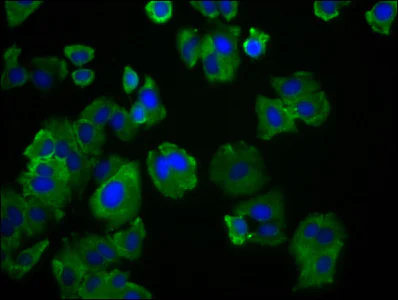
Immunocytochemistry/ Immunofluorescence - Anti-SLC19A3 antibody (AB237630)
  • ICC/IF

Supplier Data

Immunocytochemistry/ Immunofluorescence - Anti-SLC19A3 antibody (AB237630)

4% formaldehyde-fixed, 0.2% Triton X-100 permeabilized HepG2 (human liver hepatocellular carcinoma cell line) cells stained for SLC19A3 (green) using ab237630 at 1/166 dilution in ICC/IF, followed by Alexa Fluor 488® conjugated Goat Anti-Rabbit IgG (H+L). Counter-stained with DAPI.

Key facts

Host species

Rabbit

Clonality

Polyclonal

Isotype

IgG

Carrier free

No

Reacts with

Human

Applications

ICC/IF, WB

applications

Immunogen

Recombinant Fragment Protein within Human SLC19A3 aa 150-300. The exact immunogen used to generate this antibody is proprietary information.

Q9BZV2

Reactivity data

{ "title": "Reactivity Data", "filters": { "stats": ["", "Species", "Dilution Info", "Notes"], "tabs": { "all-applications": {"fullname" : "All Applications", "shortname": "All Applications"}, "WB" : {"fullname" : "Western blot", "shortname":"WB"}, "ICCIF" : {"fullname" : "Immunocytochemistry/ Immunofluorescence", "shortname":"ICC/IF"} }, "product-promise": { "all": "all", "testedAndGuaranteed": "tested", "guaranteed": "expected", "predicted": "predicted", "notRecommended": "not-recommended" } }, "values": { "Human": { "WB-species-checked": "testedAndGuaranteed", "WB-species-dilution-info": "1/500 - 1/5000", "WB-species-notes": "<p></p>", "ICCIF-species-checked": "testedAndGuaranteed", "ICCIF-species-dilution-info": "1/50 - 1/200", "ICCIF-species-notes": "<p></p>" }, "Cynomolgus monkey": { "WB-species-checked": "predicted", "WB-species-dilution-info": "", "WB-species-notes": "", "ICCIF-species-checked": "predicted", "ICCIF-species-dilution-info": "", "ICCIF-species-notes": "" } } }

Properties and storage information

Form
Liquid
Purification technique
Affinity purification Protein G
Purification notes
Purity greater than 95%.
Storage buffer
pH: 7.4 Preservative: 0.03% Proclin 300 Constituents: PBS, 50% Glycerol (glycerin, glycerine)
Shipped at conditions
Blue Ice
Appropriate short-term storage duration
1-2 weeks
Appropriate short-term storage conditions
+4°C
Appropriate long-term storage conditions
-20°C
Aliquoting information
Upon delivery aliquot
Storage information
Avoid freeze / thaw cycle

Supplementary information

This supplementary information is collated from multiple sources and compiled automatically.

The SLC19A3 protein also known as thiamine transporter 2 is involved in the transport of thiamine across cell membranes. This protein consists of approximately 496 amino acids and its molecular mass is about 54 kDa. SLC19A3 is expressed in various tissues with higher levels found in the liver brain and kidneys. The protein functions to facilitate the uptake of thiamine a critical vitamin B1 into cells where it is necessary for proper cellular metabolism.
Biological function summary

Thiamine transporter 2 participates in the management of thiamine homeostasis ensuring cells receive adequate nutrients to meet metabolic demands. SLC19A3 forms part of a complex with other transporter proteins that contribute to the maintenance of cellular thiamine levels. This protein's activity is important in tissues with high metabolic rates supporting the production of ATP through involvement in metabolic pathways requiring thiamine-based cofactors.

Pathways

The SLC19A3 protein is integral to both the energy metabolism and the thiamine metabolism pathways. It plays a role in converting thiamine into its active form thiamine pyrophosphate which is necessary for the function of enzymes like pyruvate dehydrogenase and alpha-ketoglutarate dehydrogenase. These enzymes are involved in the citric acid cycle highlighting the importance of SLC19A3 in energy production. Its activity is related to other proteins such as SLC19A2 which also facilitates thiamine transport within similar pathways.

Impaired function of the SLC19A3 protein is linked to thiamine metabolism dysfunction syndrome 2 (THMD2) and biotin-thiamine-responsive basal ganglia disease. These diseases result from mutations disrupting thiamine transport leading to neurological and metabolic complications. SLC19A3 disruptions also align with changes in L-type calcium channel subunits indicating a broader network of nutrient transport and ion channel regulation in maintaining cellular health.

Product protocols

For this product, it's our understanding that no specific protocols are required. You can visit:

Target data

Mediates high affinity thiamine uptake, probably via a proton anti-port mechanism (PubMed : 11731220, PubMed : 33008889, PubMed : 35512554, PubMed : 35724964). Has no folate transport activity (PubMed : 11731220). Mediates H(+)-dependent pyridoxine transport (PubMed : 33008889, PubMed : 35512554, PubMed : 35724964, PubMed : 36456177).
See full target information SLC19A3

Publications (1)

Recent publications for all applications. Explore the full list and refine your search

Molecular and cellular biochemistry 477:649-661 PubMed34870753

2021

MiR-1246 regulates the PI3K/AKT signaling pathway by targeting PIK3AP1 and inhibits thyroid cancer cell proliferation and tumor growth.

Applications

Unspecified application

Species

Unspecified reactive species

Jingyan Li,Zhanlei Zhang,Jieting Hu,Xiaoting Wan,Wei Huang,Hong Zhang,Ningyi Jiang
View all publications

Product promise

We are committed to supporting your work with high-quality reagents, and we're here for you every step of the way. In the unlikely event that one of our products does not perform as expected, you're protected by our Product Promise.
For full details, please see our Terms & Conditions

Please note: All products are 'FOR RESEARCH USE ONLY. NOT FOR USE IN DIAGNOSTIC OR THERAPEUTIC PROCEDURES'.

For licensing inquiries, please contact partnerships@abcam.com