JavaScript is disabled in your browser. Please enable JavaScript to view this website.
AB222900

Anti-SLCO1B3/OATP1B3 antibody

Be the first to review this product! Submit a review

|

(2 Publications )
Rabbit Polyclonal SLCO1B3/OATP1B3 antibody. Suitable for IHC-P, ICC/IF and reacts with Human samples. Cited in 2 publications. Immunogen corresponding to Recombinant Fragment Protein within Human SLCO1B3 aa 600-700.
3 Images
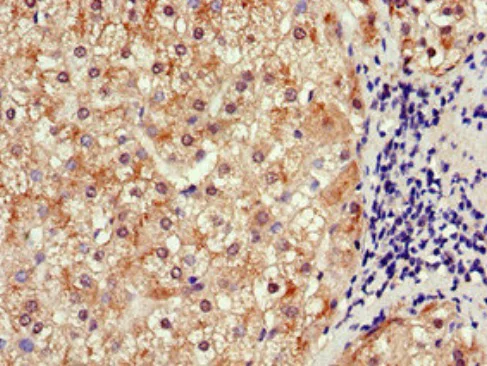
Immunohistochemistry (Formalin/PFA-fixed paraffin-embedded sections) - Anti-SLCO1B3/OATP1B3 antibody (AB222900)
  • IHC-P

Supplier Data

Immunohistochemistry (Formalin/PFA-fixed paraffin-embedded sections) - Anti-SLCO1B3/OATP1B3 antibody (AB222900)

Paraffin embedded human liver cancer tissue stained for SLCO1B3/OATP1B3 with ab222900 (1/100 dilution) in immunohistochemical analysis.
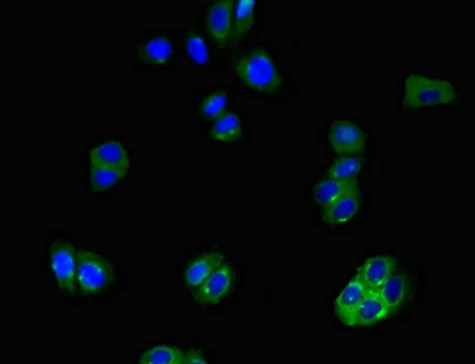
Immunocytochemistry/ Immunofluorescence - Anti-SLCO1B3/OATP1B3 antibody (AB222900)
  • ICC/IF

Supplier Data

Immunocytochemistry/ Immunofluorescence - Anti-SLCO1B3/OATP1B3 antibody (AB222900)

HepG2 (human liver hepatocellular carcinoma cell line) cells stained for SLCO1B3/OATP1B3 (green) using ab222900 (1/100 dilution) in ICC/IF. Secondary : Alexa Fluor 488®-conjugated Goat Anti-Rabbit IgG (H+L).
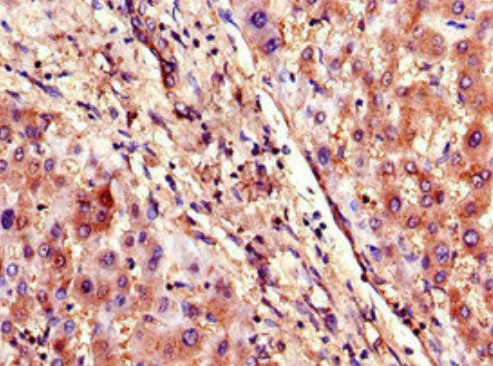
Immunohistochemistry (Formalin/PFA-fixed paraffin-embedded sections) - Anti-SLCO1B3/OATP1B3 antibody (AB222900)
  • IHC-P

Supplier Data

Immunohistochemistry (Formalin/PFA-fixed paraffin-embedded sections) - Anti-SLCO1B3/OATP1B3 antibody (AB222900)

Paraffin embedded human liver tissue stained for SLCO1B3/OATP1B3 with ab222900 (1/100 dilution) in immunohistochemical analysis.

Key facts

Host species

Rabbit

Clonality

Polyclonal

Isotype

IgG

Carrier free

No

Reacts with

Human

Applications

IHC-P, ICC/IF

applications

Immunogen

Recombinant Fragment Protein within Human SLCO1B3 aa 600-700. The exact immunogen used to generate this antibody is proprietary information.

Q9NPD5

Reactivity data

{ "title": "Reactivity Data", "filters": { "stats": ["", "Species", "Dilution Info", "Notes"], "tabs": { "all-applications": {"fullname" : "All Applications", "shortname": "All Applications"}, "IHCP" : {"fullname" : "Immunohistochemistry (Formalin/PFA-fixed paraffin-embedded sections)", "shortname":"IHC-P"}, "ICCIF" : {"fullname" : "Immunocytochemistry/ Immunofluorescence", "shortname":"ICC/IF"} }, "product-promise": { "all": "all", "testedAndGuaranteed": "tested", "guaranteed": "expected", "predicted": "predicted", "notRecommended": "not-recommended" } }, "values": { "Human": { "IHCP-species-checked": "testedAndGuaranteed", "IHCP-species-dilution-info": "1/20 - 1/200", "IHCP-species-notes": "<p></p>", "ICCIF-species-checked": "testedAndGuaranteed", "ICCIF-species-dilution-info": "1/50 - 1/200", "ICCIF-species-notes": "<p></p>" } } }

Properties and storage information

Form
Liquid
Purification technique
Affinity purification Protein G
Purification notes
Purity >95%
Storage buffer
pH: 7.4 Preservative: 0.03% Proclin 300 Constituents: PBS, 50% Glycerol (glycerin, glycerine)
Shipped at conditions
Blue Ice
Appropriate short-term storage duration
1-2 weeks
Appropriate short-term storage conditions
+4°C
Appropriate long-term storage conditions
-20°C
Aliquoting information
Upon delivery aliquot
Storage information
Avoid freeze / thaw cycle

Supplementary information

This supplementary information is collated from multiple sources and compiled automatically.

SLCO1B3 also known as OATP1B3 is an organic anion transporting polypeptide with a mass of approximately 84 kDa. It functions as a transporter involved in the uptake of various endogenous and exogenous compounds. Mechanically OATP1B3 facilitates the movement of bile acids hormones and drugs across the basolateral membrane in hepatocytes. It is expressed mainly in the liver where it plays a significant role in drug metabolism and disposition.
Biological function summary

OATP1B3 impacts several physiological processes notably the clearance and systemic availability of drugs and endogenous compounds. It is not considered part of a larger protein complex but works closely with other transporters to regulate the hepatobiliary system. Through its selective transport of substrates OATP1B3 contributes to maintaining homeostasis and proper liver function ensuring efficient detoxification and excretion.

Pathways

OATP1B3 plays a role in the enterohepatic circulation of bile acids and drug metabolism pathways. The transporter influences the pharmacokinetics of many drugs and interacts with related proteins such as CYP3A4 which metabolizes these substrates following their uptake. By mediating hepatic uptake OATP1B3 serves as a gatekeeper within the drug metabolism and disposition process managing entry into the liver for further processing by these enzyme systems.

OATP1B3 has associations with liver-related conditions such as cholestasis and liver cancer. Impaired function or expression of OATP1B3 can lead to altered pharmacokinetics contributing to drug-induced liver injury. Additionally it interacts with proteins like MRP2 which is involved in the excretion of conjugated bile acids. Understanding the role of OATP1B3 in these diseases provides insights into potential therapeutic strategies and drug development.

Product protocols

For this product, it's our understanding that no specific protocols are required. You can visit:

Target data

Mediates the Na(+)-independent uptake of organic anions (PubMed : 10779507, PubMed : 15159445, PubMed : 17412826). Shows broad substrate specificity, can transport both organic anions such as bile acid taurocholate (cholyltaurine) and conjugated steroids (17-beta-glucuronosyl estradiol, dehydroepiandrosterone sulfate (DHEAS), and estrone 3-sulfate), as well as eicosanoid leukotriene C4, prostaglandin E2 and L-thyroxine (T4) (PubMed : 10779507, PubMed : 11159893, PubMed : 12568656, PubMed : 15159445, PubMed : 17412826, PubMed : 19129463). Hydrogencarbonate/HCO3(-) acts as the probable counteranion that exchanges for organic anions (PubMed : 19129463). Shows a pH-sensitive substrate specificity towards sulfated steroids, taurocholate and T4 which may be ascribed to the protonation state of the binding site and leads to a stimulation of substrate transport in an acidic microenvironment (PubMed : 19129463). Involved in the clearance of bile acids and organic anions from the liver (PubMed : 22232210). Can take up bilirubin glucuronides from plasma into the liver, contributing to the detoxification-enhancing liver-blood shuttling loop (PubMed : 22232210). Transports coproporphyrin I and III, by-products of heme synthesis, and may be involved in their hepatic disposition (PubMed : 26383540). May contribute to regulate the transport of organic compounds in testes across the blood-testis-barrier (Probable). Can transport HMG-CoA reductase inhibitors (also known as statins) such as pitavastatin, a clinically important class of hypolipidemic drugs (PubMed : 15159445). May play an important role in plasma and tissue distribution of the structurally diverse chemotherapeutic drugs methotrexate and paclitaxel (PubMed : 23243220). May also transport antihypertension agents, such as the angiotensin-converting enzyme (ACE) inhibitor prodrug enalapril, and the highly selective angiotensin II AT1-receptor antagonist valsartan, in the liver (PubMed : 16624871, PubMed : 16627748).
See full target information SLCO1B3

Alternative Names

LST2, OATP1B3, OATP8, SLC21A8, SLCO1B3, Solute carrier organic anion transporter family member 1B3, Liver-specific organic anion transporter 2, Organic anion transporter 8, Organic anion-transporting polypeptide 8, Solute carrier family 21 member 8, LST-2, OATP-8

Publications (2)

Recent publications for all applications. Explore the full listand refine your search

World journal of surgical oncology 18:127 PubMed32534581

2020

Low expression of organic anion-transporting polypeptide 1B3 predicts a poor prognosis in hepatocellular carcinoma.

Applications

Unspecified application

Species

Unspecified reactive species

Shihan Chen,Kun Li,Jiayun Jiang,Xiaofei Wang,Yuelong Chai,Chang Zhang,Qingsong Deng,Ling Shuai,Kai Feng,Kuansheng Ma,Leida Zhang

Cell death and differentiation 26:1346-1364 PubMed30341421

2018

Circular RNA circAGO2 drives cancer progression through facilitating HuR-repressed functions of AGO2-miRNA complexes.

Applications

Unspecified application

Species

Unspecified reactive species

Yajun Chen,Feng Yang,Erhu Fang,Wenjing Xiao,Hong Mei,Huanhuan Li,Dan Li,Huajie Song,Jianqun Wang,Mei Hong,Xiaojing Wang,Kai Huang,Liduan Zheng,Qiangsong Tong
View all publications

Product promise

We are committed to supporting your work with high-quality reagents, and we're here for you every step of the way. In the unlikely event that one of our products does not perform as expected, you're protected by our Product Promise.
For full details, please see our Terms & Conditions

Please note: All products are 'FOR RESEARCH USE ONLY. NOT FOR USE IN DIAGNOSTIC OR THERAPEUTIC PROCEDURES'.

For licensing inquiries, please contact partnerships@abcam.com