Anti-Smad3 antibody [EPR19686-142] - BSA and Azide free (Capture)
- RabMAb
- Recombinant
- Advanced Validation
- What is this?
Be the first to review this product! Submit a review
|
(0 Publication)
- ChIC/CUT&RUN-seq
Supplier Data
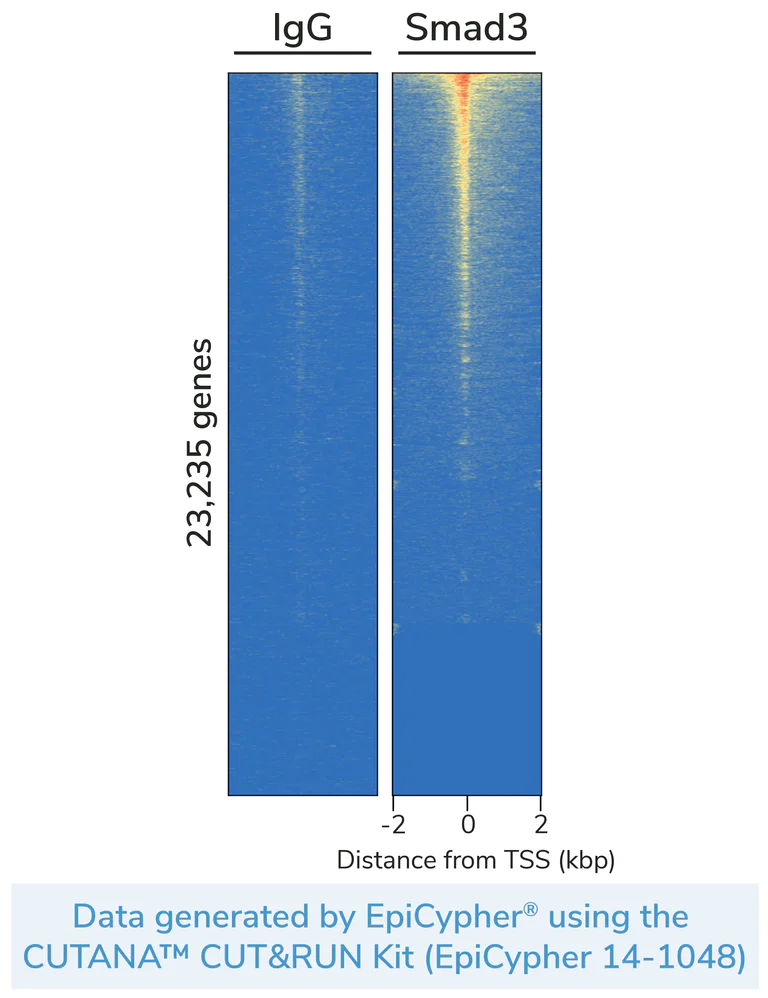
ChIC/CUT&RUN sequencing - Anti-Smad3 antibody [EPR19686-142] - BSA and Azide free (Capture) (AB252605)
CUT&RUN profiling with Smad3 antibody demonstrates robust genome-wide enrichment in cells. Heatmaps of genome-wide signal flanking annotated transcription start sites (TSSs, +/- 2 kbp) display CUT&RUN data generated using the CUTANA™ CUT&RUN Kit (EpiCypher 14-1048) with Smad3 antibody (Abcam ab252605, 0.5 µg). 500,000 HeLa cells were used per reaction. IgG antibody was included as a negative control to assess non-specific background. Libraries were prepared using the CUTANA™ CUT&RUN Library Prep Kit (EpiCypher 14-1001). Sequencing was performed with paired-end 50 bp reads, and data were processed on CUTANA™ Cloud (cloud.epicypher.com) by alignment to the hg38 genome. Heatmaps were generated using deepTools (Ramнrez et al., Nucleic Acids Res. 2014; PMID : 24799436). Row-linked data are ranked by intensity relative to Smad3, with red indicating high localized enrichment and blue denoting background.
- ChIC/CUT&RUN-seq
Supplier Data
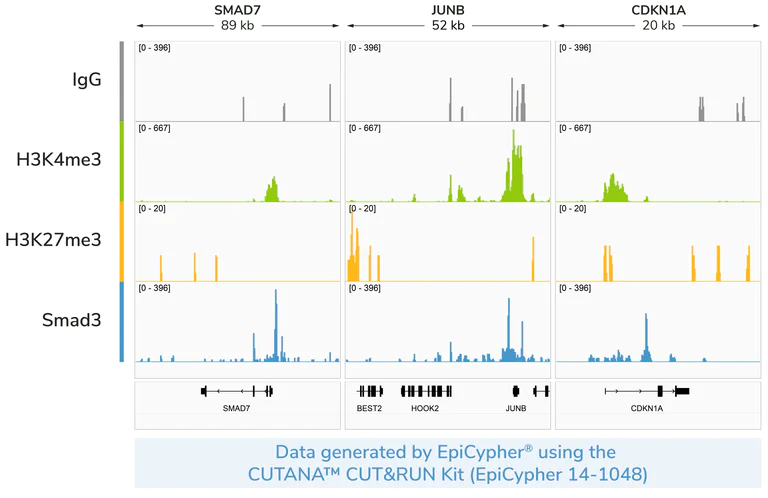
ChIC/CUT&RUN sequencing - Anti-Smad3 antibody [EPR19686-142] - BSA and Azide free (Capture) (AB252605)
CUT&RUN profiling with Smad3 antibody reveals the expected genomic enrichment pattern in cells. Representative genome browser tracks show CUT&RUN data generated using the CUTANA™ CUT&RUN Kit (EpiCypher 14-1048) with Smad3 antibody (Abcam ab252605, 0.5 µg). 500,000 HeLa cells were used per reaction. IgG, H3K4me3, and H3K27me3 antibodies were included as controls to assess non-specific background, active promoters, and repressed chromatin, respectively. Libraries were prepared using the CUTANA™ CUT&RUN Library Prep Kit (EpiCypher 14-1001). Sequencing was performed with paired-end 50 bp reads, and data were processed on CUTANA™ Cloud (cloud.epicypher.com) by alignment to the hg38 genome. Images were generated using Integrative Genomics Viewer (IGV, Broad Institute).
- sELISA
Supplier Data
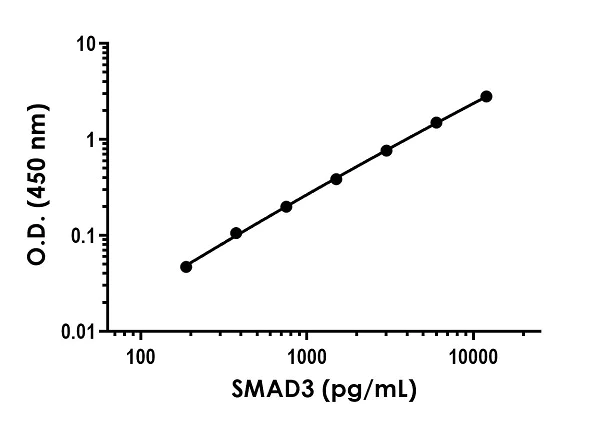
Sandwich ELISA - Anti-Smad3 antibody [EPR19686-142] - BSA and Azide free (Capture) (AB252605)
Representative standard curve from corresponding SimpleStep ELISA® Kit (ab264624).
Complementary Products


Primary Antibodies
AB207447
Anti-Smad2 + Smad3 antibody [EPR19557] - ChIP Grade
20ul selling size|RabMAb|Advanced Validation|Recombinant

- 0
- 0
Primary Antibodies
AB52903
Anti-SMAD3 (pS423/425) + SMAD5 (pS463/465) + SMAD1 (pS463/465) + SMAD2 (pS465/467) antibody [EP823Y]
20ul selling size|Recombinant|Advanced Validation|RabMAb

- 4
- 21


Reactivity data
Product details
ab252605 is a BSA and Azide Free antibody supplied in an unconjugated format and it is suitable for sandwich ELISAs to quantify SMAD3. The recommended pair for sandwich ELISA is:
Capture: ab252605, SMAD3 Capture Antibody (unconjugated)
Detector: ab252664, SMAD3 Detector Antibody (unconjugated)
The reference range value is 187.5 - 12000 pg/ml.
Patented technology
Our RabMAb® technology is a patented hybridoma-based technology for making rabbit monoclonal antibodies. For details on our patents, please refer to RabMAb® patents.
What are the advantages of a recombinant monoclonal antibody?
This product is a recombinant monoclonal antibody, which offers several advantages including:
- - High batch-to-batch consistency and reproducibility
- - Improved sensitivity and specificity
- - Long-term security of supply
- - Animal-free batch production
For more information, read more on recombinant antibodies.
Conjugation ready
Our carrier-free antibodies are typically supplied in a PBS-only formulation, purified and free of BSA, sodium azide and glycerol. This conjugation-ready format is designed for use with fluorochromes, metal isotopes, oligonucleotides, and enzymes, which makes them ideal for antibody labelling, functional and cell-based assays, flow-based assays (e.g. mass cytometry) and Multiplex Imaging applications.
Use our conjugation kits for antibody conjugates that are ready-to-use in as little as 20 minutes with 1 minute hands-on-time and 100% antibody recovery: available for fluorescent dyes, HRP, biotin and gold.
Sandwich ELISA
The recommended antibody orientation is based on internal optimization for ELISA-based assays. Antibody orientation is assay dependent and needs to be optimized for each assay type. Please note that the range provided for this antibody is only an estimation based on the performance of the product using the recommended antibody pair. Performance of the antibody pair will depend on the specific characteristics of your assay. We guarantee the product works in sandwich ELISA, but we do not guarantee the sensitivity or dynamic range of the antibody in your assay.
Properties and storage information
Form
Purification technique
Storage buffer
Shipped at conditions
Appropriate short-term storage conditions
Appropriate long-term storage conditions
Supplementary information
This supplementary information is collated from multiple sources and compiled automatically.
Biological function summary
Smad3 acts as a mediator of signal transduction for the TGF-beta (transforming growth factor-beta) superfamily forming a complex with phosphorylated Smad2. This enables it to regulate transcriptional activity influencing cell proliferation differentiation and apoptosis. Smad3 also participates in various cellular processes by interacting with other co-factors and regulatory proteins that aid in fine-tuning its function.
Pathways
Smad3 plays an important role in the TGF-beta signaling pathway where it works closely with Smad4 to propagate the signal. Upon phosphorylation it forms a complex with co-Smad (Smad4) and moves into the nucleus to influence gene expression. Smad3 is also involved in pathways related to oncogenesis and tissue fibrosis indicating its significant role in cellular regulation and response mechanisms.
Product protocols
- Visit the General protocols
- Visit the Troubleshooting
Target data
Alternative Names
Product promise
Please note: All products are 'FOR RESEARCH USE ONLY. NOT FOR USE IN DIAGNOSTIC OR THERAPEUTIC PROCEDURES'.
For licensing inquiries, please contact partnerships@abcam.com