Anti-SMC2 antibody
4
(1 Review)
|
(26 Publications)
Rabbit Polyclonal SMC2 antibody. Suitable for IP, WB and reacts with Human samples. Cited in 26 publications. Immunogen corresponding to Synthetic Peptide within Human SMC2.
View Alternative Names
CAPE, SMC2L1, PRO0324, SMC2, Structural maintenance of chromosomes protein 2, SMC protein 2, SMC-2, Chromosome-associated protein E, XCAP-E homolog, hCAP-E
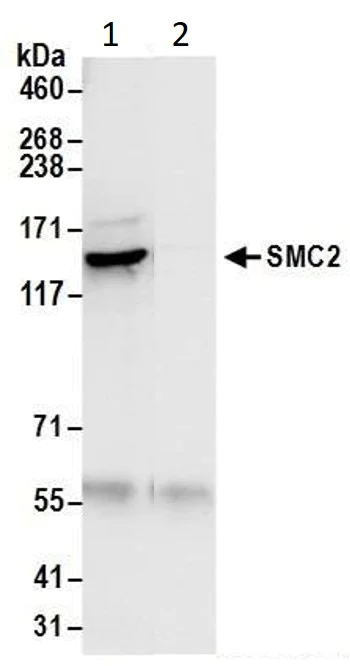
- IP
Supplier Data
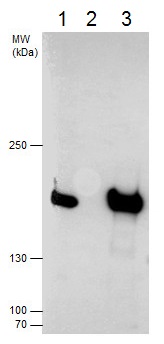
Immunoprecipitation - Anti-SMC2 antibody (AB10412)
Immunoprecipitation of Human Aurora A with ab10412 at 1 μg/mL.
Lane 1 : ab10412 + Whole cell lysate (1.0 mg per IP reaction; 20% of IP loaded) from HeLa cells prepared using NETN lysis buffer.
Lane 2 : IgG control + Whole cell lysate (1.0 mg per IP reaction; 20% of IP loaded) from HeLa cells prepared using NETN lysis buffer.
Detection : Chemiluminescence
All lanes:
Immunoprecipitation - Anti-SMC2 antibody (ab10412)
Predicted band size: 135 kDa
false
Exposure time: 3s
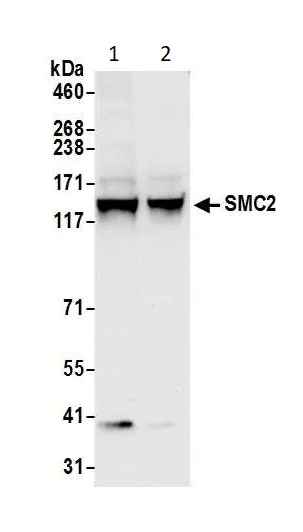
- WB
Supplier Data
Western blot - Anti-SMC2 antibody (AB10412)
All lanes:
Western blot - Anti-SMC2 antibody (ab10412) at 0.1 µg/mL
Lane 1:
HeLa cell lysate at 50 µg
Lane 2:
HEK293 cell lysate at 50 µg
Predicted band size: 135 kDa
false
Exposure time: 3s
Alternative Products
Complementary Products
Primary Antibodies
AB1791
Anti-Histone H3 antibody - Nuclear Marker and ChIP Grade
Lab Essentials

- 5
- 233
Primary Antibodies
AB217678
Anti-Rad21 antibody [EPR22506-15] - ChIP Grade
20ul selling size|BOND RX™ Validated|RabMAb|Advanced Validation|Recombinant
- 4
- 2
Reactivity data
Properties and storage information
Form
Purification technique
Purification notes
Storage buffer
Shipped at conditions
Appropriate short-term storage conditions
Appropriate long-term storage conditions
Aliquoting information
Storage information
Supplementary information
This supplementary information is collated from multiple sources and compiled automatically.
Biological function summary
SMC2 plays an essential role in ensuring proper chromosome segregation during mitosis. It acts as part of the Condensin complex a multi-protein assembly that is also composed of SMC4 CAP-D2 and CAP-G among others. This complex is important for the restructuring of chromosomes into compact forms allowing them to be easily separated during cell division. SMC2 binds to DNA and aids in the resolution of sister chromatids facilitating the equal distribution of genetic material to daughter cells.
Pathways
SMC2 operates within the cell cycle control pathway where it is involved in mitotic processes. It interacts directly with other components of the cell cycle machinery including Cyclin-dependent kinase 1 (CDK1). SMC2 also plays a role in the DNA repair pathway partnering with proteins like ATM (Ataxia-Telangiectasia Mutated kinase) which senses DNA damage and coordinates repair processes. These pathways highlight the interconnected nature of SMC2's functions in maintaining genetic stability.
Product protocols
- Visit the General protocols
- Visit the Troubleshooting
Target data
Publications (26)
Recent publications for all applications. Explore the full list and refine your search
Communications biology 8:492 PubMed40133469
2025
Applications
Unspecified application
Species
Unspecified reactive species
Nature communications 16:1675 PubMed39955279
2025
Applications
Unspecified application
Species
Unspecified reactive species
The Journal of cell biology 224: PubMed39786339
2025
Applications
Unspecified application
Species
Unspecified reactive species
Nature communications 15:7152 PubMed39169041
2024
Applications
Unspecified application
Species
Unspecified reactive species
Genes & development 34:1619-1636 PubMed33122293
2020
Applications
Unspecified application
Species
Unspecified reactive species
Cell reports 31:107533 PubMed32320646
2020
Applications
Unspecified application
Species
Unspecified reactive species
Nucleus (Austin, Tex.) 11:1-18 PubMed31924112
2020
Applications
Unspecified application
Species
Unspecified reactive species
Journal of cell science 132: PubMed31653782
2019
Applications
Unspecified application
Species
Unspecified reactive species
Nature cell biology 21:1393-1402 PubMed31685986
2019
Applications
Unspecified application
Species
Unspecified reactive species
The Journal of cell biology 218:1531-1552 PubMed30858191
2019
Applications
Unspecified application
Species
Unspecified reactive species
Product promise
Please note: All products are 'FOR RESEARCH USE ONLY. NOT FOR USE IN DIAGNOSTIC OR THERAPEUTIC PROCEDURES'.
For licensing inquiries, please contact partnerships@abcam.com