Anti-SMC4 antibody [EPR13366] - C-terminal
- RabMAb
- Recombinant
- What is this?
Be the first to review this product! Submit a review
|
(2 Publications )
- Flow Cyt (Intra)
Supplier Data
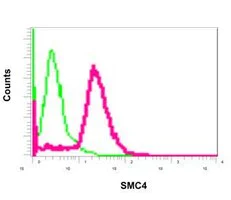
Flow Cytometry (Intracellular) - Anti-SMC4 antibody [EPR13366] - C-terminal (AB179831)
Intracellular flow cytometric analysis of permeabilized Raji cells using ab179831 at 1/10 (red) or a rabbit IgG negative (green).
- ICC/IF
Supplier Data
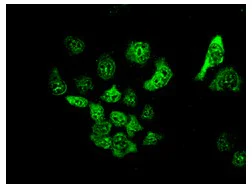
Immunocytochemistry/ Immunofluorescence - Anti-SMC4 antibody [EPR13366] - C-terminal (AB179831)
Immunofluorescent analysis of HeLa cells labeling SMC4 with ab179831 at 1/50 dilution.
- WB
Supplier Data
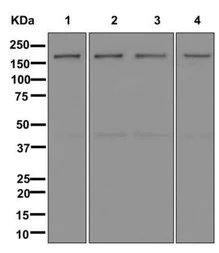
Western blot - Anti-SMC4 antibody [EPR13366] - C-terminal (AB179831)
All lanes:
Western blot - Anti-SMC4 antibody [EPR13366] - C-terminal (ab179831) at 1/1000 dilution
Lane 1:
Ramos cell lysate at 10 µg
Lane 2:
293T (Human embryonic kidney epithelial cell) cell lysate at 10 µg
Lane 3:
HeLa cell lysate at 10 µg
Lane 4:
Raji cell lysate at 10 µg
Secondary
All lanes:
Goat anti-rabbit HRP at 1/2000 dilution
Predicted band size: 147 kDa
false
Related conjugates and formulations (1)
-
Anti-SMC4 antibody [EPR13366] - BSA and Azide free
Alternative Products
Complementary Products
Primary Antibodies
AB259855
Anti-CENPB antibody [EPR24047-64]
BOND RX™ Validated|20ul selling size|RabMAb|Recombinant|KO Validated|Trial Size
- 0
- 0
Primary Antibodies
AB16667
BOND RX™ Validated|KO Validated|RabMAb|Advanced Validation|Recombinant|20ul selling size

- 5
- 133
Reactivity data
Product details
Patented technology
Our RabMAb® technology is a patented hybridoma-based technology for making rabbit monoclonal antibodies. For details on our patents, please refer to RabMAb® patents.
What are the advantages of a recombinant monoclonal antibody?
This product is a recombinant monoclonal antibody, which offers several advantages including:
- - High batch-to-batch consistency and reproducibility
- - Improved sensitivity and specificity
- - Long-term security of supply
- - Animal-free batch production
For more information, read more on recombinant antibodies.
Species reactivity
Rat: We have preliminary internal testing data to indicate this antibody may not react with this species.
Please contact us for more information.
Properties and storage information
Form
Purification technique
Storage buffer
Shipped at conditions
Appropriate short-term storage duration
Appropriate short-term storage conditions
Appropriate long-term storage conditions
Aliquoting information
Storage information
Supplementary information
This supplementary information is collated from multiple sources and compiled automatically.
Biological function summary
SMC4 operates as a part of the condensin complex which consists of several proteins including SMC2. This complex is essential in chromosome architecture mediating the compression and cohesion of sister chromatids. This structural role stabilizes chromosomes to prevent damage during cell cycle phases. By maintaining chromosomal morphology SMC4 contributes to genetic stability across generations of cells.
Pathways
SMC4 functions prominently within the chromosome segregation and cell cycle pathways. Alongside its partner SMC2 it helps manage the chromosomal landscape during mitotic events. This positioning within pathways highlights interactions with other key proteins such as cohesin which also plays a role in chromosome cohesion. By ensuring proper chromosomal condensation SMC4 synchronizes with various checkpoints throughout the cell cycle.
Product protocols
- Visit the General protocols
- Visit the Troubleshooting
Target data
Alternative Names
Publications (2)
Recent publications for all applications. Explore the full listand refine your search
Cancers 11: PubMed31357676
2019
Applications
Unspecified application
Species
Unspecified reactive species
Biochemical and biophysical research communication 505:1112-1120 PubMed30336977
2018
Applications
Unspecified application
Species
Unspecified reactive species
Product promise
Please note: All products are 'FOR RESEARCH USE ONLY. NOT FOR USE IN DIAGNOSTIC OR THERAPEUTIC PROCEDURES'.
For licensing inquiries, please contact partnerships@abcam.com