Anti-SMURF 2 antibody [EP629Y3]
- RabMAb
- Recombinant
- KO Validated
- What is this?
5
(2 Reviews)
|
(20 Publications )
- WB
Lab
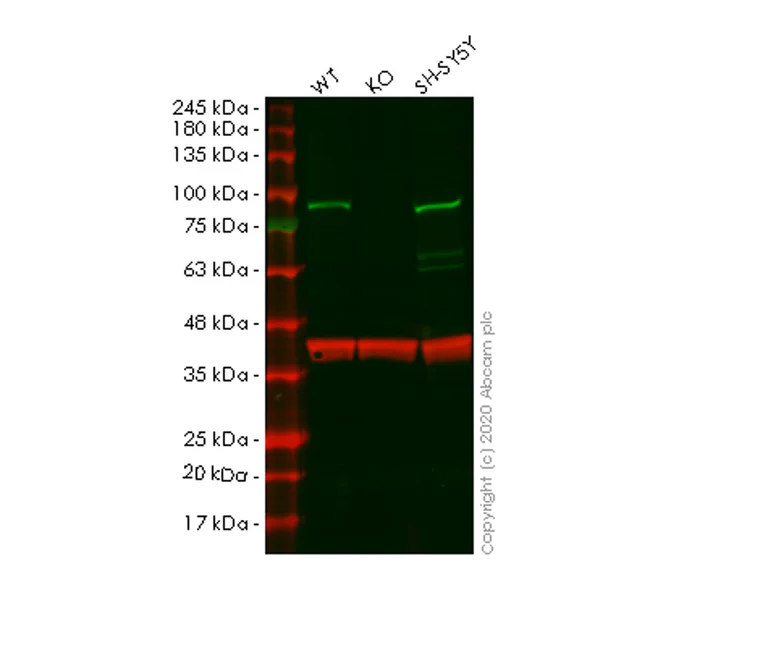
Western blot - Anti-SMURF 2 antibody [EP629Y3] (AB53316)
Lanes 1-3 : Merged signal (red and green). Green - ab53316 observed at 86 kDa. Red - loading control ab8245 observed at 36 kDa.
ab53316 Anti-SMURF 2 antibody [EP629Y3] was shown to specifically react with SMURF 2 in wild-type HeLa cells. Loss of signal was observed when knockout cell line ab265231 (knockout cell lysate ab257691) was used. Wild-type and SMURF 2 knockout samples were subjected to SDS-PAGE. ab53316 and Anti-GAPDH antibody [6C5] - Loading Control (ab8245) were incubated overnight at 4°C at 1 in 1000 dilution and 1 in 20000 dilution respectively. Blots were developed with Goat anti-Rabbit IgG H&L (IRDye® 800CW) preadsorbed (ab216773) and Goat anti-Mouse IgG H&L (IRDye® 680RD) preadsorbed (ab216776) secondary antibodies at 1 in 20000 dilution for 1 hour at room temperature before imaging.
All lanes:
Western blot - Anti-SMURF 2 antibody [EP629Y3] (ab53316) at 1/1000 dilution
Lane 1:
Wild-type HeLa cell lysate at 20 µg
Lane 2:
Western blot - Human SMURF2 knockout HeLa cell lysate (<a href='/en-us/products/cell-lysates/human-smurf2-knockout-hela-cell-lysate-ab257691'>ab257691</a>) at 20 µg
Lane 3:
SH-SY5Y cell lysate at 20 µg
Secondary
All lanes:
Western blot - Goat anti-Rabbit IgG H&L (IRDye® 800CW) preadsorbed (<a href='/en-us/products/secondary-antibodies/goat-rabbit-igg-h-l-irdye-800cw-preadsorbed-ab216773'>ab216773</a>) at 1/10000 dilution
Predicted band size: 86 kDa
Observed band size: 86 kDa
false
- WB
Lab
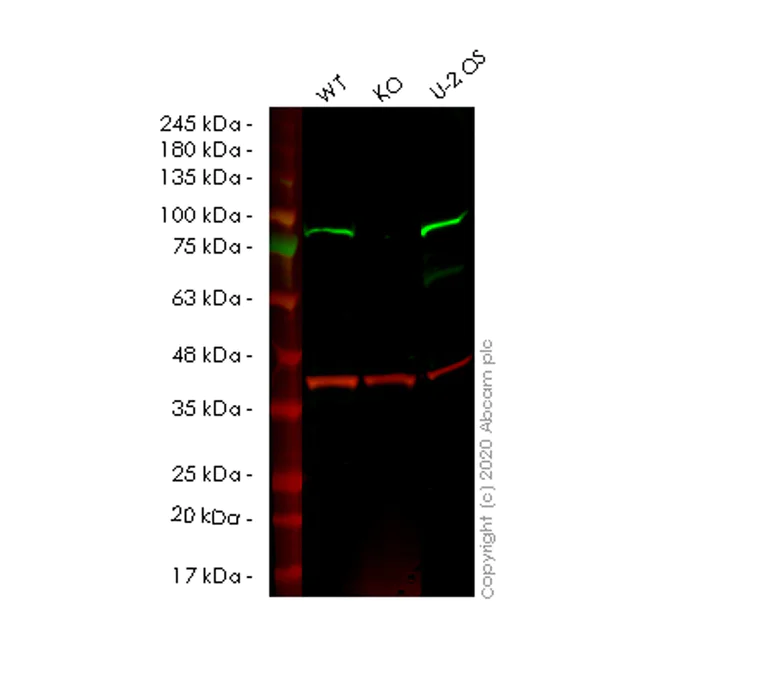
Western blot - Anti-SMURF 2 antibody [EP629Y3] (AB53316)
Lanes 1-3 : Merged signal (red and green). Green - ab53316 observed at 86 kDa. Red - loading control ab8245 observed at 36 kDa.
ab53316 Anti-SMURF 2 antibody [EP629Y3] was shown to specifically react with SMURF 2 in wild-type HeLa cells. Loss of signal was observed when knockout cell line ab264806 (knockout cell lysate ab257690) was used. Wild-type and SMURF 2 knockout samples were subjected to SDS-PAGE. ab53316 and Anti-GAPDH antibody [6C5] - Loading Control (ab8245) were incubated at room temperature for 2. 5 hours at 1 in 1000 dilution and 1 in 20000 dilution respectively. Blots were developed with Goat anti-Rabbit IgG H&L (IRDye® 800CW) preadsorbed (ab216773) and Goat anti-Mouse IgG H&L (IRDye® 680RD) preadsorbed (ab216776) secondary antibodies at 1 in 20000 dilution for 1 hour at room temperature before imaging.
All lanes:
Western blot - Anti-SMURF 2 antibody [EP629Y3] (ab53316) at 1/1000 dilution
Lane 1:
Wild-type HeLa cell lysate at 20 µg
Lane 2:
SMURF2 knockout HeLa cell lysate at 20 µg
Lane 3:
U-2 OS cell lysate at 20 µg
Secondary
All lanes:
Western blot - Goat anti-Rabbit IgG H&L (IRDye® 800CW) preadsorbed (<a href='/en-us/products/secondary-antibodies/goat-rabbit-igg-h-l-irdye-800cw-preadsorbed-ab216773'>ab216773</a>) at 1/10000 dilution
Predicted band size: 86 kDa
Observed band size: 86 kDa
false
- WB
Unknown
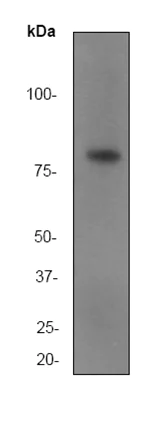
Western blot - Anti-SMURF 2 antibody [EP629Y3] (AB53316)
All lanes:
Western blot - Anti-SMURF 2 antibody [EP629Y3] (ab53316) at 1/500 dilution
All lanes:
SH-SY-5Y cell lysate at 10 µg
Secondary
All lanes:
Goat anti-rabbit HRP labeled at 1/2000 dilution
Predicted band size: 86 kDa
Observed band size: 86 kDa
false
Related conjugates and formulations (1)
-
Anti-SMURF 2 antibody [EP629Y3] - BSA and Azide free
Complementary Products
Primary Antibodies
AB40855
20ul selling size|RabMAb|Advanced Validation|Recombinant|KO Validated

- 5
- 4
Primary Antibodies
AB8227
Anti-beta Actin antibody - Loading Control
BOND RX™ Validated|Lab Essentials
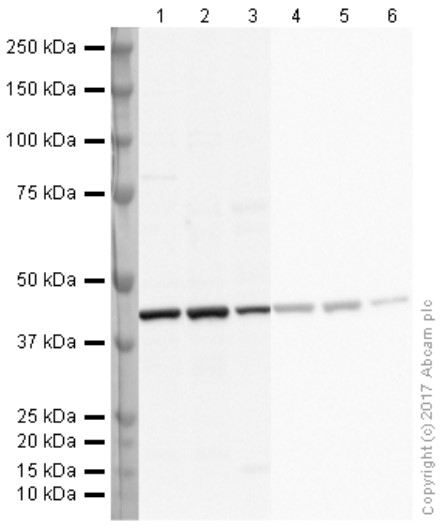
- 5
- 104
Primary Antibodies
AB235578
Anti-TGF beta Receptor I antibody [EPR20923-13]
20ul selling size|RabMAb|Recombinant|KO Validated

- 0
- 0
Reactivity data
Product details
Patented technology
Our RabMAb® technology is a patented hybridoma-based technology for making rabbit monoclonal antibodies. For details on our patents, please refer to RabMAb® patents.
What are the advantages of a recombinant monoclonal antibody?
This product is a recombinant monoclonal antibody, which offers several advantages including:
- - High batch-to-batch consistency and reproducibility
- - Improved sensitivity and specificity
- - Long-term security of supply
- - Animal-free batch production
For more information, read more on recombinant antibodies.
Properties and storage information
Form
Purification technique
Storage buffer
Shipped at conditions
Appropriate short-term storage conditions
Appropriate long-term storage conditions
Storage information
Supplementary information
This supplementary information is collated from multiple sources and compiled automatically.
Biological function summary
SMURF2 regulates many cell signaling pathways including the TGF-beta/Smad pathway. It associates with SMAD proteins to control their stability and activity acting as a negative regulator to modulate TGF-beta signaling. By promoting the ubiquitination and degradation of receptor-regulated SMADs (R-SMADs) SMURF2 impacts cellular responses to growth factors. This regulatory mechanism is important for maintaining cellular proliferation differentiation and apoptosis.
Pathways
The function of SMURF2 significantly influences the TGF-beta and BMP signaling pathways both critical in controlling cell growth and differentiation. These pathways involve interactions with other proteins like SMAD7 and SMAD2. SMURF2 interacts with SMAD7 an inhibitory SMAD to regulate Smad-dependent transcriptional responses ensuring the fine-tuning of signal transduction. These pathways' balance and regulation are vital for appropriate cellular function and response.
Product protocols
- Visit the General protocols
- Visit the Troubleshooting
Target data
Alternative Names
Publications (20)
Recent publications for all applications. Explore the full listand refine your search
Clinical, cosmetic and investigational dermatology 17:1387-1404 PubMed38881700
2024
Applications
Unspecified application
Species
Unspecified reactive species
Oncology letters 27:263 PubMed38646500
2024
Applications
Unspecified application
Species
Unspecified reactive species
International journal of molecular medicine 52: PubMed37800598
2023
Applications
Unspecified application
Species
Unspecified reactive species
APMIS : acta pathologica, microbiologica, et immunologica Scandinavica 131:313-324 PubMed37185991
2023
Applications
Unspecified application
Species
Unspecified reactive species
Cell biology international 47:894-906 PubMed36950834
2023
Applications
Unspecified application
Species
Unspecified reactive species
Aging 13:12239-12257 PubMed33872218
2021
Applications
Unspecified application
Species
Unspecified reactive species
The Journal of international medical research 48:300060520978015 PubMed33322976
2020
Applications
Unspecified application
Species
Unspecified reactive species
Aging 12:20047-20068 PubMed33099540
2020
Applications
Unspecified application
Species
Unspecified reactive species
The Journal of biological chemistry 295:18485-18493 PubMed33097595
2020
Applications
Unspecified application
Species
Unspecified reactive species
PLoS biology 16:e3000091 PubMed30566427
2018
Applications
Unspecified application
Species
Unspecified reactive species
Product promise
Please note: All products are 'FOR RESEARCH USE ONLY. NOT FOR USE IN DIAGNOSTIC OR THERAPEUTIC PROCEDURES'.
For licensing inquiries, please contact partnerships@abcam.com