JavaScript is disabled in your browser. Please enable JavaScript to view this website.
AB78105

Anti-SNAIL + SLUG antibody [20C8]

1

(2 Reviews)

|

(5 Publications)

Mouse Monoclonal SLUG antibody 20C8. Suitable for WB, sELISA and reacts with Human samples. Cited in 5 publications.

View Alternative Names

SLUG, SLUGH, SNAI2, Zinc finger protein SNAI2, Neural crest transcription factor Slug, Protein snail homolog 2, SNAH, SNAI1, Zinc finger protein SNAI1, Protein snail homolog 1, Protein sna
1 Images
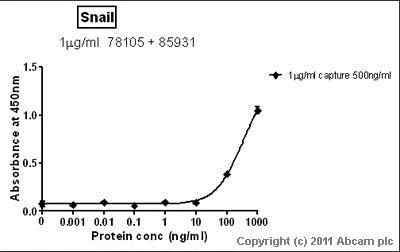
Sandwich ELISA - Anti-SNAIL + SLUG antibody [20C8] (AB78105)
  • sELISA

Unknown

Sandwich ELISA - Anti-SNAIL + SLUG antibody [20C8] (AB78105)

Standard Curve for SNAIL; dilution range 1pg/ml to 1μg/ml using Capture Antibody Mouse monoclonal [20C8] to SNAIL + SLUG (ab78105) at 1μg/ml and Detector Antibody Rabbit polyclonal to SNAIL + SLUG - ChIP Grade (ab85931) at 0.5μg/ml.

Key facts

Host species

Mouse

Clonality

Monoclonal

Clone number

20C8

Isotype

IgG1

Carrier free

No

Reacts with

Human

Applications

WB, sELISA

applications

Immunogen

Recombinant Full Length Protein corresponding to Human SNAI2.

O43623

Specificity

<p>This antibody detects endogonous proteins in the following cell lines: MDAMB-453; MDAMB-435; MDAMB-231; A375&#46;</p>

Reactivity data

{ "title": "Reactivity Data", "filters": { "stats": ["", "Species", "Dilution Info", "Notes"], "tabs": { "all-applications": {"fullname" : "All Applications", "shortname": "All Applications"}, "WB" : {"fullname" : "Western blot", "shortname":"WB"}, "sELISA" : {"fullname" : "Sandwich ELISA", "shortname":"sELISA"} }, "product-promise": { "all": "all", "testedAndGuaranteed": "tested", "guaranteed": "expected", "predicted": "predicted", "notRecommended": "not-recommended" } }, "values": { "Human": { "WB-species-checked": "testedAndGuaranteed", "WB-species-dilution-info": "1/250", "WB-species-notes": "<p></p>", "sELISA-species-checked": "testedAndGuaranteed", "sELISA-species-dilution-info": "1 µg/mL", "sELISA-species-notes": "<p>For sandwich ELISA, use this antibody as Capture at 1 µg/ml with Rabbit polyclonal to SNAIL - ChIP Grade (<a href='/en-us/products/unavailable/snail-slug-antibody-chip-grade-ab85931'>ab85931</a>) as Detection.</p>" } } }

Properties and storage information

Form
Liquid
Purification technique
Affinity purification Protein A/G
Storage buffer
Preservative: 0.02% Sodium azide Constituents: PBS
Shipped at conditions
Blue Ice
Appropriate short-term storage conditions
+4°C
Appropriate long-term storage conditions
-20°C
Aliquoting information
Upon delivery aliquot
Storage information
Avoid freeze / thaw cycle

Supplementary information

This supplementary information is collated from multiple sources and compiled automatically.

SNAIL and SLUG also known as Snai1 and Snai2 are zinc finger transcription factors important in the regulation of epithelial-mesenchymal transition (EMT). These proteins are expressed mainly in various developing tissues and tumors. The molecular weight of SNAIL is approximately 29 kDa while SLUG typically has a mass around 30 kDa. These factors function within the nucleus binding to E-box sequences in DNA to repress the transcription of epithelial markers.
Biological function summary

SNAIL and SLUG operate as vital regulators of cell motility and invasion by modulating gene expression. They do not work alone; they participate as components of a complex with other EMT-inducing transcription factors including TWIST and ZEB. These factors suppress E-cadherin and other adhesion molecules which facilitates the disassembly of tight junctions between cells promoting a mesenchymal phenotype that is more migratory and invasive.

Pathways

These transcription factors play key roles in both the TGF-beta and Wnt signaling pathways. In the TGF-beta pathway SNAIL and SLUG regulate gene expression to support EMT affecting processes in development and cancer progression. Within the Wnt pathway these factors interact with beta-catenin impacting cell cycle regulation and supporting cells' transition between epithelial and mesenchymal states a critical step in tumor metastasis.

SNAIL and SLUG significantly relate to cancer and fibrosis. In cancer their interaction with proteins such as ZEB and TWIST is important for the metastasis of carcinoma cells. In fibrosis these transcription factors link to TGF-beta-induced fibroblast activation contributing to tissue scarring. The dysregulation of SNAIL and SLUG often serves as an indicator of poor prognosis due to their roles in promoting invasive and metastatic properties in cancer.

Product protocols

For this product, it's our understanding that no specific protocols are required. You can visit:

Target data

Transcriptional repressor that modulates both activator-dependent and basal transcription. Involved in the generation and migration of neural crest cells. Plays a role in mediating RAF1-induced transcriptional repression of the TJ protein, occludin (OCLN) and subsequent oncogenic transformation of epithelial cells (By similarity). Represses BRCA2 expression by binding to its E2-box-containing silencer and recruiting CTBP1 and HDAC1 in breast cells. In epidermal keratinocytes, binds to the E-box in ITGA3 promoter and represses its transcription. Involved in the regulation of ITGB1 and ITGB4 expression and cell adhesion and proliferation in epidermal keratinocytes. Binds to E-box2 domain of BSG and activates its expression during TGFB1-induced epithelial-mesenchymal transition (EMT) in hepatocytes. Represses E-Cadherin/CDH1 transcription via E-box elements. Involved in osteoblast maturation. Binds to RUNX2 and SOC9 promoters and may act as a positive and negative transcription regulator, respectively, in osteoblasts. Binds to CXCL12 promoter via E-box regions in mesenchymal stem cells and osteoblasts. Plays an essential role in TWIST1-induced EMT and its ability to promote invasion and metastasis.
See full target information SNAI2

Additional targets

SNAI1

Publications (5)

Recent publications for all applications. Explore the full list and refine your search

Cellular signalling 75:109768 PubMed32896607

2020

Activation of autophagy inhibits epithelial to mesenchymal transition process of human lens epithelial cells induced by high glucose conditions.

Applications

Unspecified application

Species

Unspecified reactive species

Ji Li,Wei Ye,Wenqin Xu,Tianfang Chang,Luning Zhang,Jiyuan Ma,Rui Pei,Mengmei He,Jian Zhou

International journal of molecular medicine 45:265-273 PubMed31746377

2019

SNAI1 interacts with HDAC1 to control TGF‑β2‑induced epithelial‑mesenchymal transition in human lens epithelial cells.

Applications

Unspecified application

Species

Unspecified reactive species

Ning Gao,Jingming Li,Yazhou Qin,Yingna Wang,Qianyang Kang,Cheng Pei

Experimental & molecular medicine 50:e420 PubMed29303507

2018

T-cell immune regulator 1 enhances metastasis in hepatocellular carcinoma.

Applications

Unspecified application

Species

Unspecified reactive species

Hee Doo Yang,Jung Woo Eun,Kyung-Bun Lee,Qingyu Shen,Hyung Seok Kim,Sang Yean Kim,Dong-Wan Seo,Won Sang Park,Jung Young Lee,Suk Woo Nam

Stem cell research 17:62-8 PubMed27240252

2016

The mesenchymal transcription factor SNAI-1 instructs human liver specification.

Applications

ChIP

Species

Human

Orit Goldman,Victor Julian Valdes,Elena Ezhkova,Valerie Gouon-Evans

Cell death & disease 6:e1801 PubMed26136074

2015

Identification of thiostrepton as a novel therapeutic agent that targets human colon cancer stem cells.

Applications

WB

Species

Unspecified reactive species

S-Y Ju,C-Y F Huang,W-C Huang,Y Su
View all publications

Product promise

We are committed to supporting your work with high-quality reagents, and we're here for you every step of the way. In the unlikely event that one of our products does not perform as expected, you're protected by our Product Promise.
For full details, please see our Terms & Conditions

Please note: All products are 'FOR RESEARCH USE ONLY. NOT FOR USE IN DIAGNOSTIC OR THERAPEUTIC PROCEDURES'.

For licensing inquiries, please contact partnerships@abcam.com