Anti-SNAPC1 antibody [EPR16466] - BSA and Azide free
- RabMAb
- Recombinant
- What is this?
Be the first to review this product! Submit a review
|
(0 Publication)
Rabbit Recombinant Monoclonal SNAPC1 antibody. Carrier free. Suitable for ICC/IF, WB, Flow Cyt (Intra) and reacts with Human samples.
View Alternative Names
SNAP43, SNAPC1, snRNA-activating protein complex subunit 1, SNAPc subunit 1, Proximal sequence element-binding transcription factor subunit gamma, Small nuclear RNA-activating complex polypeptide 1, snRNA-activating protein complex 43 kDa subunit, PSE-binding factor subunit gamma, PTF subunit gamma, SNAPc 43 kDa subunit
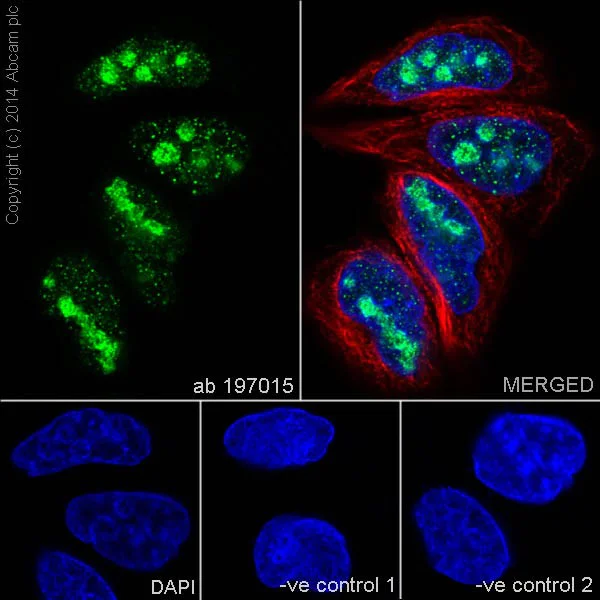
- ICC/IF
Supplier Data
Immunocytochemistry/ Immunofluorescence - Anti-SNAPC1 antibody [EPR16466] - BSA and Azide free (AB251226)
This data was developed using ab197015, the same antibody clone in a different buffer formulation.
Immunofluorescent analysis of 4% paraformaldehyde-fixed, 0.1% Triton X-100 permeabilized HeLa cells (Human epithelial cells from cervix adenocarcinoma) labeling SNAPC1 with ab197015 at 1/250 dilution, followed by Alexa Fluor®488 Goat Anti-Rabbit IgG H&L (ab150077) secondary antibody at 1/500 dilution (green). Nuclear staining on HeLa cell line is observed. The nuclear counter stain is DAPI (blue). Tubulin is detected with ab7291 (anti-Tubulin mouse mAb) at 1/1000 dilution and ab150120 (AlexaFluor®594 Goat anti-Mouse secondary) at 1/500 dilution (red).
The negative controls are as follows :
-ve control 1 : ab197015 at 1/250 dilution followed by ab150120 (AlexaFluor®594 Goat anti-Mouse secondary) at 1/500 dilution.
-ve control 2 : ab7291 (anti-Tubulin mouse mAb) at 1/1000 dilution followed by ab150077 (Alexa Fluor®488 Goat Anti-Rabbit IgG H&L) at 1/500 dilution.
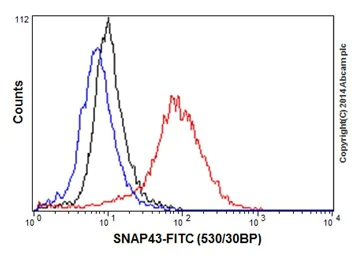
- Flow Cyt (Intra)
Supplier Data
Flow Cytometry (Intracellular) - Anti-SNAPC1 antibody [EPR16466] - BSA and Azide free (AB251226)
This data was developed using ab197015, the same antibody clone in a different buffer formulation.
Intracellular flow cytometric analysis of U-87 MG (Human glioblastoma-astrocytoma epithelial cell line) cells labeling SNAPC1 with ab197015 at 1/60 dilution (red) compared with a rabbit monoclonal IgG isotype control (black) and an unlabelled control (cells without incubation with primary antibody and secondary antibody; blue). Goat anti rabbit IgG (FITC) at 1/150 dilution was used as the secondary antibody.
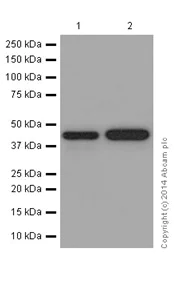
- WB
Supplier Data
Western blot - Anti-SNAPC1 antibody [EPR16466] - BSA and Azide free (AB251226)
This data was developed using ab197015, the same antibody clone in a different buffer formulation.
Blocking and dilution buffer : 5% NFDM/TBST.
All lanes:
Western blot - Anti-SNAPC1 antibody [EPR16466] (<a href='/en-us/products/primary-antibodies/snapc1-antibody-epr16466-ab197015'>ab197015</a>) at 1/5000 dilution
Lane 1:
Human testis tissue lysate at 20 µg
Lane 2:
HeLa (Human epithelial cells from cervix adenocarcinoma) cell lysate at 20 µg
Secondary
All lanes:
Goat Anti-Rabbit IgG, (H+L), Peroxidase conjugated at 1/1000 dilution
Predicted band size: 43 kDa
Observed band size: 43 kDa
false
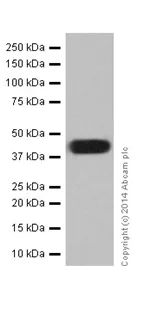
- WB
Supplier Data
Western blot - Anti-SNAPC1 antibody [EPR16466] - BSA and Azide free (AB251226)
This data was developed using ab197015, the same antibody clone in a different buffer formulation.
Blocking and dilution buffer : 5% NFDM/TBST.
All lanes:
Western blot - Anti-SNAPC1 antibody [EPR16466] (<a href='/en-us/products/primary-antibodies/snapc1-antibody-epr16466-ab197015'>ab197015</a>) at 1/5000 dilution
All lanes:
Human fetal brain tissue lysate at 10 µg
Secondary
All lanes:
Anti-Rabbit IgG (HRP), specific to the non-reduced form of IgG at 1/1000 dilution
Predicted band size: 43 kDa
Observed band size: 43 kDa
false
Related conjugates and formulations (1)
-
Anti-SNAPC1 antibody [EPR16466]
Complementary Products
Primary Antibodies
AB8898
Anti-Histone H3 (tri methyl K9) antibody - ChIP Grade
BOND RX™ Validated

- 5
- 92
Primary Antibodies
AB182858
Anti-Bcl-2 antibody [EPR17509]
BOND RX™ Validated|RabMAb|Recombinant|KO Validated|20ul selling size

- 5
- 13
Primary Antibodies
AB8580
Anti-Histone H3 (tri methyl K4) antibody - ChIP Grade
BOND RX™ Validated

- 5
- 90
Primary Antibodies
AB224637
Anti-SOX17 antibody [EPR20684]
RabMAb|Recombinant|KO Validated|20ul selling size

- 4
- 6
Reactivity data
Product details
ab251226 is the carrier-free version of ab197015.
Patented technology
Our RabMAb® technology is a patented hybridoma-based technology for making rabbit monoclonal antibodies. For details on our patents, please refer to RabMAb® patents.
What are the advantages of a recombinant monoclonal antibody?
This product is a recombinant monoclonal antibody, which offers several advantages including:
- - High batch-to-batch consistency and reproducibility
- - Improved sensitivity and specificity
- - Long-term security of supply
- - Animal-free batch production
For more information, read more on recombinant antibodies.
Conjugation ready
Our carrier-free antibodies are typically supplied in a PBS-only formulation, purified and free of BSA, sodium azide and glycerol. This conjugation-ready format is designed for use with fluorochromes, metal isotopes, oligonucleotides, and enzymes, which makes them ideal for antibody labelling, functional and cell-based assays, flow-based assays (e.g. mass cytometry) and Multiplex Imaging applications.
Use our conjugation kits for antibody conjugates that are ready-to-use in as little as 20 minutes with 1 minute hands-on-time and 100% antibody recovery: available for fluorescent dyes, HRP, biotin and gold.
Compatibility
This product is compatible with the Maxpar® Antibody Labeling Kit from Fluidigm, without the need for antibody preparation. Maxpar® is a trademark of Fluidigm Canada Inc.
Properties and storage information
Form
Storage buffer
Shipped at conditions
Appropriate short-term storage conditions
Appropriate long-term storage conditions
Storage information
Supplementary information
This supplementary information is collated from multiple sources and compiled automatically.
Biological function summary
The role of SNAPC1 lies in the assembly and regulation of the SNAPc complex. This complex functions primarily in the transcription of snRNA essential for mRNA processing and gene expression regulation. By participating in the formation of the snRNA-activating protein complex SNAPC1 facilitates the correct transcription and processing of snRNA a critical component in the spliceosomal machinery. It achieves this by forming stable interactions with other SNAPc components including SNAPC2 and SNAPC3 contributing to pre-mRNA splicing.
Pathways
SNAPC1 integrates into two major cellular pathways: transcription initiation and RNA splicing. It closely interacts with elements such as RNA polymerase II and SNAPC4 within these pathways. By securing a stable interaction with these elements SNAPC1 supports efficient transcription of snRNA and its subsequent processing. The proper function of SNAPC1 and related proteins ensures the accuracy of mRNA splicing impacting overall gene expression and cellular function.
Product protocols
- Visit the General protocols
- Visit the Troubleshooting
Target data
Product promise
Please note: All products are 'FOR RESEARCH USE ONLY. NOT FOR USE IN DIAGNOSTIC OR THERAPEUTIC PROCEDURES'.
For licensing inquiries, please contact partnerships@abcam.com