Anti-SNF5/SMARCB1 antibody [EPR12014]
- KO Validated
- RabMAb
- Recombinant
- What is this?
Be the first to review this product! Submit a review
|
(1 Publication)
- IP
Supplier Data
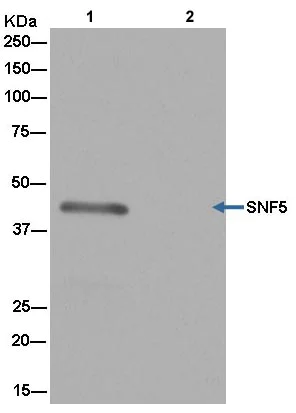
Immunoprecipitation - Anti-SNF5/SMARCB1 antibody [EPR12014] (AB181976)
Western blot analysis of HeLa cell lysate immunoprecipitated with ab181976 at 1/50 dilution (Lane 1). Lane 2 : Negative control. Anti-Rabbit IgG (HRP) secondary antibody, specific to the non-reduced form of IgG used at 1/1500 dilution.
All lanes:
Immunoprecipitation - Anti-SNF5/SMARCB1 antibody [EPR12014] (ab181976)
Predicted band size: 44 kDa
false
- WB
Lab
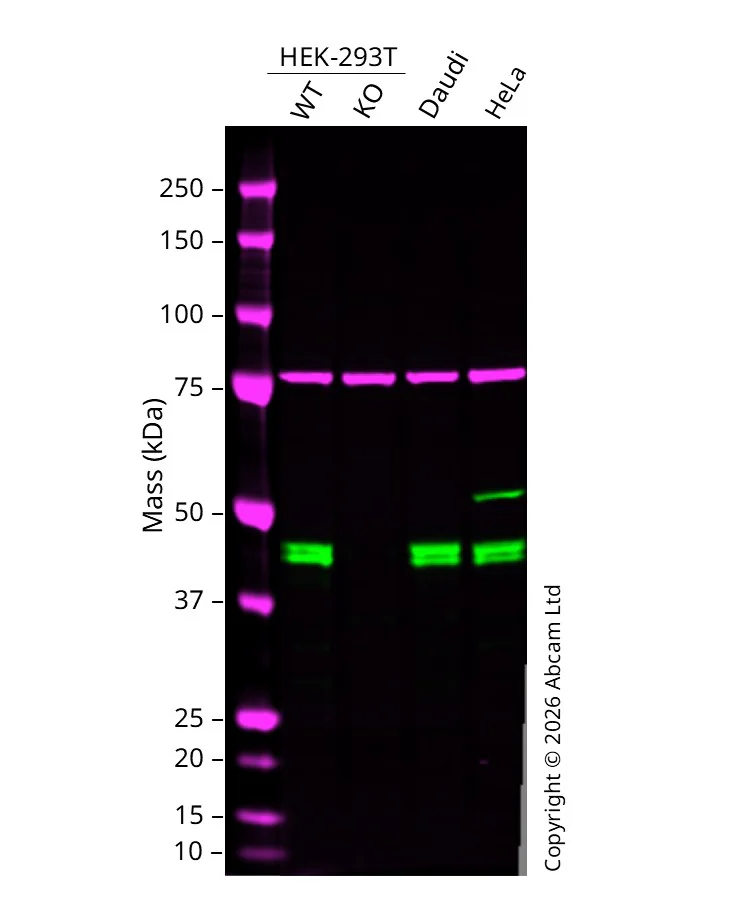
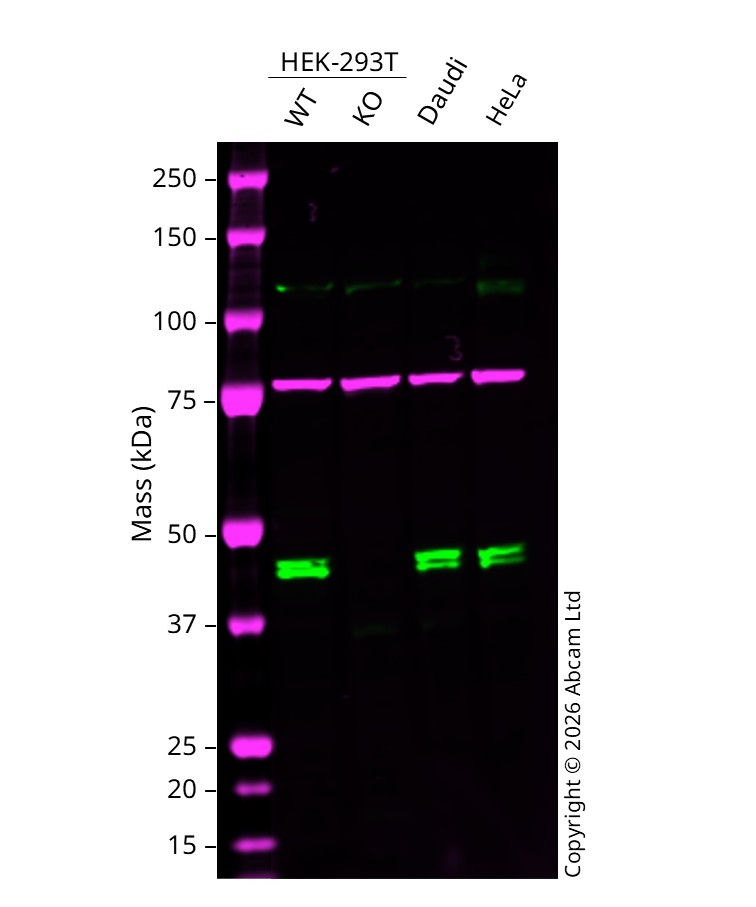
Western blot - Anti-SNF5/SMARCB1 antibody [EPR12014] (AB181976)
Western blot : Anti-SNF5/SMARCB1 antibody [EPR12014] ab181976 staining at 1/10000 dilution, shown in green; Mouse anti-CANX ab238078 loading control staining at 1/20000 dilution, shown in magenta. A band was observed at 44 kDa in Wild-type HEK-293T cell lysates with no signal observed at this size in SMARCB1 knockout HEK-293T cell line. To generate this image, samples were run on an SDS-PAGE gel then transferred onto a nitrocellulose membrane. Membranes were blocked in 5% Milk in TBS-0.1 % Tween® 20 (TBS-T) before incubation with primary antibodies overnight at 4 °C. Blots were washed four times in TBS-T, incubated with secondary antibodies for 1 h at room temperature, washed again four times then imaged. Secondary antibodies used were Goat anti-Rabbit 800CW and Goat anti-Mouse 680RD at 1/20,000 dilution.
All lanes:
Western blot - Anti-SNF5/SMARCB1 antibody [EPR12014] (ab181976) at 1/10000 dilution
Lane 1:
Western blot - Human wild-type HEK-293T cell line (ab255449) at 20 µg
Lane 2:
Western blot - Human SMARCB1 (SNF5) knockout HEK-293T cell line (<a href='/en-us/products/cell-lines/human-smarcb1-snf5-knockout-hek-293t-cell-line-ab267269'>ab267269</a>) at 20 µg
Lane 3:
Daudi at 20 µg
Lane 4:
HeLa at 20 µg
Secondary
All lanes:
Goat anti-Rabbit 800CW & Goat anti-Mouse 680RD at 1/20000 dilution
Predicted band size: 44 kDa
Observed band size: 44 kDa
false
- WB
Supplier Data
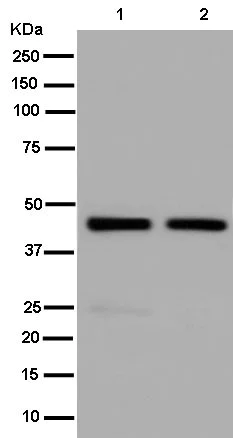
Western blot - Anti-SNF5/SMARCB1 antibody [EPR12014] (AB181976)
All lanes:
Western blot - Anti-SNF5/SMARCB1 antibody [EPR12014] (ab181976) at 1/5000 dilution
Lane 1:
293 cell lysate at 20 µg
Lane 2:
K562 cell lysate at 20 µg
Secondary
All lanes:
Goat Anti-Rabbit IgG, (H+L), Peroxidase conjugate at 1/1000 dilution
Predicted band size: 44 kDa
Observed band size: 44 kDa
false
- WB
Supplier Data
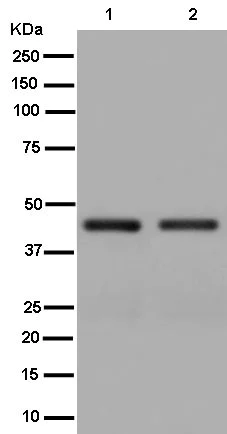
Western blot - Anti-SNF5/SMARCB1 antibody [EPR12014] (AB181976)
All lanes:
Western blot - Anti-SNF5/SMARCB1 antibody [EPR12014] (ab181976) at 1/20000 dilution
Lane 1:
HeLa cell lysate at 20 µg
Lane 2:
Jurkat cell lysate at 20 µg
Secondary
All lanes:
Goat Anti-Rabbit IgG, (H+L), Peroxidase conjugate at 1/1000 dilution
Predicted band size: 44 kDa
Observed band size: 44 kDa
false
Related conjugates and formulations (1)
-
Anti-SNF5/SMARCB1 antibody [EPR12014] - BSA and Azide free
Alternative Products

Primary Antibodies
AB126734
Anti-SNF5/SMARCB1 antibody [EPR6966]
RabMAb|Recombinant|KO Validated
- 4
- 3
Primary Antibodies
AB192864
Anti-SNF5/SMARCB1 antibody [EPR12014-77]
RabMAb|Recombinant|KO Validated

- 0
- 0
Primary Antibodies
AB222519
Anti-SNF5/SMARCB1 antibody [EPR20189]
KO Validated|RabMAb|Recombinant|Trial Size|Trial Size|Trial Size|Trial Size

- 0
- 0
Complementary Products
Primary Antibodies
AB201460
Anti-HNF-4-alpha antibody [EPR16885-99]
20ul selling size|RabMAb|Advanced Validation|Recombinant

- 4
- 2
Primary Antibodies
AB110641
Anti-BRG1 antibody [EPNCIR111A]
20ul selling size|BOND RX™ Validated|Recombinant|KO Validated|Advanced Validation|RabMAb

- 5
- 10
Primary Antibodies
AB52492
Anti-ALDH1A1 antibody [EP1933Y] - C-terminal
RabMAb|Recombinant|KO Validated|20ul selling size

- 4
- 22
Primary Antibodies
AB181447
Anti-Histone H2A (phospho S129) antibody [EPR17588] - ChIP Grade
RabMAb|Advanced Validation|Recombinant

- 0
- 0
Reactivity data
Product details
Patented technology
Our RabMAb® technology is a patented hybridoma-based technology for making rabbit monoclonal antibodies. For details on our patents, please refer to RabMAb® patents.
What are the advantages of a recombinant monoclonal antibody?
This product is a recombinant monoclonal antibody, which offers several advantages including:
- - High batch-to-batch consistency and reproducibility
- - Improved sensitivity and specificity
- - Long-term security of supply
- - Animal-free batch production
For more information, read more on recombinant antibodies.
Properties and storage information
Form
Purification technique
Storage buffer
Shipped at conditions
Appropriate short-term storage duration
Appropriate short-term storage conditions
Appropriate long-term storage conditions
Aliquoting information
Storage information
Supplementary information
This supplementary information is collated from multiple sources and compiled automatically.
Biological function summary
SNF5/SMARCB1 acts as an integral component of the SWI/SNF complex. This complex functions in altering nucleosome positioning on DNA impacting gene expression linked to cell cycle regulation differentiation and DNA repair. By working within this complex SNF5/SMARCB1 helps in the activation or repression of specific gene sets based on cellular requirements displaying an essential role in maintaining normal cellular function. The interplay of SNF5/SMARCB1 with other chromatin-modifying enzymes extends its influence across various genetic pathways.
Pathways
The involvement of SNF5/SMARCB1 in the cell cycle and transcription regulation pathways is acknowledged. It participates intimately in the p53 signaling pathway which is critical for cell cycle checkpoints and apoptotic responses. SNF5/SMARCB1 engages with other proteins such as p53 and RB1 coordinating to maintain genomic integrity and proper transcriptional programming. These pathways spotlight the protein's influence in important cell fate decisions.
Product protocols
- Visit the General protocols
- Visit the Troubleshooting
Target data
Alternative Names
Publications (1)
Recent publications for all applications. Explore the full listand refine your search
Cancer management and research 17:2235-2244 PubMed41050881
2025
Applications
Unspecified application
Species
Unspecified reactive species
Product promise
Please note: All products are 'FOR RESEARCH USE ONLY. NOT FOR USE IN DIAGNOSTIC OR THERAPEUTIC PROCEDURES'.
For licensing inquiries, please contact partnerships@abcam.com