Anti-SNRPD2 antibody [EPR16762] - BSA and Azide free
- RabMAb
- Recombinant
- What is this?
Be the first to review this product! Submit a review
|
(1 Publication)
- IHC-P
Supplier Data
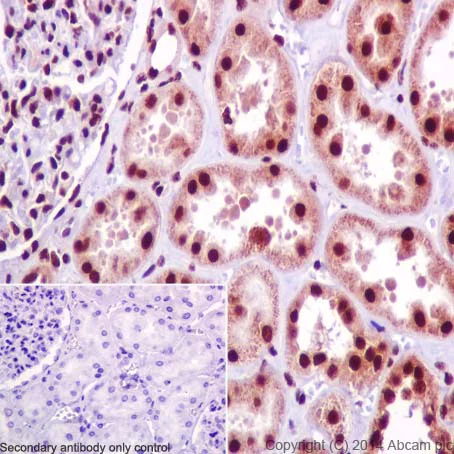
Immunohistochemistry (Formalin/PFA-fixed paraffin-embedded sections) - Anti-SNRPD2 antibody [EPR16762] - BSA and Azide free (AB251254)
This data was developed using ab198296, the same antibody clone in a different buffer formulation.
Immunohistochemical analysis of paraffin-embedded Human kidney tissue labeling SNRPD2 with ab198296 at 1/600 dilution followed by Goat Anti-Rabbit IgG H&L (HRP) (ab97051) at 1/500 dilution. Cytoplasm and nucleus staining on Human kidney tissue is observed. Counter stained with Hematoxylin.
Negative control Using PBS instead of primary antbody, secondary ab is Goat Anti-Rabbit IgG H&L (HRP)
Perform heat mediated antigen retrieval with Tris/EDTA buffer pH 9.0 before commencing with IHC staining protocol.
- Flow Cyt (Intra)
Lab
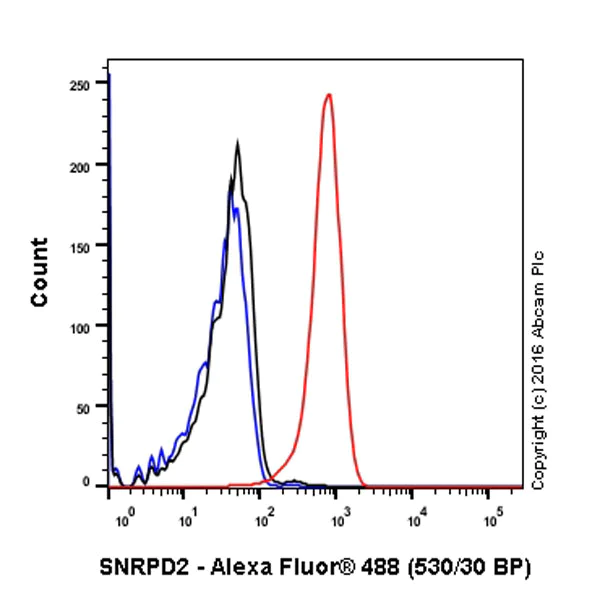
Flow Cytometry (Intracellular) - Anti-SNRPD2 antibody [EPR16762] - BSA and Azide free (AB251254)
This data was developed using ab198296, the same antibody clone in a different buffer formulation.
Intracellular Flow Cytometry analysis of HeLa cells labelling SNRPD2 (red) with purified ab198296 at dilution of 1/150. The secondary antibody used was Alexa Fluor® 488 goat-anti-rabbit IgG (1/2000). Cells were fixed with 4% paraformaldehyde and permeabilised with 90% methanol. Isotype control antibody was Rabbit monoclonal IgG (black). The blue line shows cells without incubation with primary antibody and secondary antibody.
- IP
Supplier Data
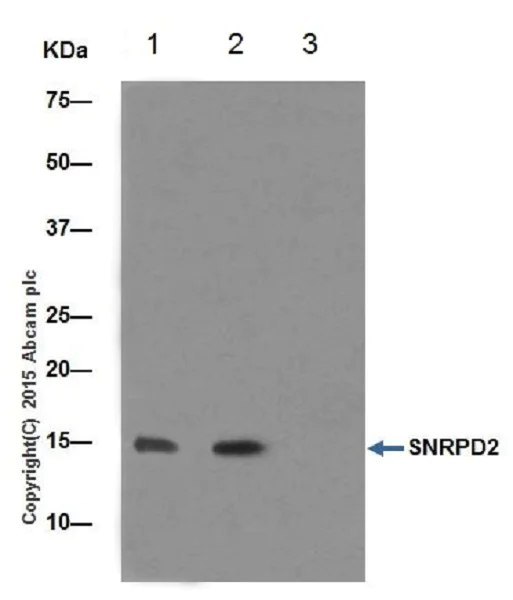
Immunoprecipitation - Anti-SNRPD2 antibody [EPR16762] - BSA and Azide free (AB251254)
This data was developed using ab198296&44; the same antibody clone in a different buffer formulation.
NRPD2 protein was immunoprecipitation from 1mg of MCF-7 (Human breast adenocarcinoma) whole cell lysate with ab198296 at 1/100 dilution. Western blot was performed from the immunoprecipitate using ab198296 at 1/1000 dilution. Anti-Rabbit IgG (HRP), specific to the non-reduced form of IgG, was used as secondary antibody at 1/1000 dilution. Lane 1 : Input, MCF-7 (Human breast adenocarcinoma) whole cell lysate, 10ug. Lane 2 : IP of NRPD2 from MCF-7 (Human breast adenocarcinoma) whole cell lysate. Lane 3 : IP using Rabbit monoclonal IgG (ab172730) instead of ab198296 in MCF-7 (Human breast adenocarcinoma) whole cell lysate.
Blocking and dilution buffer : 5% NFDM/TBST.
All lanes:
Immunoprecipitation - Anti-SNRPD2 antibody [EPR16762] (<a href='/en-us/products/primary-antibodies/snrpd2-antibody-epr16762-ab198296'>ab198296</a>)
Predicted band size: 14 kDa
Observed band size: 14 kDa
false
Exposure time: 5s
- IHC-P
Supplier Data
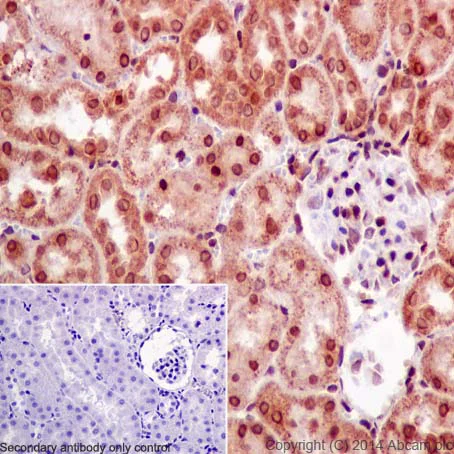
Immunohistochemistry (Formalin/PFA-fixed paraffin-embedded sections) - Anti-SNRPD2 antibody [EPR16762] - BSA and Azide free (AB251254)
This data was developed using ab198296, the same antibody clone in a different buffer formulation.
Immunohistochemical analysis of paraffin-embedded Rat kidney tissue labeling SNRPD2 with ab198296 at 1/600 dilution followed by Goat Anti-Rabbit IgG H&L (HRP) (ab97051) at 1/500 dilution. Cytoplasm and nucleus staining on Rat kidney tissue is observed. Counter stained with Hematoxylin.
Negative control Using PBS instead of primary antbody, secondary ab is Goat Anti-Rabbit IgG H&L (HRP)
Perform heat mediated antigen retrieval with Tris/EDTA buffer pH 9.0 before commencing with IHC staining protocol.
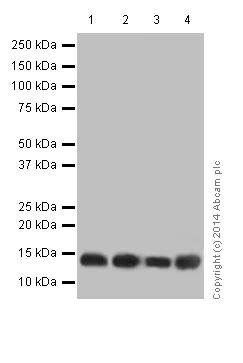
- WB
Supplier Data
Western blot - Anti-SNRPD2 antibody [EPR16762] - BSA and Azide free (AB251254)
This data was developed using ab198296, the same antibody clone in a different buffer formulation.
Blocking and dilution buffer : 5% NFDM/TBST.
All lanes:
Western blot - Anti-SNRPD2 antibody [EPR16762] (<a href='/en-us/products/primary-antibodies/snrpd2-antibody-epr16762-ab198296'>ab198296</a>) at 1/20000 dilution
Lane 1:
HepG2 cell lysate at 20 µg
Lane 2:
MCF7 cell lysate at 20 µg
Lane 3:
A549 cell lysate at 20 µg
Lane 4:
HeLa cell lysate at 20 µg
Secondary
All lanes:
Goat Anti-Rabbit IgG, (H+L), Peroxidase conjugate at 1/1000 dilution
Predicted band size: 14 kDa
Observed band size: 14 kDa
true
Exposure time: 30s
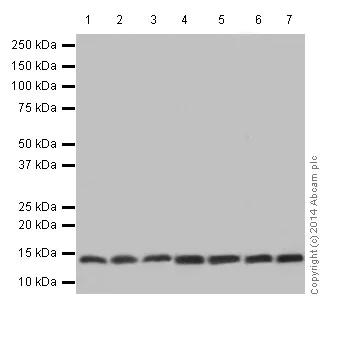
- WB
Supplier Data
Western blot - Anti-SNRPD2 antibody [EPR16762] - BSA and Azide free (AB251254)
This data was developed using ab198296, the same antibody clone in a different buffer formulation.
Blocking and dilution buffer : 5% NFDM/TBST.
Lanes 1 - 6:
Western blot - Anti-SNRPD2 antibody [EPR16762] (<a href='/en-us/products/primary-antibodies/snrpd2-antibody-epr16762-ab198296'>ab198296</a>) at 1/2000 dilution
Lane 7:
Western blot - Anti-SNRPD2 antibody [EPR16762] (<a href='/en-us/products/primary-antibodies/snrpd2-antibody-epr16762-ab198296'>ab198296</a>) at 1/20000 dilution
Lane 1:
Mouse brain lysate at 10 µg
Lane 2:
Mouse spleen lysate at 10 µg
Lane 3:
Rat brain lysate at 10 µg
Lane 4:
Rat spleen lysate at 10 µg
Lane 5:
C6 cell lysate at 10 µg
Lane 6:
RAW 264.7 cell lysate at 10 µg
Lane 7:
PC12 cell lysate at 10 µg
Secondary
All lanes:
Goat Anti-Rabbit IgG, (H+L), Peroxidase conjugate at 1/1000 dilution
Predicted band size: 14 kDa
Observed band size: 14 kDa
true
Exposure time: 30s
Related conjugates and formulations (10)
-
Anti-SNRPD2 antibody [EPR16762]
-
660 APC
APC Anti-SNRPD2 antibody [EPR16762]
-
519 Alexa Fluor® 488
Alexa Fluor® 488 Anti-Sm-D2 antibody [EPR16762]
-
565 Alexa Fluor® 555
Alexa Fluor® 555 Anti-Sm-D2 antibody [EPR16762]
-
603 Alexa Fluor® 568
Alexa Fluor® 568 Anti-SNRPD2 antibody [EPR16762]
-
617 Alexa Fluor® 594
Alexa Fluor® 594 Anti-Sm-D2 antibody [EPR16762]
-
665 Alexa Fluor® 647
Alexa Fluor® 647 Anti-Sm-D2 antibody [EPR16762]
-
775 Alexa Fluor® 750
Alexa Fluor® 750 Anti-SNRPD2 antibody [EPR16762]
-
HRP Anti-SNRPD2 antibody [EPR16762]
-
578 PE
PE Anti-SNRPD2 antibody [EPR16762]
Complementary Products


Primary Antibodies
AB115777
Anti-beta Actin antibody [SP124] - Cytoskeleton Marker
20ul selling size|RabMAb|Lab Essentials|Recombinant

- 4
- 1

Primary Antibodies
AB181602
Anti-GAPDH antibody [EPR16891] - Loading Control
KD Validated|RabMAb|Recombinant|Lab Essentials|20ul selling size

- 5
- 23
Reactivity data
Product details
ab251254 is the carrier-free version of ab198296.
Patented technology
Our RabMAb® technology is a patented hybridoma-based technology for making rabbit monoclonal antibodies. For details on our patents, please refer to RabMAb® patents.
What are the advantages of a recombinant monoclonal antibody?
This product is a recombinant monoclonal antibody, which offers several advantages including:
- - High batch-to-batch consistency and reproducibility
- - Improved sensitivity and specificity
- - Long-term security of supply
- - Animal-free batch production
For more information, read more on recombinant antibodies.
Conjugation ready
Our carrier-free antibodies are typically supplied in a PBS-only formulation, purified and free of BSA, sodium azide and glycerol. This conjugation-ready format is designed for use with fluorochromes, metal isotopes, oligonucleotides, and enzymes, which makes them ideal for antibody labelling, functional and cell-based assays, flow-based assays (e.g. mass cytometry) and Multiplex Imaging applications.
Use our conjugation kits for antibody conjugates that are ready-to-use in as little as 20 minutes with 1 minute hands-on-time and 100% antibody recovery: available for fluorescent dyes, HRP, biotin and gold.
Compatibility
This product is compatible with the Maxpar® Antibody Labeling Kit from Fluidigm, without the need for antibody preparation. Maxpar® is a trademark of Fluidigm Canada Inc.
Properties and storage information
Form
Storage buffer
Shipped at conditions
Appropriate short-term storage conditions
Appropriate long-term storage conditions
Storage information
Supplementary information
This supplementary information is collated from multiple sources and compiled automatically.
Biological function summary
SNRPD2 participates in the formation of the spliceosomal core necessary for the removal of introns from pre-mRNA which is important for generating mature mRNA transcripts. This protein is a part of the spliceosome complex consisting of other snRNPs and numerous accessory proteins. SNRPD2's involvement in mRNA processing highlights its fundamental role in gene expression regulation affecting how cells translate genetic information into functional proteins.
Pathways
SNRPD2 is a critical element in the spliceosome pathway a major route for the post-transcriptional modification of RNA. This pathway is integral to the regulation of alternative splicing events influencing protein diversity. SNRPD2 also interacts with other spliceosomal proteins such as SNRPB and SNRPE cooperating to facilitate precise exon-exon junctions. The fidelity of this pathway depends substantially on the integrity and functionality of SNRPD2 alongside its protein partners.
Product protocols
- Visit the General protocols
- Visit the Troubleshooting
Target data
Alternative Names
Publications (1)
Recent publications for all applications. Explore the full list and refine your search
World journal of gastroenterology 26:1745-1757 PubMed32351291
2020
Applications
Unspecified application
Species
Unspecified reactive species
Product promise
Please note: All products are 'FOR RESEARCH USE ONLY. NOT FOR USE IN DIAGNOSTIC OR THERAPEUTIC PROCEDURES'.
For licensing inquiries, please contact partnerships@abcam.com