JavaScript is disabled in your browser. Please enable JavaScript to view this website.
AB100881

Anti-Somatostatin Receptor 1/SSTR1 antibody

1

(1 Review)

|

(2 Publications )
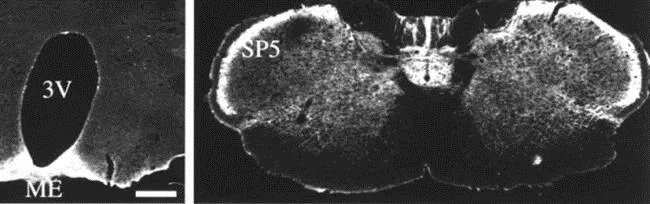
Rabbit Polyclonal Somatostatin Receptor 1/SSTR1 antibody. Suitable for ICC/IF and reacts with Rat samples. Cited in 2 publications. Immunogen corresponding to Synthetic Peptide within Mouse Sstr1 aa 350 to C-terminus.
3 Images
Immunocytochemistry/ Immunofluorescence - Anti-Somatostatin Receptor 1/SSTR1 antibody (AB100881)
  • ICC/IF

Supplier Data

Immunocytochemistry/ Immunofluorescence - Anti-Somatostatin Receptor 1/SSTR1 antibody (AB100881)

Immunocytochemistry/ Immunofluorescence showing Somatostatin Receptor 1/SSTR1 staining in rat brain using ab100881.
Immunocytochemistry/ Immunofluorescence - Anti-Somatostatin Receptor 1/SSTR1 antibody (AB100881)
  • ICC/IF

Unknown

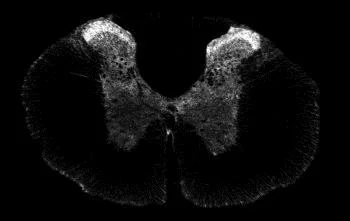
Immunocytochemistry/ Immunofluorescence - Anti-Somatostatin Receptor 1/SSTR1 antibody (AB100881)

ab100881 showing anti-Sst1 depicts sst1 as a presynaptic receptor in the superficial layers of the spinal cord dorsal horn.
Immunocytochemistry/ Immunofluorescence - Anti-Somatostatin Receptor 1/SSTR1 antibody (AB100881)
  • ICC/IF

Unknown

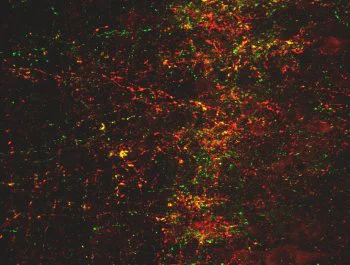
Immunocytochemistry/ Immunofluorescence - Anti-Somatostatin Receptor 1/SSTR1 antibody (AB100881)

ab100881 at 1/5000 showing dual labeling of anti-sst1 (green) and somatostatin (red). Anti-Sst1 shows sst1 in neuronal terminals co-localized with somatostatin

Key facts

Host species

Rabbit

Clonality

Polyclonal

Isotype

IgG

Carrier free

No

Reacts with

Rat

Applications

ICC/IF

applications

Immunogen

Synthetic Peptide within Mouse Sstr1 aa 350 to C-terminus. The exact immunogen used to generate this antibody is proprietary information.

P30873

Reactivity data

{ "title": "Reactivity Data", "filters": { "stats": ["", "Species", "Dilution Info", "Notes"], "tabs": { "all-applications": {"fullname" : "All Applications", "shortname": "All Applications"}, "ICCIF" : {"fullname" : "Immunocytochemistry/ Immunofluorescence", "shortname":"ICC/IF"} }, "product-promise": { "all": "all", "testedAndGuaranteed": "tested", "guaranteed": "expected", "predicted": "predicted", "notRecommended": "not-recommended" } }, "values": { "Rat": { "ICCIF-species-checked": "testedAndGuaranteed", "ICCIF-species-dilution-info": "", "ICCIF-species-notes": "<p></p>" } } }

Properties and storage information

Form
Liquid
Purity
Whole antiserum
Storage buffer
Preservative: 0.02% Sodium azide Constituents: Whole serum
Shipped at conditions
Blue Ice
Appropriate short-term storage conditions
+4°C
Appropriate long-term storage conditions
-20°C
Aliquoting information
Upon delivery aliquot
Storage information
Avoid freeze / thaw cycle

Supplementary information

This supplementary information is collated from multiple sources and compiled automatically.

Somatostatin Receptor 1 (SSTR1) is a G-protein coupled receptor that plays an important role in mediating the effects of the neuropeptide somatostatin. This receptor is often referred to simply as SSTR1 and has a molecular mass of approximately 42 kDa. SSTR1 gets expressed in numerous tissues including the brain kidney and lung. It is known to couple with inhibitory G-proteins leading to reduced adenylate cyclase activity and decreased levels of cyclic AMP which impacts cell signaling.
Biological function summary

SSTR1 is important in the regulation of endocrine and neuronal signaling. It does not engage in complex formation but interacts through its pathways to inhibit hormone secretion. In neurons SSTR1 modulates neurotransmitter release impacting processes such as pain perception and neuronal growth. This function extends to controlling cell proliferation influencing cancer cells where it can suppress tumor growth by altering cell-cycle dynamics and inducing apoptosis.

Pathways

SSTR1 plays its role in the somatostatin signaling pathway and the cAMP signaling pathway. Within these pathways it works along with proteins such as adenylate cyclase which it inhibits to relay somatostatin's signals effectively. SSTR1's ability to reduce cAMP levels makes it an important player in signal transduction pathways that govern cell function and communication.

SSTR1 has relevance in conditions like acromegaly and neuroendocrine tumors. In acromegaly the receptor's ability to reduce growth hormone secretion is important for symptom management. SSTR1 also relates to neuroendocrine tumors through its interaction with somatostatin which can inhibit tumor growth and progression. In these contexts SSTR1's function intertwines with other somatostatin receptors like SSTR2 to modulate growth hormone release and cell proliferation in these diseases.

Product protocols

For this product, it's our understanding that no specific protocols are required. You can visit:

Target data

Receptor for somatostatin with higher affinity for somatostatin-14 than -28. This receptor is coupled via pertussis toxin sensitive G proteins to inhibition of adenylyl cyclase. In addition it stimulates phosphotyrosine phosphatase and Na(+)/H(+) exchanger via pertussis toxin insensitive G proteins.
See full target information Sstr1

Alternative Names

Smstr1, Somatostatin receptor type 1, SS-1-R, SS1-R, SS1R, SRIF-2

Publications (2)

Recent publications for all applications. Explore the full list and refine your search

Genomics, proteomics & bioinformatics 19:754-771 PubMed33631425

2021

Oleic Acid and Eicosapentaenoic Acid Reverse Palmitic Acid-induced Insulin Resistance in Human HepG2 Cells via the Reactive Oxygen Species/JUN Pathway.

Applications

Unspecified application

Species

Unspecified reactive species

Yaping Sun,Jifeng Wang,Xiaojing Guo,Nali Zhu,Lili Niu,Xiang Ding,Zhensheng Xie,Xiulan Chen,Fuquan Yang

Molecular therapy. Nucleic acids 22:140-152 PubMed32927363

2020

HOTAIR Accelerates Dyskinesia in a MPTP-Lesioned Mouse Model of PD via SSTR1 Methylation-Mediated ERK1/2 Axis.

Applications

Unspecified application

Species

Unspecified reactive species

Lijun Cai,Li Tu,Xiulin Yang,Qian Zhang,Tian Tian,Rang Gu,Xiang Qu,Qian Wang,Jinyong Tian
View all publications

Product promise

We are committed to supporting your work with high-quality reagents, and we're here for you every step of the way. In the unlikely event that one of our products does not perform as expected, you're protected by our Product Promise.
For full details, please see our Terms & Conditions

Please note: All products are 'FOR RESEARCH USE ONLY. NOT FOR USE IN DIAGNOSTIC OR THERAPEUTIC PROCEDURES'.

For licensing inquiries, please contact partnerships@abcam.com