JavaScript is disabled in your browser. Please enable JavaScript to view this website.
AB126354

Anti-SPATA5L1 antibody

Be the first to review this product! Submit a review

|

(1 Publication)

Rabbit Polyclonal SPATA5L1 antibody. Suitable for IHC-P, WB, ICC/IF and reacts with Human samples. Cited in 1 publication. Immunogen corresponding to Recombinant Fragment Protein within Human AFG2B aa 500-650.

View Alternative Names

SPATA5L1, AFG2B, ATPase family gene 2 protein homolog B, AFG2 AAA ATPase homolog B, Ribosome biogenesis protein SPATA5L1, Spermatogenesis-associated protein 5-like protein 1
3 Images
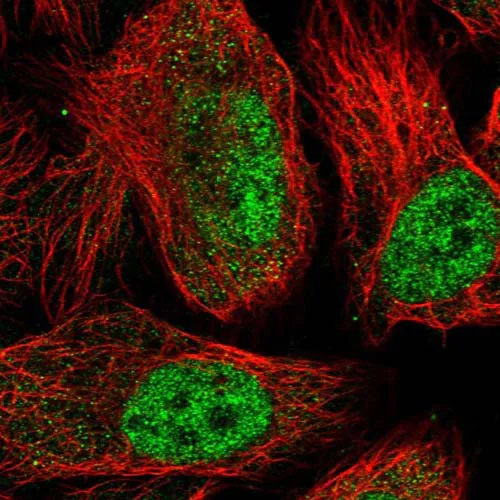
Immunocytochemistry/ Immunofluorescence - Anti-SPATA5L1 antibody (AB126354)
  • ICC/IF

Unknown

Immunocytochemistry/ Immunofluorescence - Anti-SPATA5L1 antibody (AB126354)

Immunofluorescent staining of Human cell line U-2 OS shows positivity in nucleus but not nucleoli. Recommended concentration of ab126354 1-4 µg/ml. Cells treated with PFA/Triton X-100.
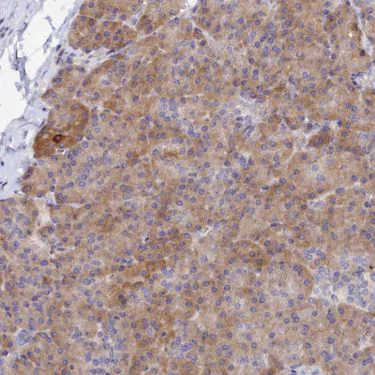
Immunohistochemistry (Formalin/PFA-fixed paraffin-embedded sections) - Anti-SPATA5L1 antibody (AB126354)
  • IHC-P

Unknown

Immunohistochemistry (Formalin/PFA-fixed paraffin-embedded sections) - Anti-SPATA5L1 antibody (AB126354)

ab126354 at a 1/50 dilution staining SPATA5L1 in paraffin embedded Human pancreas tissue by immunohistochemistry.
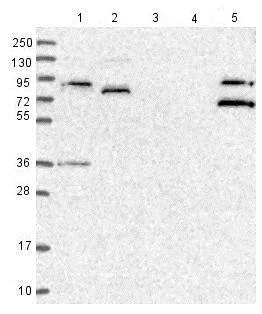
Western blot - Anti-SPATA5L1 antibody (AB126354)
  • WB

Unknown

Western blot - Anti-SPATA5L1 antibody (AB126354)

All lanes:

Western blot - Anti-SPATA5L1 antibody (ab126354) at 1/250 dilution

Lane 1:

RT4 cell lysate

Lane 2:

U251 MG cell lysate

Lane 3:

Human plasma lysate

Lane 4:

Human liver tissue lysate

Lane 5:

Human tonsil tissue lysate

Predicted band size: 81 kDa

false

Key facts

Host species

Rabbit

Clonality

Polyclonal

Isotype

IgG

Carrier free

No

Reacts with

Human

Applications

WB, IHC-P, ICC/IF

applications

Immunogen

Recombinant Fragment Protein within Human AFG2B aa 500-650. The exact immunogen used to generate this antibody is proprietary information.

Q9BVQ7

Reactivity data

{ "title": "Reactivity Data", "filters": { "stats": ["", "Species", "Dilution Info", "Notes"], "tabs": { "all-applications": {"fullname" : "All Applications", "shortname": "All Applications"}, "IHCP" : {"fullname" : "Immunohistochemistry (Formalin/PFA-fixed paraffin-embedded sections)", "shortname":"IHC-P"}, "WB" : {"fullname" : "Western blot", "shortname":"WB"}, "ICCIF" : {"fullname" : "Immunocytochemistry/ Immunofluorescence", "shortname":"ICC/IF"} }, "product-promise": { "all": "all", "testedAndGuaranteed": "tested", "guaranteed": "expected", "predicted": "predicted", "notRecommended": "not-recommended" } }, "values": { "Human": { "IHCP-species-checked": "testedAndGuaranteed", "IHCP-species-dilution-info": "1/50 - 1/200", "IHCP-species-notes": "<p></p> Perform heat-mediated antigen retrieval with citrate buffer pH 6 before commencing with IHC staining protocol.", "WB-species-checked": "testedAndGuaranteed", "WB-species-dilution-info": "0.04-0.4 µg/mL", "WB-species-notes": "<p></p>", "ICCIF-species-checked": "testedAndGuaranteed", "ICCIF-species-dilution-info": "0.25-2 µg/mL", "ICCIF-species-notes": "<p></p>" } } }

Properties and storage information

Form
Liquid
Purification technique
Affinity purification Immunogen
Storage buffer
pH: 7.2 Preservative: 0.02% Sodium azide Constituents: PBS, 40% Glycerol (glycerin, glycerine)
Shipped at conditions
Blue Ice
Appropriate short-term storage conditions
+4°C
Appropriate long-term storage conditions
-20°C
Aliquoting information
Upon delivery aliquot
Storage information
Avoid freeze / thaw cycle

Supplementary information

This supplementary information is collated from multiple sources and compiled automatically.

SPATA5L1 also known as Spermatogenesis-Associated 5-Like 1 is a protein with a molecular mass of approximately 69 kDa. It plays a role in the cellular mechanisms that regulate protein interactions and stability. SPATA5L1 expresses in a wide range of tissues with higher concentrations observed in reproductive tissues suggesting a potential role in reproductive biology. Its expression pattern indicates involvement in specialized cellular processes that require precise regulation.
Biological function summary

SPATA5L1 participates in processes that involve cellular growth and differentiation. It is not a member of a specific protein complex but interacts with multiple signaling proteins to execute its functions. SPATA5L1 supports the maintenance of cellular homeostasis by ensuring proper functioning of molecular pathways. Its role becomes essential in cells requiring rapid division and growth where it impacts cellular dynamics and function.

Pathways

SPATA5L1 interacts with regulatory networks involved in cell cycle control and RNA processing. In particular it associates with the MAPK signaling pathway which plays a role in transmitting signals from cell surface receptors to the DNA in the nucleus. This pathway connects SPATA5L1 with proteins such as MEK and ERK which modulate cellular responses to external stimuli. By operating within these pathways SPATA5L1 affects processes essential for cellular adaptation and survival.

SPATA5L1 shows associations with certain reproductive disorders. Its dysregulation is linked to impaired spermatogenesis potentially leading to infertility. Additionally abnormal expression levels may have implications in cancer biology as SPATA5L1 interacts with proteins like p53 an important regulator in tumor suppression pathways. These associations suggest SPATA5L1 as a relevant target for understanding and potentially managing related disease mechanisms.

Product protocols

For this product, it's our understanding that no specific protocols are required. You can visit:

Target data

ATP-dependent chaperone part of the 55LCC heterohexameric ATPase complex which is chromatin-associated and promotes replisome proteostasis to maintain replication fork progression and genome stability. Required for replication fork progression, sister chromatid cohesion, and chromosome stability. The ATPase activity is specifically enhanced by replication fork DNA and is coupled to cysteine protease-dependent cleavage of replisome substrates in response to replication fork damage. Uses ATPase activity to process replisome substrates in S-phase, facilitating their proteolytic turnover from chromatin to ensure DNA replication and mitotic fidelity (PubMed : 38554706). Plays an essential role in the cytoplasmic maturation steps of pre-60S ribosomal particles by promoting the release of shuttling protein RSL24D1/RLP24 from the pre-ribosomal particles (PubMed : 35354024).
See full target information AFG2B

Publications (1)

Recent publications for all applications. Explore the full list and refine your search

iScience 28:112722 PubMed40546969

2025

Distinct functions of PAXX and MRI during chromosomal end joining.

Applications

Unspecified application

Species

Unspecified reactive species

Metztli Cisneros-Aguirre,Felicia Wednesday Lopezcolorado,Xiaoli Ping,Ruby Chen,Jeremy M Stark
View all publications

Product promise

We are committed to supporting your work with high-quality reagents, and we're here for you every step of the way. In the unlikely event that one of our products does not perform as expected, you're protected by our Product Promise.
For full details, please see our Terms & Conditions

Please note: All products are 'FOR RESEARCH USE ONLY. NOT FOR USE IN DIAGNOSTIC OR THERAPEUTIC PROCEDURES'.

For licensing inquiries, please contact partnerships@abcam.com