JavaScript is disabled in your browser. Please enable JavaScript to view this website.
AB121893

Anti-Stabilin 2 antibody

4

(1 Review)

|

(9 Publications )
Rabbit Polyclonal Stabilin 2 antibody. Suitable for IHC-P, ICC/IF and reacts with Human samples. Cited in 9 publications. Immunogen corresponding to Recombinant Fragment Protein within Human STAB2 aa 1200-1350.
2 Images
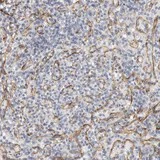
Immunohistochemistry (Formalin/PFA-fixed paraffin-embedded sections) - Anti-Stabilin 2 antibody (AB121893)
  • IHC-P

Unknown

Immunohistochemistry (Formalin/PFA-fixed paraffin-embedded sections) - Anti-Stabilin 2 antibody (AB121893)

ab121893 at 1/200 dilution staining Stabilin 2 in Paraffin-embedded Human Spleen tissue by Immunohistochemistry.
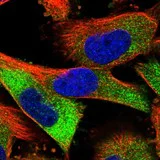
Immunocytochemistry/ Immunofluorescence - Anti-Stabilin 2 antibody (AB121893)
  • ICC/IF

Unknown

Immunocytochemistry/ Immunofluorescence - Anti-Stabilin 2 antibody (AB121893)

ab128931 at 4 μg/ml staining Stabilin 2 in PFA/Triton X-100 fixed/permeabilized U 251 MG cells by Immunofluorescence (green).

Key facts

Host species

Rabbit

Clonality

Polyclonal

Isotype

IgG

Carrier free

No

Reacts with

Human

Applications

ICC/IF, IHC-P

applications

Immunogen

Recombinant Fragment Protein within Human STAB2 aa 1200-1350. The exact immunogen used to generate this antibody is proprietary information.

Q8WWQ8

Reactivity data

{ "title": "Reactivity Data", "filters": { "stats": ["", "Species", "Dilution Info", "Notes"], "tabs": { "all-applications": {"fullname" : "All Applications", "shortname": "All Applications"}, "IHCP" : {"fullname" : "Immunohistochemistry (Formalin/PFA-fixed paraffin-embedded sections)", "shortname":"IHC-P"}, "ICCIF" : {"fullname" : "Immunocytochemistry/ Immunofluorescence", "shortname":"ICC/IF"} }, "product-promise": { "all": "all", "testedAndGuaranteed": "tested", "guaranteed": "expected", "predicted": "predicted", "notRecommended": "not-recommended" } }, "values": { "Human": { "IHCP-species-checked": "testedAndGuaranteed", "IHCP-species-dilution-info": "1/500 - 1/1000", "IHCP-species-notes": "<p></p> Perform heat-mediated antigen retrieval with citrate buffer pH 6 before commencing with IHC staining protocol.", "ICCIF-species-checked": "testedAndGuaranteed", "ICCIF-species-dilution-info": "0.25-2 µg/mL", "ICCIF-species-notes": "<p></p>" } } }

Properties and storage information

Form
Liquid
Purification technique
Affinity purification Immunogen
Storage buffer
pH: 7.2 Preservative: 0.02% Sodium azide Constituents: PBS, 40% Glycerol (glycerin, glycerine)
Shipped at conditions
Blue Ice
Appropriate short-term storage conditions
+4°C
Appropriate long-term storage conditions
-20°C
Aliquoting information
Upon delivery aliquot
Storage information
Avoid freeze / thaw cycle

Supplementary information

This supplementary information is collated from multiple sources and compiled automatically.

Stabilin 2 also known as FEEL-2 (Fasciclin EGF-like Laminin-type EGF-like and Link domain-containing scavenger receptor 2) is a receptor involved in the endocytic clearance of various ligands. It is a large protein with a mass of approximately 315 kDa. Stabilin 2 shows expression in sinusoidal endothelial cells mainly in the liver spleen and lymph nodes. The protein facilitates the internalization and degradation of hyaluronic acid and heparin playing a significant role in removing glycosaminoglycans from the vascular system.
Biological function summary

Stabilin 2 functions to clear hyaluronic acid from the bloodstream efficiently. This receptor is part of the scavenger receptor family and engages in binding and internalizing other ligands such as phosphatidylserine on apoptotic cells contributing to cellular homeostasis. Stabilin 2 forms complexes with other proteins like stabilin 1 providing coordinated involvement in endocytosis and scavenger functions. Stabilin 2's role in the clearance of extracellular matrix components positions it as significant in tissue remodeling and repair processes.

Pathways

Stabilin 2 participates in the hyaluronan metabolic pathway. This pathway involves the turnover of hyaluronic acid an important component of the extracellular matrix. Stabilin 2 alongside other receptors like CD44 regulates the balance of hyaluronic acid levels in tissues influencing processes like cell migration and proliferation. This protein also integrates into pathways related to the clearance of apoptotic cells interacting with receptors such as TIM-4 to maintain immune system balance and prevent inflammation.

Stabilin 2 connections to liver fibrosis and atherosclerosis offer insights into its biological significance. During liver fibrosis stabilin 2 expression may increase in response to inflammation and tissue damage aiding in the clearance of extracellular matrix components to limit fibrotic progression. In atherosclerosis this receptor contributes to lipid homeostasis by promoting the removal of apoptotic cell debris from vessel walls. Connections with proteins such as scavenger receptor class B type 1 (SR-B1) highlight Stabilin 2's role in managing lipids and inflammation which are critical in these disease contexts.

Product protocols

For this product, it's our understanding that no specific protocols are required. You can visit:

Target data

Phosphatidylserine receptor that enhances the engulfment of apoptotic cells. Hyaluronan receptor that binds to and mediates endocytosis of hyaluronic acid (HA). Also acts, in different species, as a primary systemic scavenger receptor for heparin (Hep), chondroitin sulfate (CS), dermatan sulfate (DS), nonglycosaminoglycan (GAG), acetylated low-density lipoprotein (AcLDL), pro-collagen propeptides and advanced glycation end products (AGE). May serve to maintain tissue integrity by supporting extracellular matrix turnover or it may contribute to maintaining fluidity of bodily liquids by resorption of hyaluronan. Counter receptor which plays an important role in lymphocyte recruitment in the hepatic vasculature. Binds to both Gram-positive and Gram-negative bacteria and may play a role in defense against bacterial infection. The proteolytically processed 190 kDa form also functions as an endocytosis receptor for heparin internalization as well as HA and CS.
See full target information STAB2

Alternative Names

FEEL2, FELL, FEX2, HARE, STAB2, Stabilin-2, FAS1 EGF-like and X-link domain-containing adhesion molecule 2, Hyaluronan receptor for endocytosis, FEEL-2

Publications (9)

Recent publications for all applications. Explore the full listand refine your search

JHEP reports : innovation in hepatology 6:101023 PubMed38681862

2024

Liver specification of human iPSC-derived endothelial cells transplanted into mouse liver.

Applications

Unspecified application

Species

Unspecified reactive species

Kiryu K Yap,Jan Schröder,Yi-Wen Gerrand,Aleksandar Dobric,Anne M Kong,Adrian M Fox,Brett Knowles,Simon W Banting,Andrew G Elefanty,Eduoard G Stanley,George C Yeoh,Glen P Lockwood,Victoria C Cogger,Wayne A Morrison,Jose M Polo,Geraldine M Mitchell

Journal of bioscience and bioengineering 137:64-75 PubMed37973520

2023

Coculture model of a liver sinusoidal endothelial cell barrier and HepG2/C3a spheroids-on-chip in an advanced fluidic platform.

Applications

Unspecified application

Species

Unspecified reactive species

Taha Messelmani,Anne Le Goff,Fabrice Soncin,Zied Souguir,Franck Merlier,Nathalie Maubon,Cécile Legallais,Eric Leclerc,Rachid Jellali

Toxicology 492:153550 PubMed37209942

2023

Investigation of the metabolomic crosstalk between liver sinusoidal endothelial cells and hepatocytes exposed to paracetamol using organ-on-chip technology.

Applications

Unspecified application

Species

Unspecified reactive species

Taha Messelmani,Anne Le Goff,Fabrice Soncin,Françoise Gilard,Zied Souguir,Nathalie Maubon,Bertrand Gakière,Cécile Legallais,Eric Leclerc,Rachid Jellali

Hepatology research : the official journal of the Japan Society of Hepatology 53:661-674 PubMed36866738

2023

Transcriptomic and proteomic studies suggest the establishment of advanced zonation-like profiles in human-induced pluripotent stem cell-derived liver sinusoidal endothelial cells and carboxypeptidase M-positive liver progenitor cells cocultured in a fluidic microenvironment.

Applications

Unspecified application

Species

Unspecified reactive species

Mathieu Danoy,Stéphane Poulain,Rachid Jellali,Benedikt Scheidecker,Yannick Tauran,Marjorie Leduc,Johanna Bruce,Soo Hyeon Kim,Taketomo Kido,Atsushi Miyajima,Yasuyuki Sakai,Eric Leclerc

Advanced science (Weinheim, Baden-Wurttemberg, Germany) 10:e2203315 PubMed36494102

2022

Scar-Degrading Endothelial Cells as a Treatment for Advanced Liver Fibrosis.

Applications

Unspecified application

Species

Unspecified reactive species

Peng Zhao,Tian Sun,Cheng Lyu,Kaini Liang,Yudi Niu,Yuying Zhang,Chenhui Cao,Canhong Xiang,Yanan Du

Bioengineered 12:3426-3433 PubMed34227915

2021

High expression of Stabilin-2 predicts poor prognosis in non-small-cell lung cancer.

Applications

Unspecified application

Species

Unspecified reactive species

Juanjuan Yong,Liyun Huang,Gengbiao Chen,Xiaoya Luo,Hui Chen,Lin Wang

APL bioengineering 5:026104 PubMed34027283

2021

Investigation of the hepatic development in the coculture of hiPSCs-derived LSECs and HLCs in a fluidic microenvironment.

Applications

Unspecified application

Species

Unspecified reactive species

Mathieu Danoy,Yannick Tauran,Stephane Poulain,Rachid Jellali,Johanna Bruce,Marjorie Leduc,Morgane Le Gall,Yuta Koui,Hiroshi Arakawa,Francoise Gilard,Bertrand Gakiere,Yukio Kato,Charles Plessy,Taketomo Kido,Atsushi Miyajima,Yasuyuki Sakai,Eric Leclerc

Molecular omics 16:138-146 PubMed31989141

2020

Transcriptome profiling of hiPSC-derived LSECs with nanoCAGE.

Applications

Unspecified application

Species

Unspecified reactive species

Mathieu Danoy,Stéphane Poulain,Yuta Koui,Yannick Tauran,Benedikt Scheidecker,Taketomo Kido,Atsushi Miyajima,Yasuyuki Sakai,Charles Plessy,Eric Leclerc

Biotechnology and bioengineering 116:1762-1776 PubMed30883676

2019

Optimized protocol for the hepatic differentiation of induced pluripotent stem cells in a fluidic microenvironment.

Applications

Unspecified application

Species

Unspecified reactive species

Mathieu Danoy,Myriam Lereau Bernier,Keiichi Kimura,Stephane Poulain,Sachi Kato,Daiki Mori,Taketomo Kido,Charles Plessy,Hiroyuki Kusuhara,Atsushi Miyajima,Yasuyuki Sakai,Eric Leclerc
View all publications

Product promise

We are committed to supporting your work with high-quality reagents, and we're here for you every step of the way. In the unlikely event that one of our products does not perform as expected, you're protected by our Product Promise.
For full details, please see our Terms & Conditions

Please note: All products are 'FOR RESEARCH USE ONLY. NOT FOR USE IN DIAGNOSTIC OR THERAPEUTIC PROCEDURES'.

For licensing inquiries, please contact partnerships@abcam.com