Anti-STAT5a (phospho Y694) antibody [6HCLC]
- Recombinant
- What is this?
Be the first to review this product! Submit a review
|
(1 Publication)
Rabbit Recombinant Multiclonal STAT5a phospho Y694 antibody. Suitable for IHC-P, ChIP, WB and reacts with Human samples. Cited in 1 publication. Immunogen corresponding to Synthetic Peptide within Human STAT5A pY694 aa 650 to C-terminus.
View Alternative Names
STAT5, STAT5A, Signal transducer and activator of transcription 5A
- IHC-P
Supplier Data
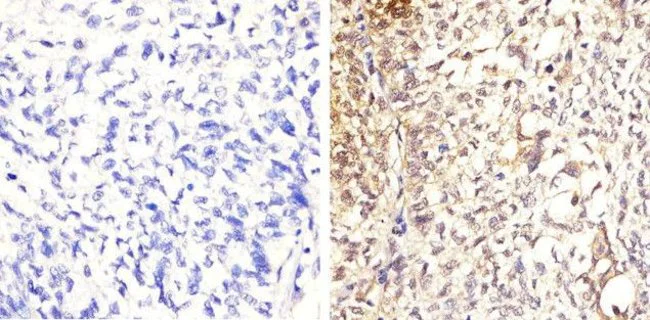
Immunohistochemistry (Formalin/PFA-fixed paraffin-embedded sections) - Anti-STAT5a (phospho Y694) antibody [6HCLC] (AB277762)
Immunohistochemistry analysis of STAT5 Alpha (pY694) showing staining in the cytoplasm and nucleus of paraffin-embedded human lung squamous carcinoma (right) compared to a negative control without primary antibody (left). To expose target proteins, antigen retrieval was performed using 10mM sodium citrate (pH 6.0), microwaved for 8-15 min. Following antigen retrieval, tissues were blocked in 3% H2O2-methanol for 15 min at room temperature, washed with ddH2O and PBS, and then probed with ab277762 diluted in 3% BSA-PBS at a dilution of 1/20 overnight at +4°C in a humidified chamber. Tissues were washed extensively in PBST and detection was performed using an HRP-conjugated secondary antibody followed by colorimetric detection using a DAB kit. Tissues were counterstained with hematoxylin and dehydrated with ethanol and xylene to prep for mounting.
- IHC-P
Supplier Data
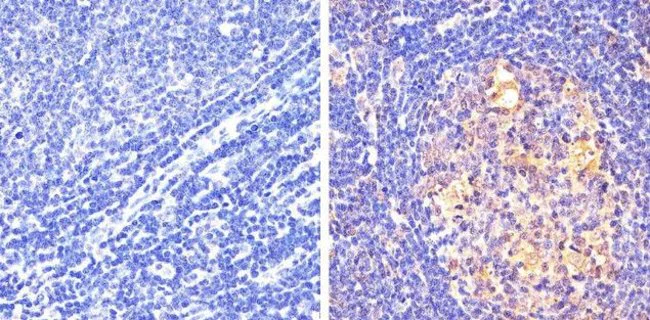
Immunohistochemistry (Formalin/PFA-fixed paraffin-embedded sections) - Anti-STAT5a (phospho Y694) antibody [6HCLC] (AB277762)
Immunohistochemistry analysis of STAT5 Alpha (pY694) showing staining in the cytoplasm and nucleus of paraffin-embedded human diffuse large B cell lymphoma (right) compared to a negative control without primary antibody (left). To expose target proteins, antigen retrieval was performed using 10mM sodium citrate (pH 6.0), microwaved for 8-15 min. Following antigen retrieval, tissues were blocked in 3% H2O2-methanol for 15 min at room temperature, washed with ddH2O and PBS, and then probed with ab277762 diluted in 3% BSA-PBS at 1/20 dilution overnight at +4°C in a humidified chamber. Tissues were washed extensively in PBST and detection was performed using an HRP-conjugated secondary antibody followed by colorimetric detection using a DAB kit. Tissues were counterstained with hematoxylin and dehydrated with ethanol and xylene to prep for mounting.

- ChIP
Supplier Data
ChIP - Anti-STAT5a (phospho Y694) antibody [6HCLC] (AB277762)
Chromatin immunoprecipitation analysis of Phospho-STAT5 alpha (pTyr694) was performed using cross-linked chromatin from 1 x 10⁶ HCT116 human colon carcinoma cells treated with serum for 0, 15, and 30 minutes. Immunoprecipitation was performed using a multiplex microplate Matrix ChIP assay (see reference for Matrix ChIP protocol : http://www.ncbi.nlm.nih.gov/pubmed/22098709) with 1.0 μL/100 μL well volume of a Phospho-STAT5 alpha (pTyr694) Recombinant Rabbit Polyclonal Antibody (ab277762). Chromatin aliquots from ~1 x 10⁵ cells were used per ChIP pull-down. Quantitative PCR data were done in quadruplicate using 1 μL of eluted DNA in 2 μL SYBR real-time PCR reactions containing primers to amplify exon-1 or exon-2 of human Egr-1, or the imprinting control region (ICR) of the human H19 locus. PCR calibration curves were generated for each primer pair from a dilution series of sheared total genomic DNA. Quantitation of immunoprecipitated chromatin is presented as signal relative to the total amount of input chromatin. Results represent the mean +/- SEM for three experiments. A schematic representation of the human Egr-1 and H19 loci are shown above the data where boxes represent exons (black boxes = translated regions, white boxes = UTRs), the zigzag lines represent introns, and the straight line represents upstream sequence. Regions amplified by Egr-1 and H19 primers are represented by black bars. Data courtesy of the Innovators Program.
- ChIP
Supplier Data
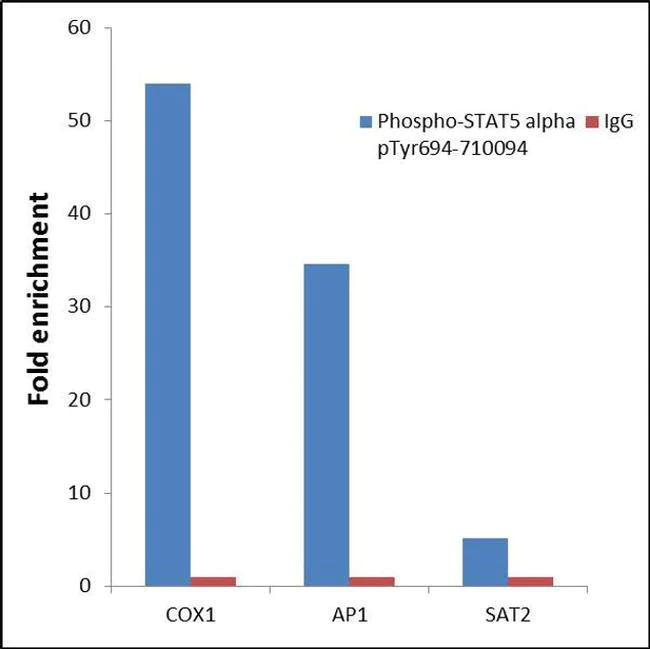
ChIP - Anti-STAT5a (phospho Y694) antibody [6HCLC] (AB277762)
Enrichment of endogenous STAT5 alpha pTyr694 protein at specific gene loci using Anti-Phospho-STAT5 alpha pTyr694 Recombinant Rabbit Polyclonal Antibody : Chromatin Immunoprecipitation (ChIP) was performed using Anti-Phospho-STAT5 alpha pTyr694 Recombinant Rabbit Polyclonal Antibody (ab277762, 5 μg) on sheared chromatin from 2 million HeLa cells treated with 100 ng/mL of IFN gamma for 45 minutes using the "MAGnify ChIP system" kit. Normal Rabbit IgG was used as a negative IP control. The purified DNA was analyzed by 7500 Fast qPCR system with optimized PCR primer pairs for the promoter of active COX1, AP1 gene, used as positive control target, and the SAT2, used as negative control target. Data is presented as fold enrichment of the antibody signal versus the negative control IgG using the comparative CT method.
Complementary Products


Primary Antibodies
AB76315
Anti-STAT3 (phospho Y705) antibody [EP2147Y]
RabMAb|Recombinant|Lab Essentials|20ul selling size

- 4
- 21


Reactivity data
Product details
What are recombinant multiclonals?
Recombinant multiclonals are a mixture of recombinant antibodies co-expressed from a library of heavy and light chains. They offer several advantages including:
- - The sensitivity of polyclonal antibodies by recognising multiple epitopes
- - High batch-to-batch consistency and reproducibility
- - Improved sensitivity and specificity
- - Long-term security of supply
- - Animal-free batch production
View our range of recombinant multiclonal antibodies.
Properties and storage information
Form
Purification technique
Storage buffer
Shipped at conditions
Appropriate short-term storage duration
Appropriate short-term storage conditions
Appropriate long-term storage conditions
Storage information
Supplementary information
This supplementary information is collated from multiple sources and compiled automatically.
Biological function summary
Many systems use STAT5a to regulate cell proliferation differentiation and survival. It often forms a complex with other proteins like STAT5b which is a closely related counterpart and both contribute to similar cellular processes. STAT5a can dimerize upon activation allowing it to move to the cell nucleus to influence gene expression directly.
Pathways
Researchers place STAT5a prominently in the JAK-STAT signaling pathway. This pathway is essential for transmitting information received from extracellular chemical signals to the cell nucleus resulting in the activation of genes controlling cellular functions. STAT5a works together with Janus kinases (JAKs) to mediate various biological responses including hormone signaling and immune function. It also interacts with proteins like IL-2 receptor subunits which are involved in many cytokine-driven processes.
Product protocols
- Visit the General protocols
- Visit the Troubleshooting
Target data
Publications (1)
Recent publications for all applications. Explore the full list and refine your search
Nature communications 16:8295 PubMed40957887
2025
Applications
Unspecified application
Species
Unspecified reactive species
Product promise
Please note: All products are 'FOR RESEARCH USE ONLY. NOT FOR USE IN DIAGNOSTIC OR THERAPEUTIC PROCEDURES'.
For licensing inquiries, please contact partnerships@abcam.com