Anti-SUN1 antibody [HL1947]
- Recombinant
- What is this?
Be the first to review this product! Submit a review
|
(0 Publication)
- ICC/IF
Supplier Data
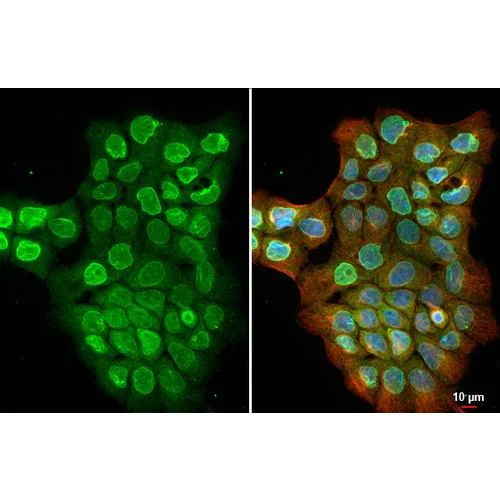
Immunocytochemistry/ Immunofluorescence - Anti-SUN1 antibody [HL1947] (AB317119)
ab317119 detects SUN1 protein at nuclear envelope by immunofluorescent analysis.
Sample : A431 cells were fixed in 4% paraformaldehyde at RT for 15 min.
Green : SUN1 stained by ab317119 diluted at 1 : 500.
Red : alpha Tubulin a cytoskeleton marker stained by alpha Tubulin antibody diluted at 1 : 1000.
Blue : Fluoroshield with DAPI.
- IHC-P
Supplier Data
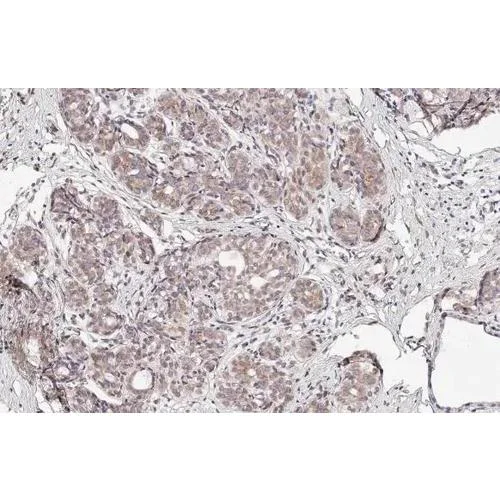
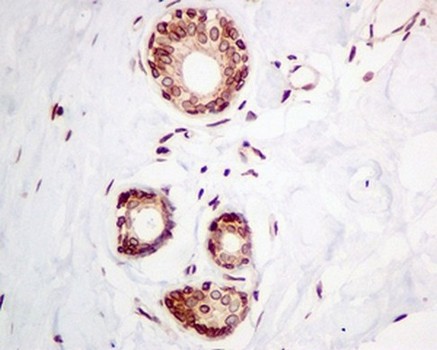
Immunohistochemistry (Formalin/PFA-fixed paraffin-embedded sections) - Anti-SUN1 antibody [HL1947] (AB317119)
ab317119 detects SUN1 protein at nucleus by immunohistochemical analysis.
Sample : Paraffin-embedded human breast carcinoma.
SUN1 stained by ab317119 diluted at 1 : 100.
Antigen Retrieval : Citrate buffer pH 6.0 15 min.
- WB
Lab
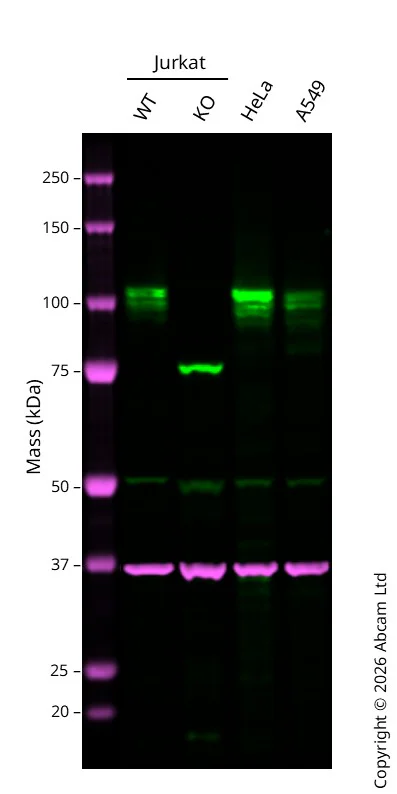
Western blot - Anti-SUN1 antibody [HL1947] (AB317119)
Western blot : Anti-SUN1 antibody [HL1947] ab317119 staining at 1/1000 dilution, shown in green; Mouse anti GAPDH ab8245 loading control staining at 1/20000 dilution, shown in magenta. A band was observed at 105 kDa in Wild-type Jurkat cell line with no signal observed at this size in SUN1 knockout Jurkat cell line. To generate this image, samples were run on an SDS-PAGE gel then transferred onto a nitrocellulose membrane. Membranes were blocked in 5% Milk in TBS-0.1 % Tween® 20 (TBS-T) before incubation with primary antibodies overnight at 4 °C. Blots were washed four times in TBS-T, incubated with secondary antibodies for 1 h at room temperature, washed again four times then imaged. Secondary antibodies used were Goat anti-Rabbit 800CW and Goat anti-Mouse 680RD at 1/20,000 dilution.
All lanes:
Western blot - Anti-SUN1 antibody [HL1947] (ab317119) at 1/1000 dilution
Lane 1:
Wild-type Jurkat cell lysates at 20 µg
Lane 2:
SUN1 knockout Jurkat cell lysates at 20 µg
Lane 3:
HeLa cell lysates at 20 µg
Lane 4:
A549 cell lysates at 20 µg
Secondary
All lanes:
Goat anti-Rabbit 800CW & Goat anti-Mouse 680RD at 1/20000 dilution
Predicted band size: 87 kDa
Observed band size: 105 kDa
false
Complementary Products

Primary Antibodies
AB8982
Anti-Lamin B1 antibody [119D5-F1] - Nuclear Envelope Marker
KO Validated|Lab Essentials

- 4
- 6
Reactivity data
Product details
What are the advantages of a recombinant monoclonal antibody?
This product is a recombinant monoclonal antibody, which offers several advantages including:
- - High batch-to-batch consistency and reproducibility
- - Improved sensitivity and specificity
- - Long-term security of supply
- - Animal-free batch production
For more information, read more on recombinant antibodies.
Properties and storage information
Form
Storage buffer
Shipped at conditions
Appropriate short-term storage duration
Appropriate short-term storage conditions
Appropriate long-term storage conditions
Aliquoting information
Storage information
Supplementary information
This supplementary information is collated from multiple sources and compiled automatically.
Biological function summary
SUN1 plays significant roles in cellular functions through its interaction with other proteins. It is an essential part of the LINC (Linker of Nucleoskeleton and Cytoskeleton) complex where it interacts with KASH domain-containing proteins that span the outer nuclear membrane. This interaction is important for nuclear positioning centrosome attachment and chromosomal movement. SUN1 participates in critical processes such as DNA repair and meiotic progression influencing cell cycle regulation and genetic stability.
Pathways
SUN1 integrates into cellular communication systems by mediating mechanical signals across the nuclear-cytoplasmic boundary. It is actively involved in the nuclear envelope-endoplasmic reticulum network which is critical for nuclear-cytoskeletal coupling. The protein associates with SUN2 another member of the SUN family and they both interact with the Nesprin proteins anchoring the nucleus to the cell's structural framework. This association enables SUN1 to influence signaling pathways related to cell division and differentiation.
Product protocols
- Visit the General protocols
- Visit the Troubleshooting
Target data
Additional targets
Alternative Names
Product promise
Please note: All products are 'FOR RESEARCH USE ONLY. NOT FOR USE IN DIAGNOSTIC OR THERAPEUTIC PROCEDURES'.
For licensing inquiries, please contact partnerships@abcam.com