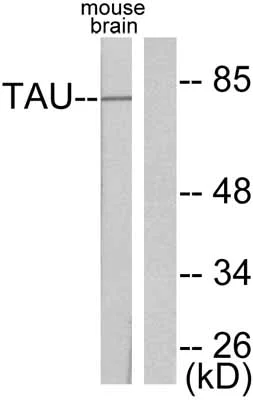
- WB
Unknown
Western blot - Anti-Tau antibody (AB47579)
All lanes:
Western blot - Anti-Tau antibody (ab47579)
Lane 1:
Mouse brain cell extract
Lane 2:
Mouse brain cell extract with peptide
Predicted band size: 78 kDa
false

- WB
CiteAb
Western blot - Anti-Tau antibody (AB47579)
Tau western blot using anti-Tau antibody ab47579. Publication image and figure legend from Qi, B., Yang, Y., et al., 2020, Mol Brain, PubMed 32272942.
ab47579 was used in this publication in western blot. This may not be the same as the application(s) guaranteed by Abcam. For a full list of applications guaranteed by Abcam for ab47579 please see the product overview.
CBD3 expression reduces Aβ1–42 and p-tau plaques. Representative western blots of lysates (n = 4) from the indicated conditions probed with antibodies against ADAM10, Aβ1–42, p-tau, t-tau, or GAPDH (housekeeping/loading control). The hippocampal tissues were from wildtype (WT) mice, APP/PS1 mice, APP/PS1 mice administered control AAV, or APP/PS1 mice administered CBD3 harboring AAV. Quantification of levels of Aβ1–42 (b), p-tau/t-tau (c), and ADAM10 (d) normalized to control (n = 4 per condition). *p < 0.05, one-way ANOVA with Dunnett's post-hoc test. n.s., not significant.
false
Alternative Products
Primary Antibodies
AB76128
BOND RX™ Validated|20ul selling size|RabMAb|Recombinant

- 5
- 1
Primary Antibodies
AB92682
Anti-Tau (phospho Ser356) antibody [EPR2603]
20ul selling size|RabMAb|Recombinant
- 0
- 0
Primary Antibodies
AB109390
Anti-Tau (phospho S396) antibody [EPR2731]
BOND RX™ Validated|20ul selling size|RabMAb|Recombinant

- 4
- 14
Primary Antibodies
AB151559
Anti-Tau (phospho T231) antibody [EPR2488]
BOND RX™ Validated|20ul selling size|RabMAb|Recombinant

- 5
- 6
Primary Antibodies
AB32057
Anti-Tau (phospho S396) antibody [E178]
BOND RX™ Validated|20ul selling size|RabMAb|Recombinant

- 5
- 5
Primary Antibodies
AB170892
Anti-Tau (phospho S214) antibody [EPR1884(2)]
BOND RX™ Validated|20ul selling size|RabMAb|Recombinant|Trial Size|Trial Size

- 5
- 1
Primary Antibodies
AB92676
Anti-Tau (phospho S404) antibody [EPR2605]
BOND RX™ Validated|20ul selling size|RabMAb|Recombinant

- 5
- 4
Primary Antibodies
AB93726
BOND RX™ Validated|20ul selling size|RabMAb|Recombinant

- 5
- 4
Complementary Products
Primary Antibodies
AB183734
RabMAb|Recombinant|Lab Essentials|20ul selling size

- 5
- 24
Primary Antibodies
AB109390
Anti-Tau (phospho S396) antibody [EPR2731]
BOND RX™ Validated|20ul selling size|RabMAb|Recombinant
- 4
- 14
Primary Antibodies
AB138501
Anti-Alpha-synuclein antibody [MJFR1]
BOND RX™ Validated|RabMAb|Recombinant|KO Validated

- 5
- 10
Primary Antibodies
AB151559
Anti-Tau (phospho T231) antibody [EPR2488]
BOND RX™ Validated|20ul selling size|RabMAb|Recombinant
- 5
- 6
Reactivity data
Properties and storage information
Form
Purification technique
Purification notes
Storage buffer
Shipped at conditions
Appropriate short-term storage conditions
Appropriate long-term storage conditions
Storage information
Supplementary information
This supplementary information is collated from multiple sources and compiled automatically.
Biological function summary
Tau is involved in the assembly and stabilization of microtubules essential for maintaining neuronal structure. It interacts with microtubule-binding domains (MBD) to bind and bundle microtubules facilitating intracellular transport. Tau forms a part of the neuronal cytoskeleton complex working closely with other cytoskeletal proteins to preserve the proper axonal transport and function. Abnormally phosphorylated Tau often termed phospho-Tau disrupts this complex affecting microtubule stability.
Pathways
Tau has critical involvement in several signaling cascades such as the microtubule-binding and transport pathways. Glycogen synthase kinase 3 beta (GSK3β) and cyclin-dependent kinase 5 (CDK5) frequently phosphorylate Tau controlling its interaction with microtubules. Phosphorylated Tau accumulates leading to the formation of neurofibrillary tangles often observed in neurodegenerative conditions. Additionally Tau interacts with GAPDH impacting cellular energy regulation through potential pathway cross-talk involving oxidative stress responses.
Product protocols
- Visit the General protocols
- Visit the Troubleshooting
Target data
Additional targets
Alternative Names
Publications (5)
Recent publications for all applications. Explore the full listand refine your search
Neural regeneration research 17:152-162 PubMed34100451
2021
Applications
Unspecified application
Species
Unspecified reactive species
Molecular brain 13:58 PubMed32272942
2020
Applications
Unspecified application
Species
Unspecified reactive species
Frontiers in neuroscience 12:647 PubMed30283295
2018
Applications
Unspecified application
Species
Unspecified reactive species
CNS neuroscience & therapeutics 24:212-221 PubMed29345054
2018
Applications
Unspecified application
Species
Unspecified reactive species
Journal of cellular and molecular medicine 16:1206-22 PubMed21762376
2011
Applications
WB
Species
Human
Product promise
Please note: All products are 'FOR RESEARCH USE ONLY. NOT FOR USE IN DIAGNOSTIC OR THERAPEUTIC PROCEDURES'.
For licensing inquiries, please contact partnerships@abcam.com